About Platystemon californicus Benth.
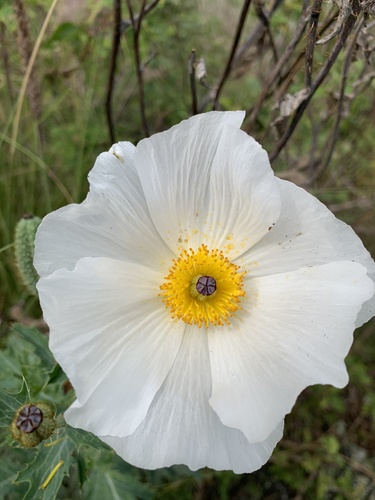
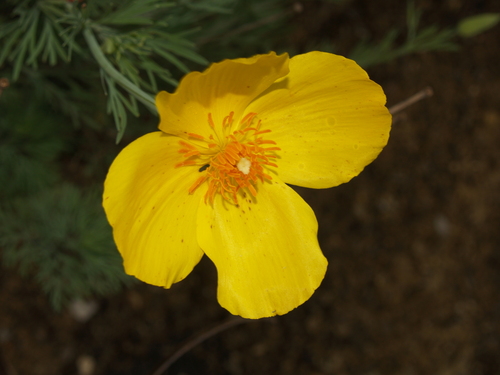
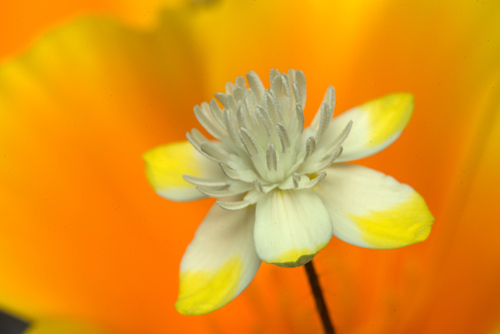
Platystemon californicus is a highly variable plant that displays such a wide range of forms that it has been split, reorganized, and redescribed as up to 57 different species. Its form often varies based on geography and habitat conditions. Coastal forms may be hairless and slightly succulent, while semidesert individuals grow as squat, hairy plants. Some authors recognize separate varieties that are ecotypes adapted to specific, often very limited, habitat types. This annual herb is usually at least somewhat hairy, and sometimes quite woolly. Its stem ranges from upright to decumbent, and grows 3 to 30 centimeters long. Leaves are arranged oppositely or in whorls along the stem; they are widely linear with smooth edges and rounded or pointed tips, and measure 1 to 9 centimeters long. The inflorescence is a single flower that grows from a leaf axil or the tip of the stem, borne on a 3 to 26 centimeter long peduncle with three hairy sepals. The flower usually has six petals, though large flowers may have more. Petals vary in size, shape, and color, measuring 6 to 19 millimeters long with rounded or pointed tips. There are five basic color patterns: solid white, solid yellow, white petals with a yellow tip, white petals with a yellow base, and white petals with both a yellow base and yellow tip. All-yellow petals are less common, and petals may turn reddish as they age. The center of the flower is filled with several whorls of stamens with thickened ends. The fruit is a capsule up to 1.6 centimeters long, divided into many sections that hold shiny black seeds. Flowers are partly pollinated by wind and partly pollinated by solitary bees.