About Platyrhinoidis triseriata (Jordan & Gilbert, 1880)
This species, commonly called the thornback guitarfish, has the scientific name Platyrhinoidis triseriata (Jordan & Gilbert, 1880).
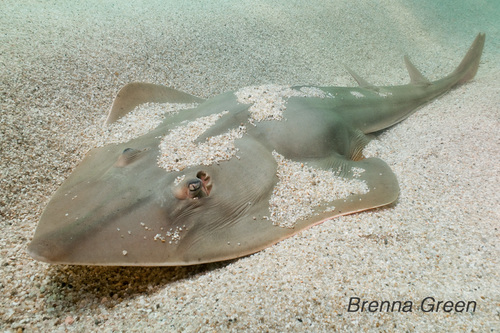
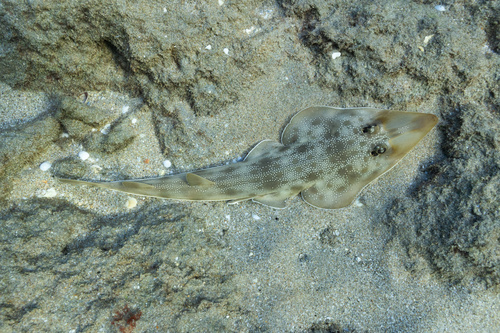
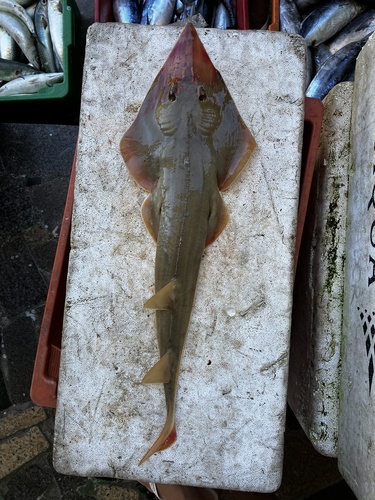
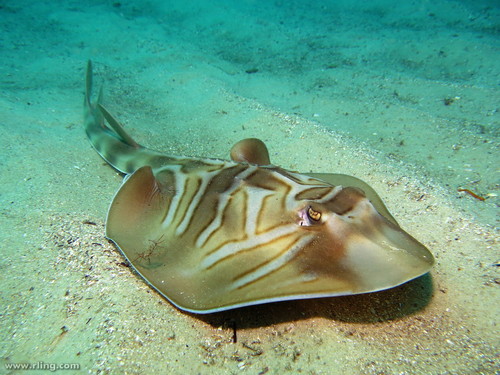
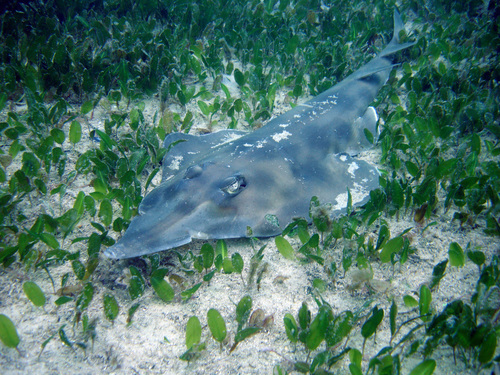
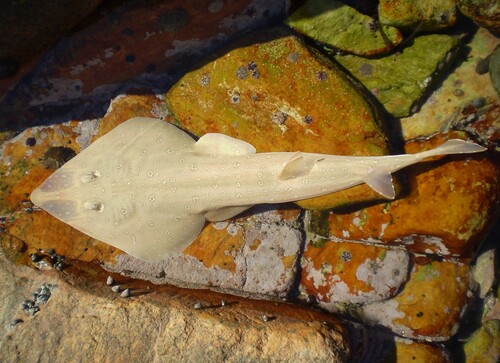
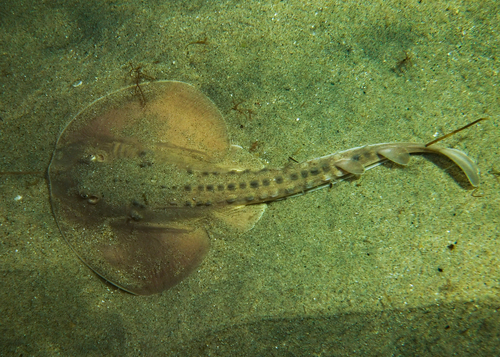
The pectoral fin disc of the thornback guitarfish is heart-shaped, slightly longer than it is wide, and thicker toward the front. The snout is short and broad, with a blunt tip that protrudes slightly from the disc. Its eyes are small and widely spaced; the spiracles are larger than the eyes and positioned just behind them. Wide nostrils are preceded by moderately large, broad skin flaps. The mouth is wide and gently arched, with a pair of creases running from the mouth corners to the nostrils, enclosing a roughly trapezoidal area. A deep furrow runs along the lower lip, wrapping around the corners of the mouth. The small teeth have low crowns that range from sharp to blunt, and are arranged in 68–82 rows in the upper jaw and 64–78 rows in the lower jaw. The five pairs of gill slits are small and located underneath the disc. The pelvic fins have curved outer margins and angular rear tips; males have long claspers. The tail is robust and much longer than the disc, with lateral skin folds running along each side. The two dorsal fins are similar in size and shape: they are longer than tall with rounded posterior margins. The first dorsal fin sits closer to the caudal fin than to the pelvic fins. The caudal fin is well-developed and almost elliptical, with no distinct lower lobe. The entire skin is covered by tiny dermal denticles; additionally, there are large recurved thorns arranged in two or three rows along the leading edge of the disc, in small groups on the snout tip, around the eyes, and on the "shoulders", and most distinctively in three rows running from the middle of the back to the second dorsal fin. This species is plain olive to grayish brown on its upper side and off-white below. The snout and disc margins are barely translucent, and the species grows up to 91 cm (36 in) long.
The thornback guitarfish is endemic to the northeastern Pacific Ocean, found from Tomales Bay to Magdalena Bay, with additional isolated populations in the Gulf of California. It is reported to be very abundant in some coastal waters off California and Baja California, such as Elkhorn Slough, and uncommon north of Monterey and in the Gulf of California. This bottom-dwelling species is typically found close to shore in water less than 6 m (20 ft) deep, though it has been recorded as deep as 137 m (449 ft). It lives in coastal habitats with muddy or sandy bottoms, including bays, sloughs, beaches, and lagoons, and can also be found in kelp beds and adjacent areas.
During the day, the thornback guitarfish spends much of its time partially buried in sediment. It can be found alone, in small groups, or in large seasonal aggregations that form in specific bays and sloughs. The diet of this ray includes polychaete worms, crustaceans (including crabs, shrimps, and isopods), squids, and small bony fishes (including anchovies, sardines, gobies, sculpins, and surfperches). It can detect prey using its electroreceptive ampullae of Lorenzini, which are most sensitive to electric fields with a frequency of 5–15 Hz. Predators of the thornback guitarfish include sharks and the northern elephant seal (Mirounga angustirostris). Documented parasites of this species are the tapeworm Echinobothrium californiense and the nematode Proleptus acutus. Thornback guitarfish mate in late summer, and females give birth the following year around the same time, with birthing peaking in August. It is aplacental viviparous, meaning developing embryos are sustained by yolk until birth. Females produce litters of 1–15 pups each year; newborn rays measure about 11 cm (4.3 in) long. Males reach sexual maturity at 37 cm (15 in) long, while females reach sexual maturity at 48 cm (19 in) long.