About Platyoides walteri (Karsch, 1887)
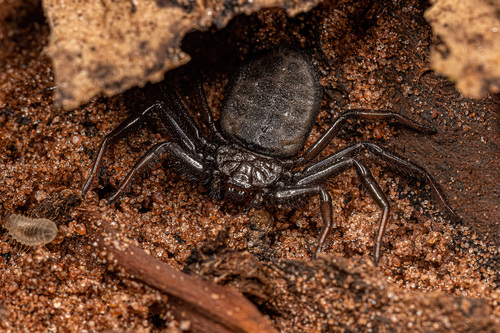
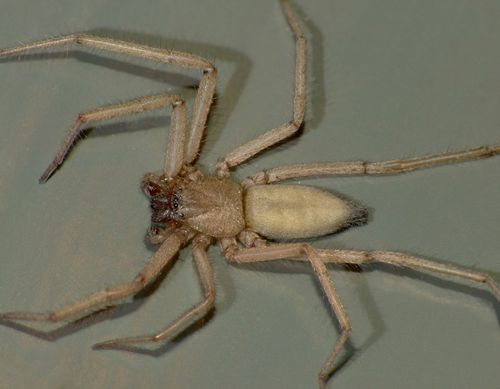
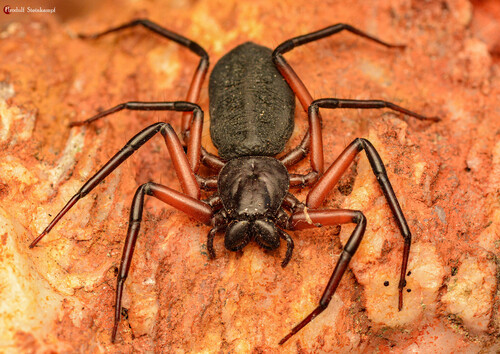
Both males and females of Platyoides walteri have been formally described by science. The species has brown carapace and chelicerae, and orange-yellow sternum and three basal leg segments. The sternum has a deep blackish-red border, and all remaining leg segments are more or less darkened. The upper surface of the opisthosoma is darkened, and sometimes has a longitudinal row of yellowish areas on each side of the median line; the underside of the opisthosoma is paler, ranging from yellowish to whitish. Among all Platyoides species, Platyoides walteri has the widest distribution. It is found across all nine provinces of South Africa, at elevations from 17 to 1,762 m above sea level. This species was originally described from specimens collected at Botshabelo in the Free State. Platyoides walteri inhabits multiple biomes: Forest, Grassland, Nama Karoo, Savanna, and Thicket. It has also been recorded in commercial avocado orchards and pine plantations. Unlike other scorpion spiders, which are typically found under bark or rocks, P. walteri is commonly found around human habitations, especially under potted plants on verandahs. Specimens were collected from pine trees using paper traps at Sabie State Forest. Platyoides walteri is synanthropic, meaning it is frequently associated with human habitations. It is a free-living wanderer, with a flattened body adapted for living in narrow crevices. The species shows remarkable adaptability to different environments, and has successfully established introduced populations in Australia.