About Platynereis bicanaliculata (Baird, 1863)
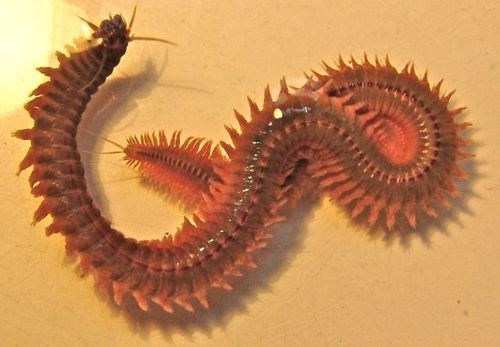
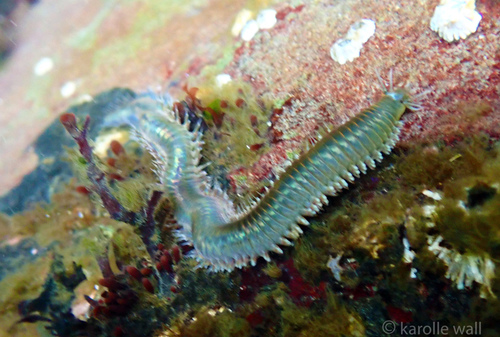
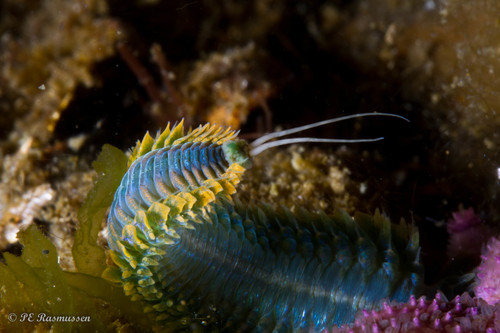
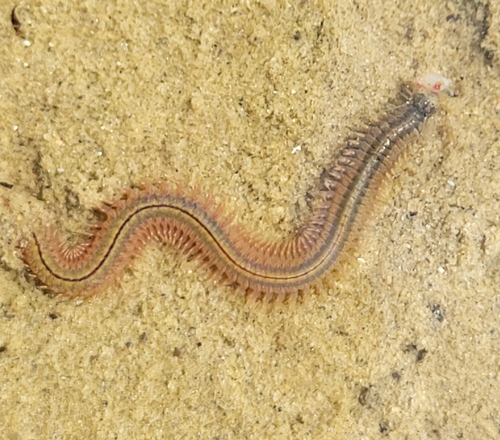
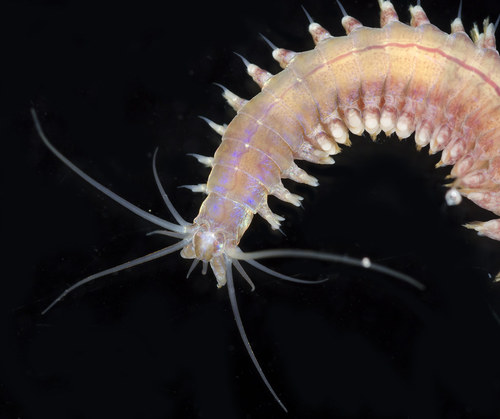
Platynereis bicanaliculata (Baird, 1863) displays a wide range of body colors, including white, pink, yellow, orange, green, and brown, and often has an iridescent sheen. It has thick, conical parapodia. Its notopodia bear simple, dark brown, two-lobed falcigers (a type of setae) that have hooked tips. Like other nereids, this species has two pairs of jaws inside an eversible pharynx, which has ridged paragnaths and 6 to 7 sclerotized "teeth" on its pharyngeal surface. Other key identifying features of the species are its slender tentacular cirri.
This species has been observed along the coasts of multiple continents and islands across the Pacific Ocean. Its observed range extends from Australia in the South Pacific, north to Japan and Taiwan, to Hawai'i in the Central Pacific, and east to North America from the Aleutian Islands to Baja California. In situ observations record this species living in soft-bottomed bays and sounds, including Puget Sound and San Francisco Bay, as well as in protected rocky habitats along the open coastline. It is generally a benthic species that is most commonly found in shallow water.
Like most polychaetes, Platynereis bicanaliculata is gonochoric, meaning individuals are either male or female. Nereid polychaetes including this species reproduce through a process called epitoky. During epitoky, mature individuals transition from benthic, bottom-dwelling organisms to pelagic, swimming organisms, undergoing major changes to their body structure and behavior to release their gametes into the open water column. Many nereid species die after completing a single reproductive event.