About Platygyra daedalea (Ellis & Solander, 1786)
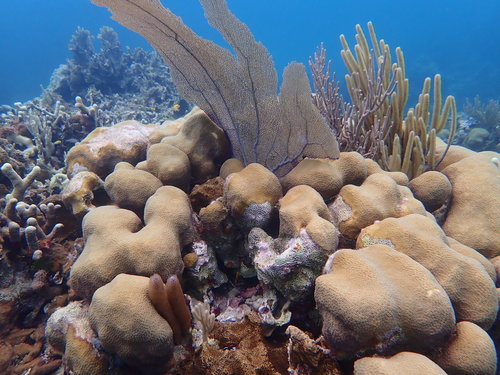
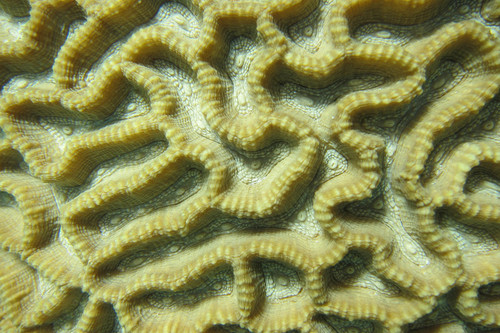
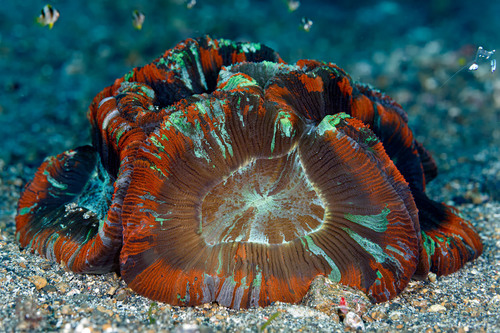
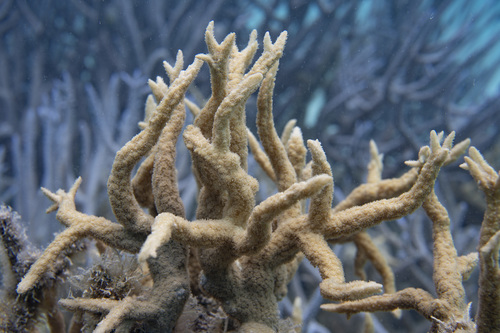
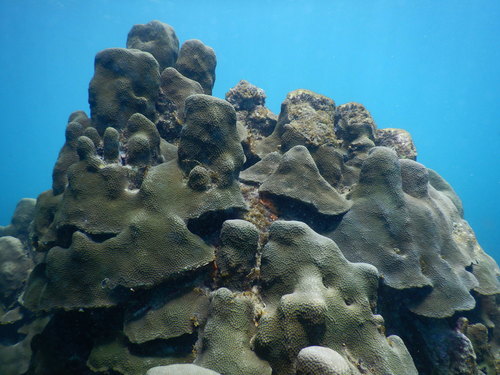
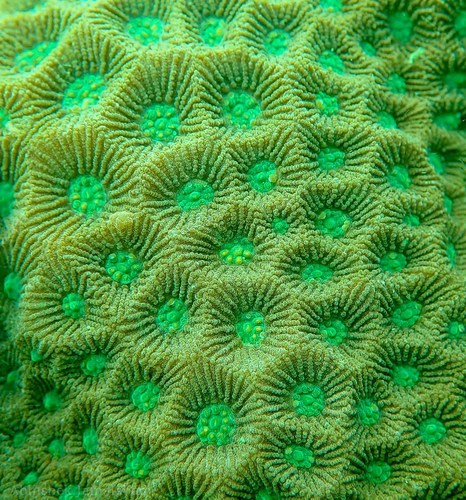
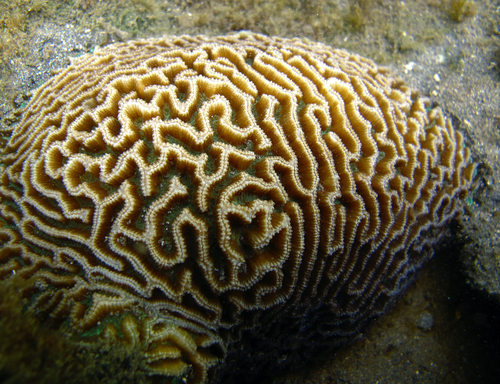
Platygyra daedalea (Ellis & Solander, 1786) most often forms massive dome or boulder-shaped colonies that can reach one metre or more in diameter. Less commonly, it forms flattened plates or grows as an encrusting coral. Its polyps are located in winding valleys separated by low, frequently perforated walls. The septa are toothed, protrude outwards, and usually have uneven or pointed tips. A distinct raised ridge called the columella runs through the centre of each valley. The colour of this coral varies, and valleys and ridges often have contrasting colours. It can be told apart from the similar, less common species Platygyra lamellina by its wider valleys, whose separating walls have more vertical sides and flatter tops. Platygyra daedalea is a common species with a broad distribution across the Indo-Pacific region. Its range stretches from Madagascar, the east coast of Africa, the Red Sea and the Gulf of Aden, to Australia, Indonesia, Japan and the South China Sea. It grows in a variety of reef environments, especially on back reef slopes, and can be found from subtidal rocks down to around 30 metres deep. It is particularly abundant in the Gulf of Thailand and the South China Sea. The polyps of P. daedalea extend at night to capture floating planktonic particles. However, most of this coral's nutrition comes from symbiotic dinoflagellates called zooxanthellae that live inside its tissues. These algae produce organic carbon and nitrogen through photosynthesis, which they provide to their coral host. To maintain this beneficial symbiosis, P. daedalea requires growth in shallow, sunlit environments. Platygyra daedalea is an aggressive coral that works to prevent competing corals from overshadowing it. In a research study, small colonies of P. daedalea were placed next to similarly sized colonies of the less aggressive Favites complanata. Some of the P. daedalea tentacles developed into specialized sweeper tentacles, which damaged the soft tissues of the adjacent F. complanata. These sweeper tentacles could reach up to 90 millimetres in length, around fifteen times the length of a normal P. daedalea tentacle, and are heavily armed with stinging cnidocytes. The damage to F. complanata's soft tissue was extensive, leaving sections of skeleton exposed that became colonized by sponges, algae and other fouling organisms. Three out of the ten attacked F. complanata colonies ultimately died.