About Platydemus manokwari Beauchamp, 1962
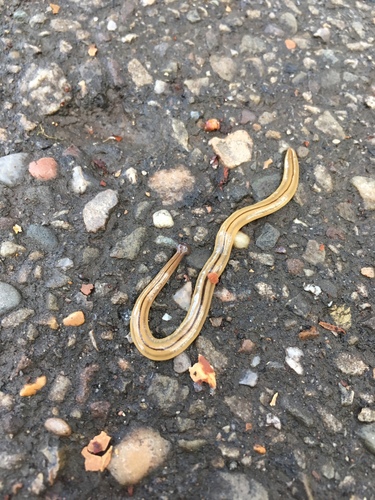
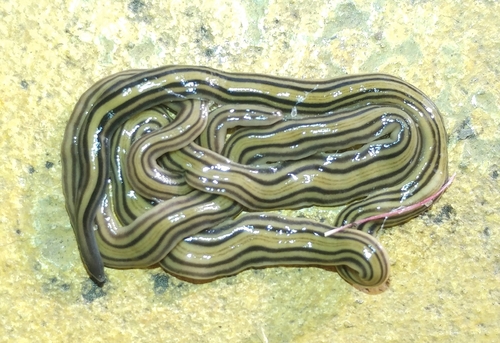
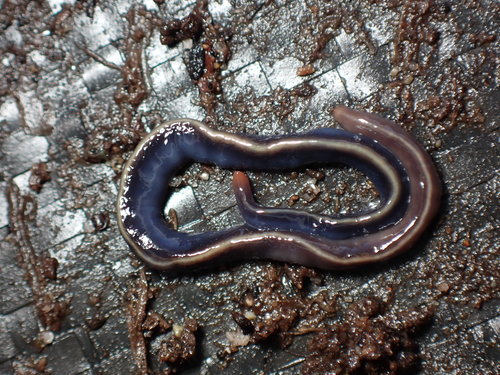
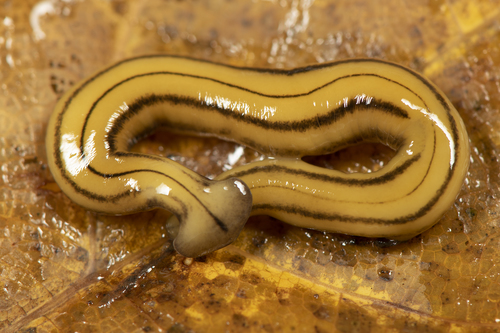
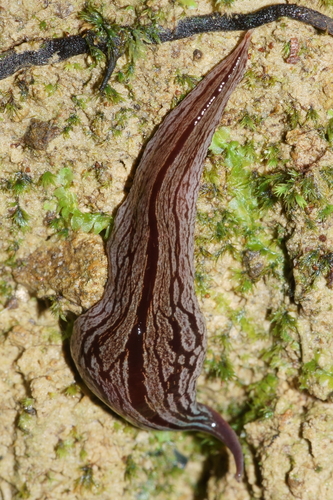
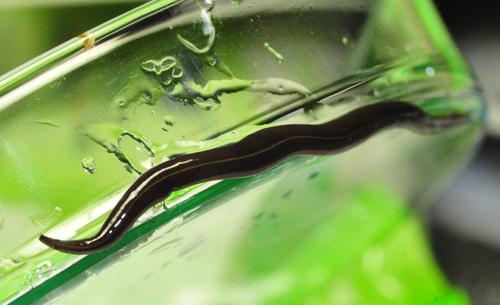
Platydemus manokwari Beauchamp, 1962 is a relatively large flatworm, reaching 40–65 millimetres (1.6–2.6 inches) in length and 4–7 millimetres (0.16–0.28 inches) in width. Its body is distinctly flat, with a thickness of less than 2 millimetres (0.08 inches). Both ends of the body are pointed, with the head end more pointed than the tail end, and two eyes are located near the tip of the head. The upper surface of the body is dark brown with a lighter central line, while the underside is pale grey. This species is native to the Pacific island of New Guinea. Its original native habitat is tropical areas, but it has now been found in nearly all temperate regions of the world, occupying agricultural areas, coastlands, disturbed areas, natural forests, planted forests, riparian zones, scrub/shrublands, urban areas, and wetlands. It is not found in urban coastal areas, possibly due to environmental factors such as a lack of vegetation. Platydemus manokwari is a large flatworm that preys on land mollusks, and has been classified as one of the 100 worst invasive species. It has been introduced to multiple tropical and subtropical islands including Micronesia, the Marquesas, the Society Islands, Samoa, Melanesia, the Hawaiian Islands, and several Japanese Islands. In 2015, it was recorded in Puerto Rico and Florida, from which it may spread further into the southern mainland United States. In 2021, it was reported from the French Antilles islands of Guadeloupe, Martinique and Saint Martin. In 2023, it was recorded in Brisbane, Australia, which remains its southernmost known location as of this report. Most introductions of P. manokwari are accidental. Common accidental introduction pathways include the trade of tropical plants and potting soil that contains the flatworm, movement of construction machinery and equipment that carries the flatworm in leftover soil, and accidental transfer during movement of seed material used for vegetation restoration. P. manokwari has also been intentionally introduced a number of times as a biological control agent. It was deliberately introduced to two Pacific islands, as well as Guam and the Okinawa islands, to control invasive Giant East African Snail (also called Giant African land snail, Achatina fulica) populations that damage crops and threaten agriculture. Experts have noted that much of the evidence supporting the claim that these predators can control Achatina fulica populations is based on a poor understanding of ecological principles, and that the fact that P. manokwari preys on Giant African land snail is not evidence that it can control their populations. While P. manokwari did control Giant African land snail populations in introduced ranges, it also began preying on endemic land snail species. Many of the islands it has invaded host endemic adaptive radiations of rare and endangered snail species, which are a primary food source for P. manokwari. This predation led to an unprecedented increase in P. manokwari populations and a marked decline in endemic land snail populations.