About Platycodon grandiflorus (Jacq.) A.DC.
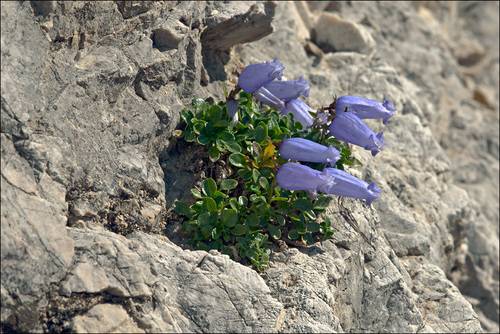
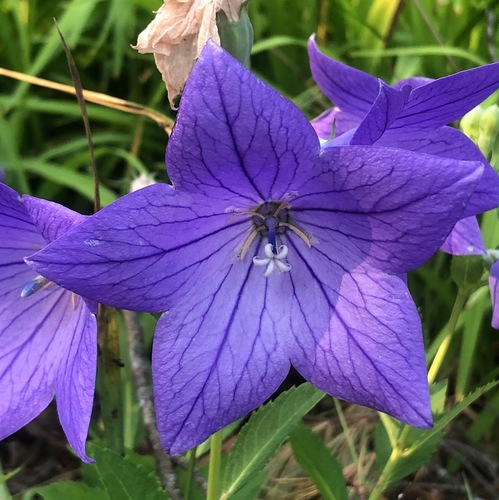
Platycodon grandiflorus (Jacq.) A.DC. is an herbaceous perennial flowering plant. It typically grows 60 cm (24 in) tall by 30 cm (12 in) wide, producing dark green leaves and blue flowers in late summer. A distinctive feature of this species is its flower buds, which swell like a balloon before opening fully. Like its close relatives the campanulas, its five petals are fused into a bell shape at the base. In the wild, Platycodon grandiflorus is a perennial most commonly found growing in mountains and fields, with a wild height range of 40 to 100 centimeters (16 to 39 in). It has thick roots, and cutting its stem releases a white juice. Its leaves measure 5 to 12 centimeters (2.0 to 4.7 in) long, with narrow ends and toothed edges. Flowers, which may be purple or white, bloom in July and August; one or more flowers grow upward at the end of a terminal cluster, and the corolla is split into five lobes forming an open bell shape. This species is native to China, Japan, the Korean Peninsula, and eastern Siberia. For cultivation, P. grandiflorus is cold hardy down to −40 °C (−40 °F), and can be grown in USDA hardiness zones 3A to 9b. It dies back completely in winter, re-emerges in late spring, and flowers in summer, though nurseries often sell fully flowering plants from April onward. While the wild species bears blue flowers, cultivated varieties exist with white, pink, and purple blooms; white-flowered plants are particularly common in Korea. The species, along with its cultivars 'Apoyama group' and 'Mariesii', has been awarded the Royal Horticultural Society's Award of Garden Merit. Extracts and purified platycoside saponin compounds from the roots of P. grandiflorus may show neuroprotective, antimicrobial, anti-inflammatory, anti-cancer, anti-allergy, cholesterol-lowering effects, and may improve insulin resistance. Evidence for these potential effects has mostly been observed in vitro; only cholesterol-lowering effects have been documented in both in vitro studies and in rat trials. There is a lack of confirmed efficacy data and limited safety information for use in humans, so further research is needed.