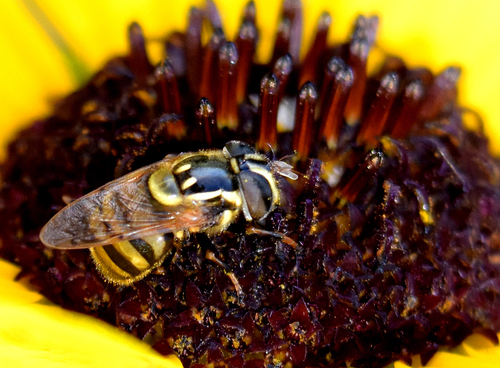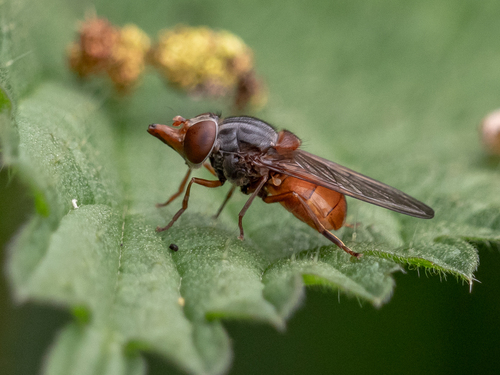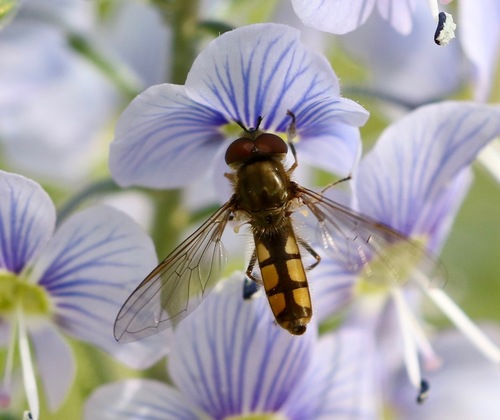
About Platycheirus manicatus (Meigen, 1822)
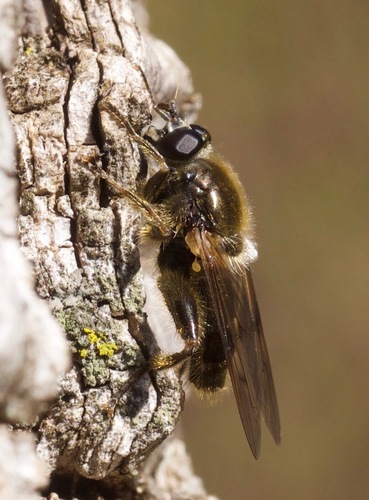
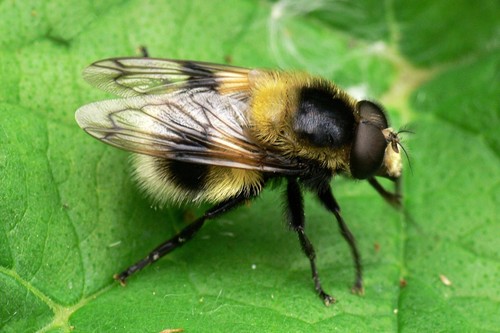
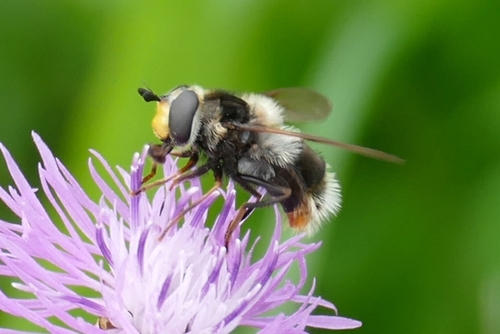
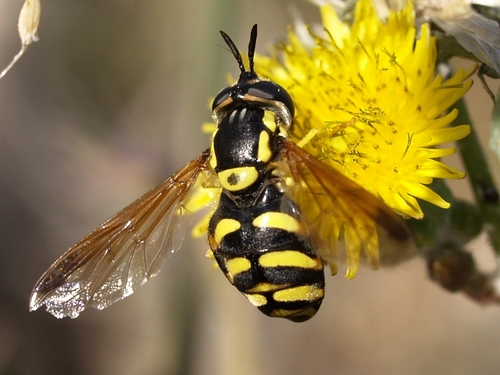
This description covers male Platycheirus manicatus (Meigen, 1822); for morphological terminology, refer to Speight's Key to Genera of European Syrphidae with Morphological terms, the Glossary of morphological terminology of adult Syrphidae, Steenis' Picture key to Nearctic syrphid genera, and Miranda et al. Adult body length ranges from 7.9–10.1 mm (0.31–0.40 in). The face strongly protrudes downward, with the anterior oral margin extending well past the facial tubercle. The face is covered in powdery yellow, with the exception of the shining black tubercle (see Figure 1 and general anatomy diagrams). Legs are mostly dark, but the short apex of the femora and the joint of the tibiae are pale. The first two tarsomeres of the foreleg are very pale. The first foreleg tarsomere (T1, see general anatomy) is nearly triangular, approximately 2.5 times as wide as the tip of the tibia, and slightly longer than it is wide. The second foreleg tarsomere (T2) is nearly rectangular, three-quarters as wide as the first tarsomere, and one-quarter as long as the first tarsomere. The remaining foreleg tarsomeres are unmodified. The fore tibia has several fine, wavy setae (hairs) on the outer half of its ventral surface; the longest of these setae are approximately three times the width of the tibia. The middle tibia has sparse, wavy posterodorsal and posterior pile (hairs) on its outer half; the longest of this pile is about four times as long as the tibial diameter (see Figure 2). The first tarsomere (T1) of the hind leg is strongly swollen. All other parts of the legs are unmodified. The entire thorax is covered in strong yellow or grey powder, and has dense thoracic pile that is half pale and half dark. The halter is yellow, and the entire wing is covered in microtrichia (microscopic hairs). The abdomen is narrowly oval; the yellow spots on tergites 2 through 4 are longer than wide, and are separated from the anterior and lateral margins of their respective tergites. Females have small yellow spots on tergite 5 (see the bottom of Figure 1). Distribution: In the Palearctic realm, it occurs from Fennoscandia south to Iberia and the Mediterranean basin, and from Ireland eastward through Europe into Turkey, Russia, Siberia, and the Altai. In the Nearctic realm, it occurs in Alaska and Greenland.