About Platycercus caledonicus (Gmelin, 1788)
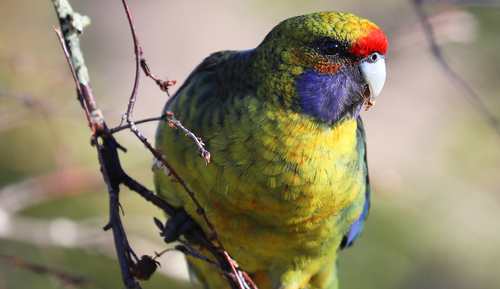
The green rosella, Platycercus caledonicus, is the largest species in the rosella genus. Adults measure 29 to 36 cm (11 to 14 in) in total length, with a wingspan of 44 to 54 cm (17 to 21 in). They have long narrow wings, a long 12-feathered tail, and the two central tail feathers are wider than the others. Adult males are heavier, averaging around 150 g (5.3 oz) compared to females that average 120 g (4.2 oz), and males have a larger bill. Adult green rosellas have yellow heads and underparts, with blue cheeks and a red band across the forehead and upper lores. Red markings may appear on the yellow feathers of the forecrown, lower lores, cheeks, chest, and thighs. The yellow feathers on the sides and back of the head and neck, and the underparts have dark brown bases. The edges of underpart feathers can be pale brown, creating a faint scalloped pattern that fades as feathers wear. Some yellow nape feathers have white bases, which can form a visible whitish nape patch after feather wear. The yellow coloring on the back of the head blends indistinctly into the dark plumage of the hindneck, mantle, and back. This upper back plumage is black or dark brown with green margins. Shoulder feathers are blackish with yellow tips. By the end of the breeding season, these margins and tips are often worn away, leaving the plumage a more solid black. The blue-violet feathers on the chin, throat, and cheeks have brown-black bases. The blackish plumage of the back extends to the rump. The long tail is dark green with brown shafts, and has dark blue outer feathers and tips. Most of the wing plumage is black and green, with violet-blue marginal coverts, primary coverts, and alula. Primaries and outer secondaries are dark brown with blue tints. The undersides of wing feathers are dark brown with blue-violet tips. The iris is brown, surrounded by a dark grey orbital ring. The bill is pale grey with a dark grey cere, and the legs are grey. Female green rosellas have duller yellow plumage than males, are more likely to have red markings, and the green edges on the black upperpart plumage are more prominent. Young birds that have just left the nest have juvenile plumage for their first year of life. Juveniles have dark green head, neck, upperparts, and underparts. All their feathers have dark brown bases. Their wings are mostly dark brown and black with a blue sheen, and their wings and tails are shorter than those of adults. The bill may have a buff sheen, and juveniles have an under-wing stripe that is absent in adults. All age classes generally moult between January and April. After the first juvenile moult, young green rosellas gain immature plumage. This plumage is similar to juvenile plumage, but it includes patches of the yellow underpart feathers and adult-coloured wing feathers that mark mature birds. Some green juvenile feathers remain until the bird reaches its second year of life, though they are heavily worn by that point. The green rosella is found across Tasmania and the Bass Strait islands, and is one of the most commonly encountered bird species in this range. It also occurs on offshore islands including Maria Island, Bruny Island, De Witt Island, and Maatsuyker Island. Its movements have not been extensively studied. While it may be locally nomadic in some areas, the green rosella is generally sedentary; even populations at higher altitudes do not migrate. It has become rare on King Island, due to land clearing and possibly competition for nesting sites with the introduced common starling (Sturnus vulgaris). On King Island, the green rosella is restricted to the Pegarah forest during the breeding season, though it may travel to other areas at other times of year. It occupies most habitats with at least some tree cover, up to 1500 m (5000 ft) above sea level. Habitats include temperate Southern beech rainforest (where it generally stays in the canopy), wet and dry sclerophyll forest, woodland, Melaleuca shrubland, coastal heath, dwarf alpine conifer forest, sedgeland, buttongrass moors, tussock grassland, as well as fields, orchards, and urban parks and gardens.