About Platycercus adscitus (Latham, 1790)
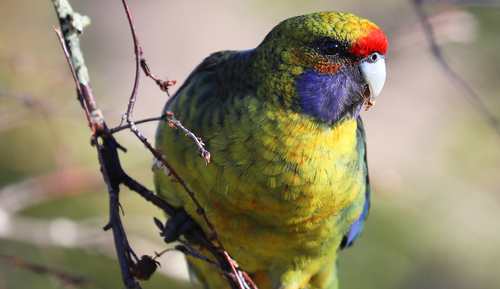
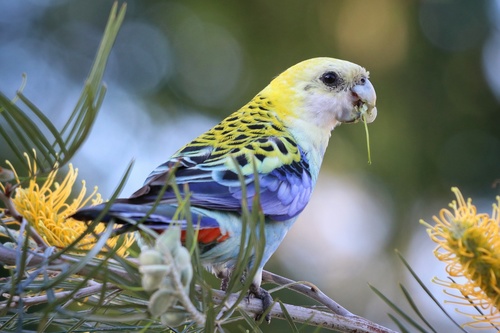
The pale-headed rosella, scientifically named Platycercus adscitus (Latham, 1790), measures 33 cm (13 in) in total length, with 15 cm of that length made up by its tail. Its underparts are pale blue, while its upper breast and head are pale cream-yellow; its tail is blue-black and green, and its vent is blood red. The feathers on the nape, scapulars, and back are black with bright yellow edges, which creates a distinct scalloped appearance. For the northern race of this species, the yellow in these feather edges is paler, with a faint pale blue tinge. The southern subspecies has entirely white cheeks, while the northern subspecies has blue flushing on the lower parts of its cheeks. The species' bill is pale blue-white, its legs are dark grey, and its eyes are yellow-brown. Males and females have similar overall appearance, though the female is slightly smaller and has duller coloration.
Two main subspecies of pale-headed rosella are recognized with a broad range of intermediate forms between them. The nominate subspecies P. a. adscitus occurs from Cape York Peninsula south to Cardwell in central-northern Queensland. The southern subspecies P. a. palliceps ranges from Townsville and inland areas south through northeastern New South Wales, to the area around the Clarence River. The species is common across its entire range. It prefers open forest as its habitat, but has adapted well to human-altered rural landscapes, and can even become a pest in orchards and cereal crop fields. Access to watering troughs helps the species survive in the drier western limits of its range. The species was introduced to Hawaii in 1877, but the introduced population was extirpated by the late 1920s.