About Platycephalus speculator Klunzinger, 1872
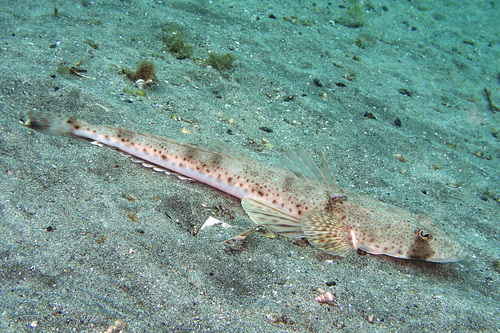
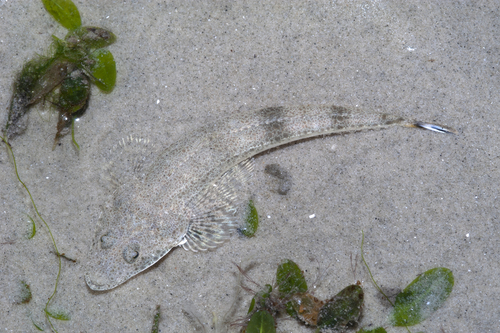
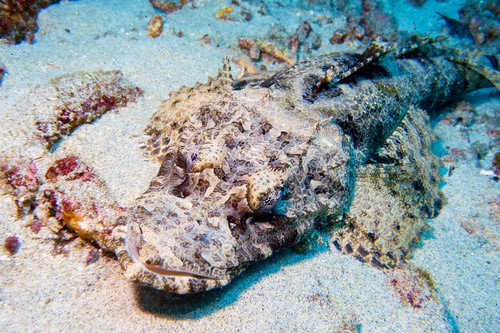
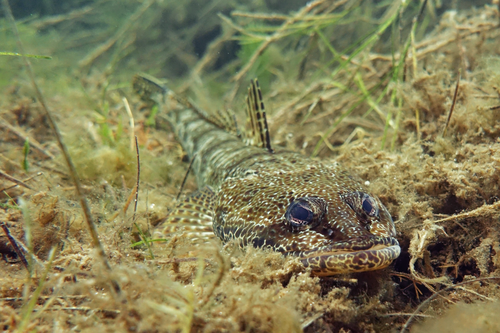
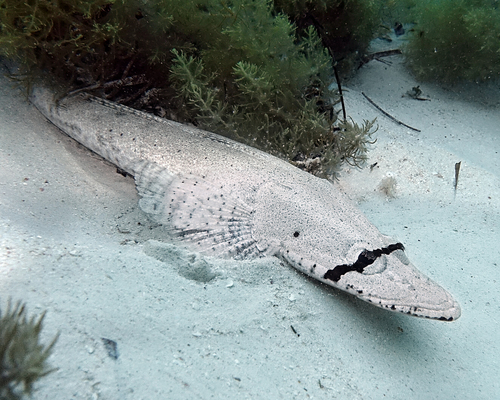
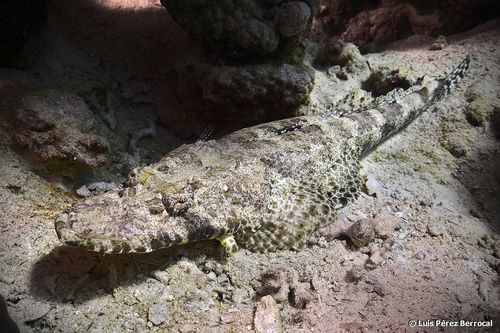
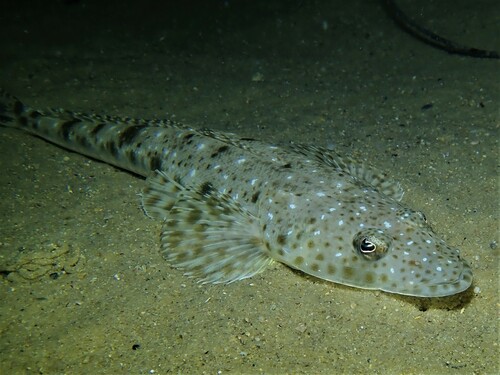
Platycephalus speculator has an elongated, slightly flattened body, with a large, flattened head that makes up about one-third of its standard length. The head has several smooth bony ridges that bear very few spines. This species has moderately large eyes, with wide, rounded lappets on the irises. Its large mouth holds small, pointed teeth on the jaws, one or two rows of vomerine teeth, and a single row of palatine teeth on each palatine, with no enlarged canine-like teeth present. The angle of the preoperculum has two robust spines, and the lower spine is slightly longer than the upper spine. The first dorsal fin has a short base, 8 or 9 spines, and the very short first spine is separate from the rest. The second dorsal fin has a moderately long base, 13 or 14 soft rays (typically 14), and its first rays are the longest. The anal fin has a similar shape to the second dorsal fin, sits opposite it, has a slightly longer base, and contains 14 soft rays. The caudal fin is truncate to rounded. This species reaches a maximum published total length of 90 cm (35 in) and a maximum weight of 8 kg (18 lb). Its overall body color ranges from sandy to dark brown or greyish, and is lighter on the ventral side, marked with many dark blotches and whitish to bluish spots. The distal part of the caudal fin has between 3 and 5 large black spots or blotches bordered by white, and these marks progressively shrink in size toward the dorsal side of the fin. Platycephalus speculator is endemic to southern Australia. Its range extends from Point Hicks in Victoria to Kalbarri in Western Australia, and it also occurs off the coast of northern Tasmania. This species favors habitats of sand and seaweed beds in shallow coastal waters, especially shallow sheltered bays, and occurs at depths down to 30 m (98 ft).