About Platycephalus laevigatus Cuvier, 1829
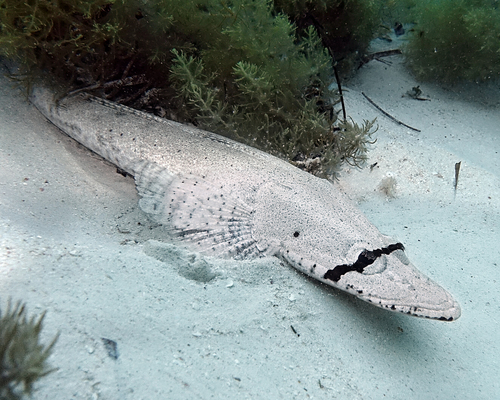
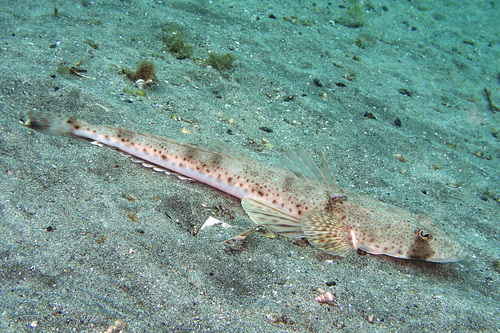
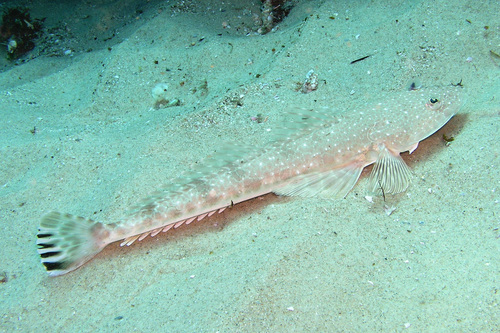
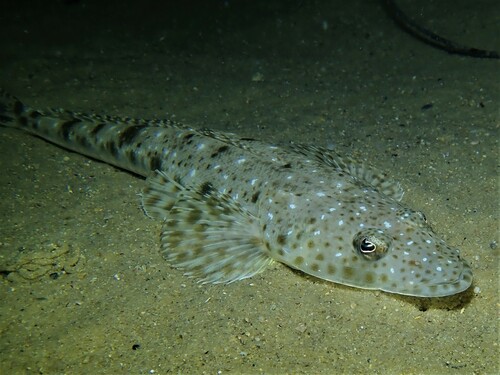
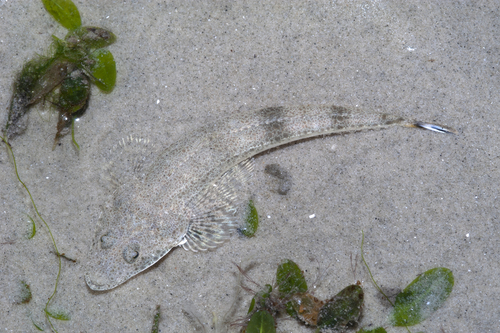
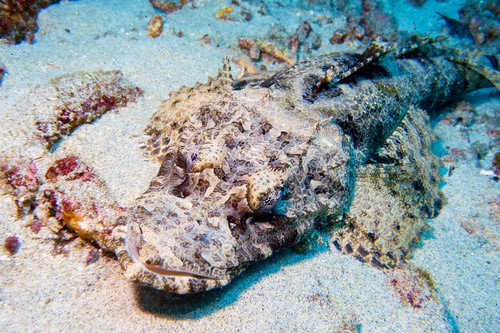
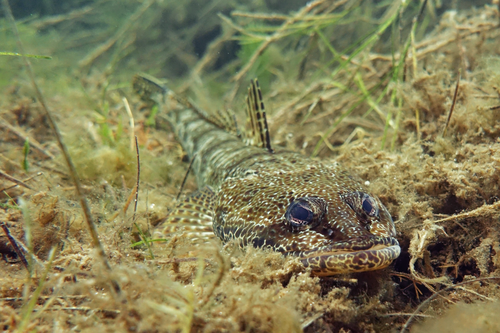
Platycephalus laevigatus has a slightly flattened, elongated body with a small, also slightly flattened smooth head that lacks ridges. Its large eyes are placed well forward on the head, and each eye has a single, lobed lappet. The species has a large mouth that holds small pointed teeth arranged in a band along the jaws, with no enlarged canine-like teeth. Two moderately sized spines are located at the angle of the preoperculum, with the upper spine being the longer of the two. The first dorsal fin has a short base, and holds 8 to 9 spines, most often 9; the first spine is very small and separated from the rest. Both the second dorsal fin and the anal fin have relatively long bases: the second dorsal fin has 14 or 15 soft rays, while the anal fin has 13 to 15 soft rays. The caudal fin is rounded. The background body colour of Platycephalus laevigatus ranges from greenish to pale brown, with darker bars crossing the back. A broken stripe runs along the middle of the flanks, and the tail is yellow with dark spots. Some individual specimens may have spots or marbled patterning. The maximum published total length for this species is 50 cm (20 in). Platycephalus laevigatus is endemic to Australia. It can be found from Greenwell Point in New South Wales to Geographe Bay in Western Australia, and its range also extends around Tasmania. This species lives in coastal waters down to at least 20 m (66 ft), where it occurs on rocky reefs, sandy areas, and seagrass beds.