About Platycephalus indicus (Linnaeus, 1758)
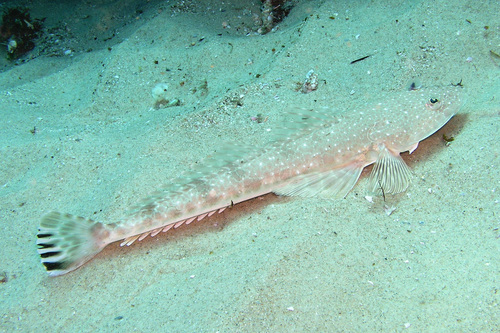
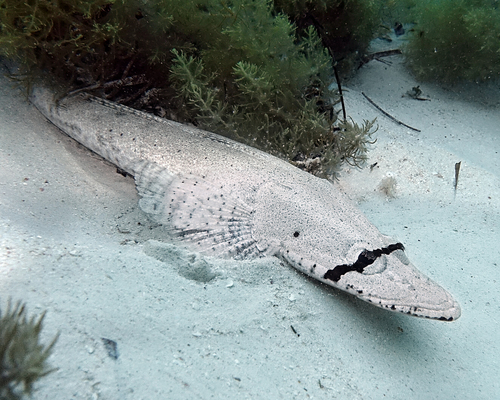
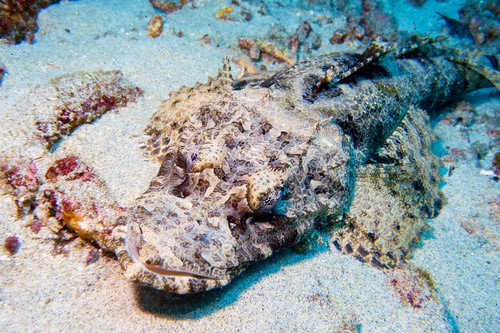
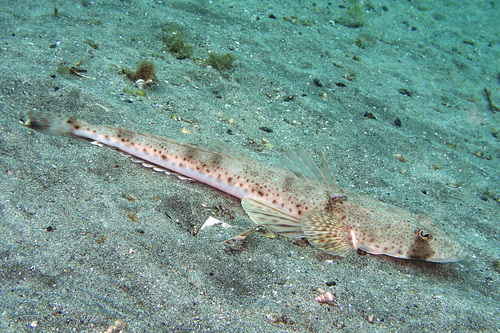
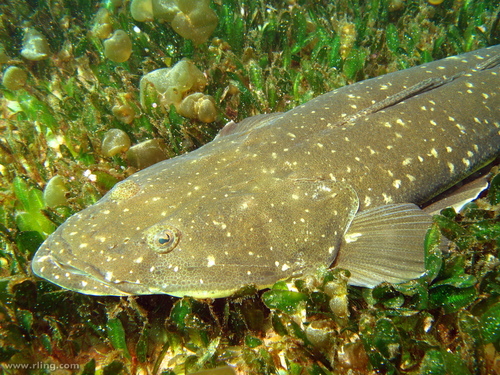
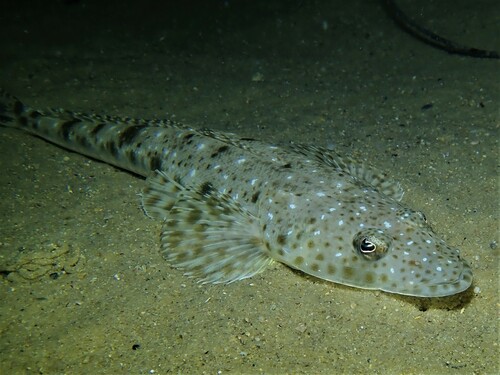
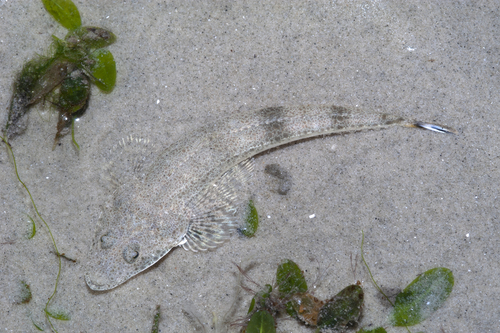
Bartail flathead, Platycephalus indicus (Linnaeus, 1758), has a smooth depressed head. The head only features low, non-spined, non-serrated parieto-occipital, scapular, and preopercular ridges. There is a short, blunt spine located in front of the eye, and the preoperculum ends in 2 strong, slightly upturned spines. It has canine-like vomerine teeth, a single clear row of canine-like teeth on the palatine, and wide bands of villiform teeth across its jaws. The first dorsal fin contains a short, separate first spine plus an additional 7 to 9 spines. Both the second dorsal fin and the anal fin have 13 soft rays. Deep incisions mark the membrane between the rays on the rear margins of both the second dorsal fin and the anal fin. Its overall body color is brownish, with 8 or 9 faint dusky bands crossing its back. The top of the head is finely mottled with roughly round spots, each surrounded by a pale ring. The lower body is yellowish. Fins other than the caudal fin have rows of dusky spots on their fin rays. The caudal fin has a longitudinal black band running through its center, with 2 diagonal black bands positioned above and below this central band. This species has a maximum published total length of 100 cm (39 in), with 60 cm (24 in) being a more typical length, and a maximum published weight of 3.5 kg (7.7 lb). This species has a broad distribution across the Indo-Pacific, ranging from the Red Sea and the eastern African coast east to the Philippines, north to Japan, and south to Papua New Guinea. It was previously thought to live in northern Australia, but the Australian population is now classified as a separate species, P. australis. It has been occasionally recorded in the Levantine waters of the Mediterranean Sea since 1953, and most likely entered this region via the Suez Canal. It inhabits depths from 20 to 200 m (66 to 656 ft) over sand and mud substrates, and is often found near reefs or seagrass beds. Juveniles of this species are known to enter the freshwater stretches of rivers.