About Platycephalus bassensis Cuvier, 1829
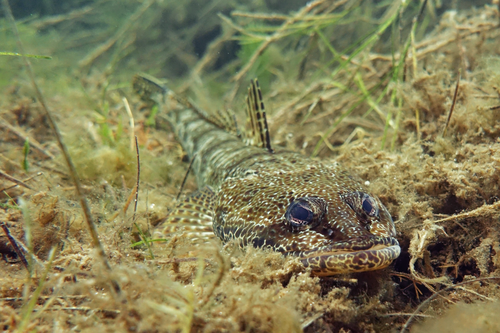
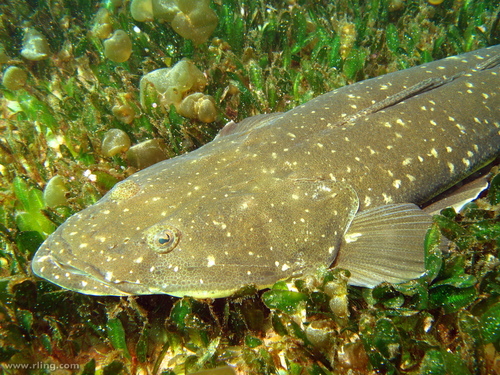
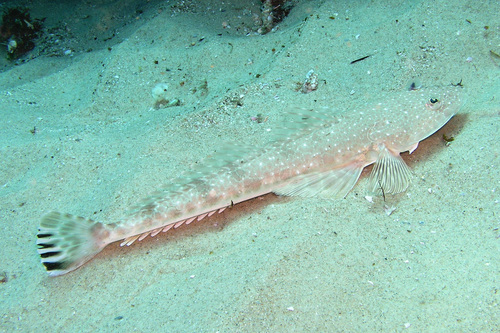
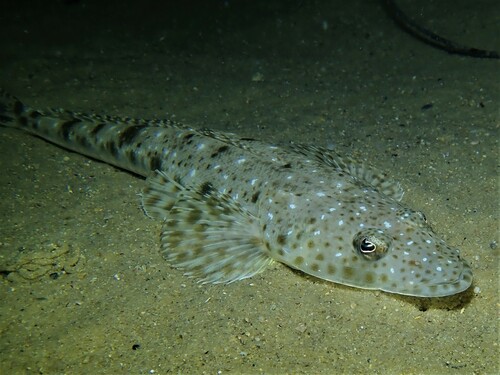
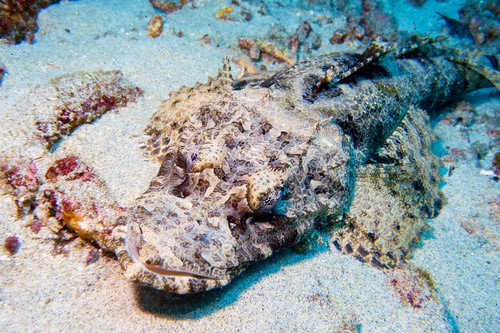
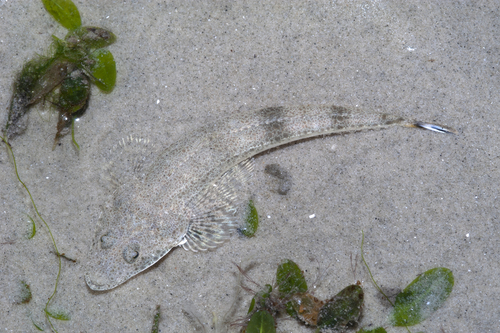
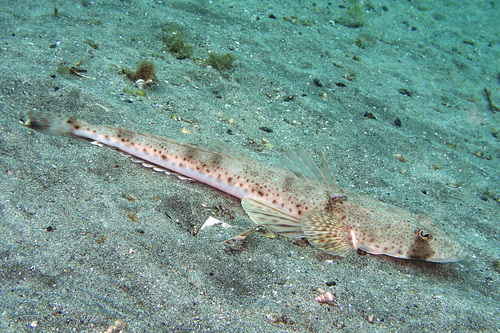
Platycephalus bassensis has an elongated and slightly flattened body, with a large, flattened head that makes up just under one-third of the fish's standard length. Two distinct bony ridges run behind the eye. The eyes are large, and each has a small lappet on the iris. It has a large mouth, with small canine-shaped teeth in the jaws, a broad patch of vomerine teeth, and a thin band of palatine teeth. Two strong spines sit on the angle of the preoperculum; the lower spine is roughly twice as long as the upper spine. The first dorsal fin has a short base, and holds 8 or 9 spines; the first spine is very short and separated from the others. The second dorsal fin has a moderately long base, with 13 or 14 soft rays (most often 14), and the front rays are the longest. The anal fin matches the second dorsal fin in shape, lies opposite it, has a slightly longer base, and contains 14 soft rays. The caudal fin is truncate. The maximum published total length for this species is 55 cm (22 in), and the maximum published weight is at least 3.1 kg (6.8 lb). Its overall body color ranges from sandy to pale brownish, with scattered small spots that vary from pale to dark. There are 2 or 3 faint bands along the posterior part of the back, and the belly is whitish. An irregular blotch marks the lower lobe of the caudal fin, and this blotch is often interrupted by pale fin rays; the upper lobe of the caudal fin is marked with large brown spots or blotches. Platycephalus bassensis is endemic to southern Australia, where it is recorded from northern New South Wales to southwestern Western Australia, including waters around Tasmania. Some taxonomic authorities note that records of this species from west of the Great Australian Bight are actually misidentifications of Platycephalus westraliae. This species lives on sandy, muddy, or shelly substrates, in shallow coastal bays down to depths of approximately 100 m (330 ft). Platycephalus bassensis has separate sexes, with external fertilisation. Spawning occurs from late Austral winter through mid December. Its eggs and larvae are pelagic; after hatching, larvae settle to the seabed and grow rapidly for their first three years of life, reaching a total length of 22 to 25 cm (8.7 to 9.8 in) in that time.