About Platichthys stellatus (Pallas, 1787)
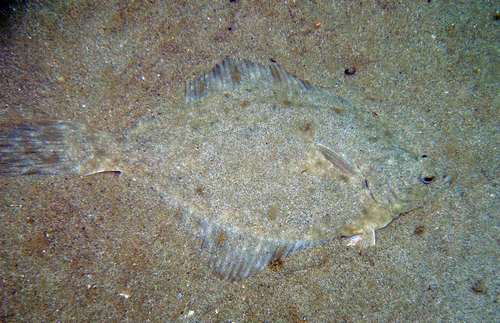
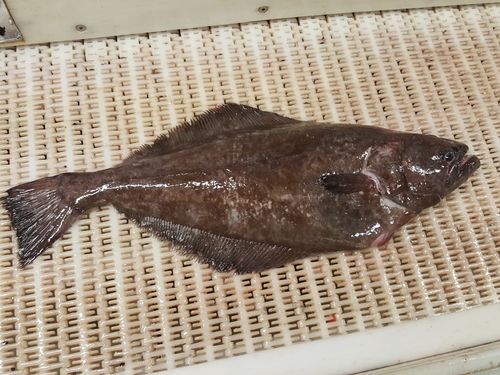
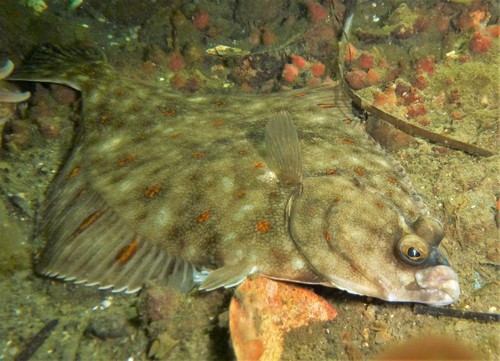
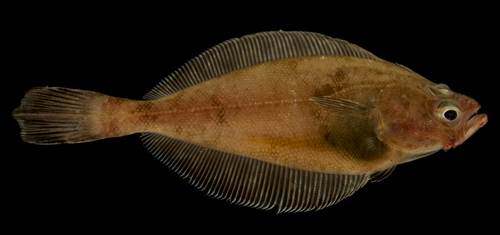
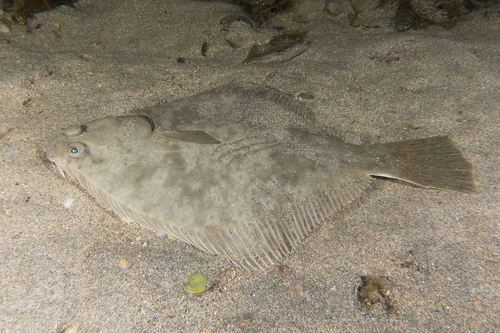
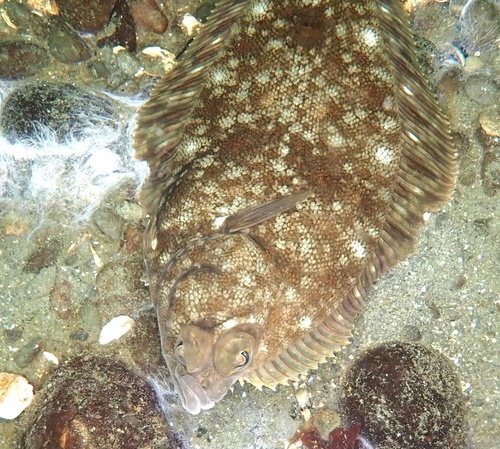
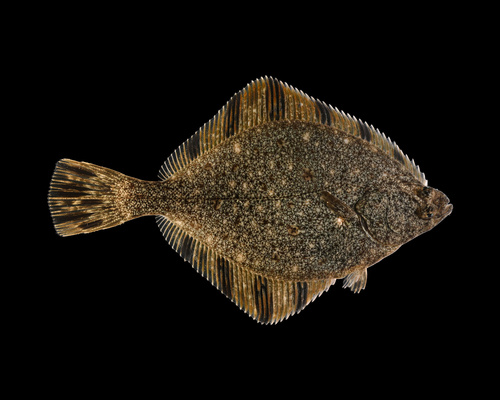
Morphology: The starry flounder (Platichthys stellatus) has an oval-shaped body with a slender, pointed head. Its eyed side ranges in color from olive to dark brown, and is nearly black in some individuals, while its blind side is white or creamy white. The species' unpaired fins are colored white to yellow-orange, with black bands running perpendicular to the body of the fish. Its caudal (posterior) fin is slightly rounded. Lateral lines with a gentle curve pass over the pectoral fin, and this species completely lacks an accessory dorsal branch. Starry flounder rely heavily on a strong anal spine for swimming; this spine acts as the primary driver of locomotion when the fish swims through the open ocean, creating propulsive force through an up-and-down motion. Distribution: The starry flounder has a relatively large native range along the North Pacific Ocean, extending as far south as Southern California. Across the Pacific, its distribution covers Korea and Southern Japan, through the Bering Strait and Arctic Alaska, to the Coronation Gulf. It is also prominently found in Canada, Santa Barbara, and Southern California. Ecology: The primary habitat of this species is mud, sand, or gravel bottoms at depths between 0 and 375 m (1230 ft), and it most commonly occurs at depths above 146 m (479 ft). It is usually found near shore, and often enters brackish and even occasionally fresh water. This fish avoids highly salinated water, because it cannot prevent its cells from becoming hypersalinated.