About Platichthys flesus (Linnaeus, 1758)
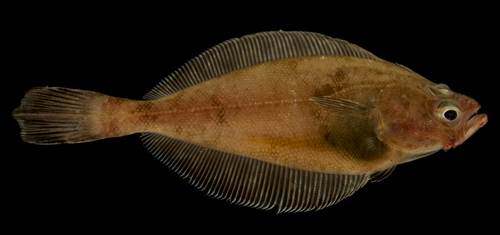
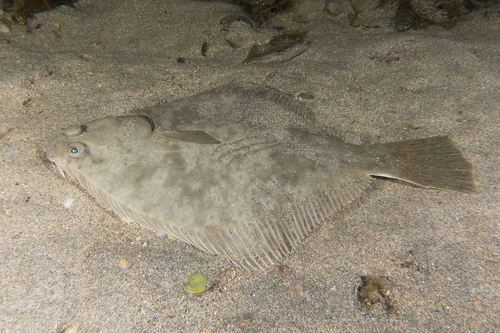
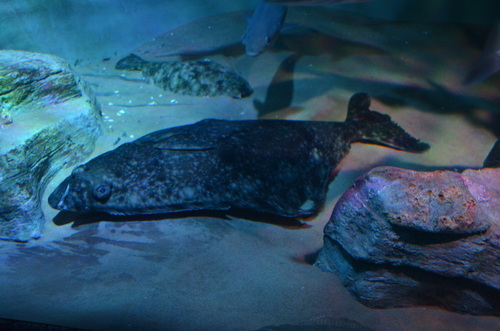
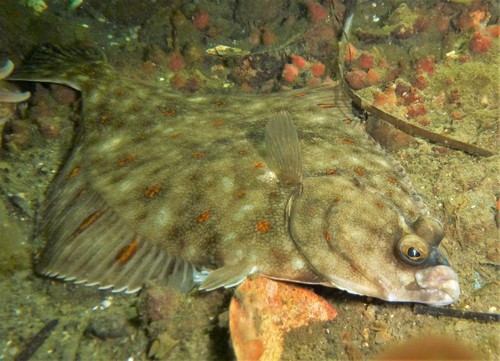
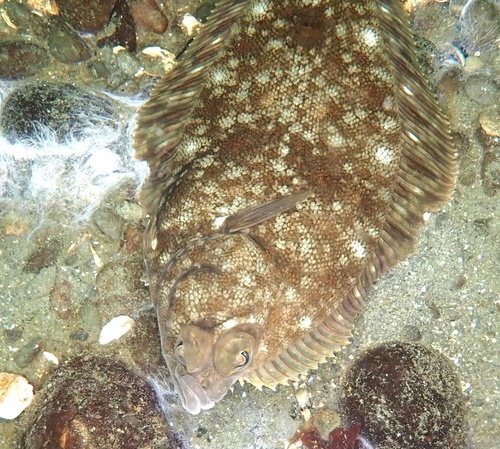
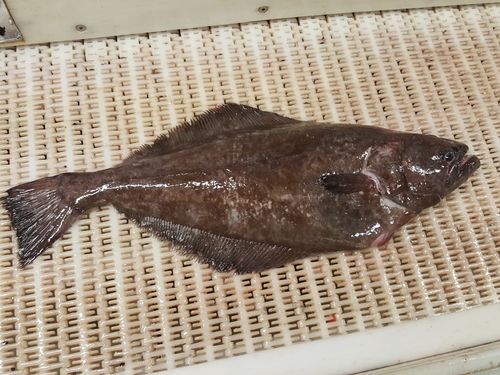
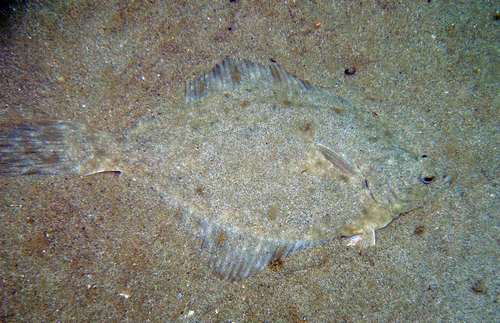
The European flounder (Platichthys flesus) is an oval-bodied flatfish, with a body width that measures roughly half its body length. The maximum recorded length for this species is 60 centimetres (24 in), with a maximum recorded weight of 2.93 kilograms (6.5 lb); most mature individuals reach a more typical length of around 50 centimetres (20 in). This fish is laterally flattened, and it both swims and rests on one side of its body. As it develops, its eyes usually both migrate to the right side of its body, so the surface that appears as its upper side is actually its right side. Around thirty percent of individuals have eyes that migrate to the left side, making the left side the uppermost surface. It has a small mouth located at the end of its bluntly pointed snout. Its upper surface is colored fawn, olive green, or pale brown, marked with smaller spots, larger darker brown patches, and some irregular reddish spots. Its opaque pearly-white under surface gives this fish the common name "white fluke". Its lateral line is nearly straight, running along the middle of the upper surface and curving around the short pectoral fins. The dorsal fin extends from the base of the head to beside the caudal peduncle; it has no dorsal spines, and holds between 53 and 62 soft rays. The anal fin also runs along the length of the body, has no spines, and contains 37 to 46 soft rays. Its skin is rough, with prickly tubercles at the base of the dorsal and anal fins, and large scales sit beside the lateral line. The caudal peduncle measures about half the length of the tail, and the caudal fin has a squared-off end. The European flounder is native to the northeastern Atlantic Ocean and the Mediterranean Sea. Its range stretches from the Barents Sea, White Sea, and Baltic Sea south to Greece, Turkey, the Black Sea, and the North African coast. It has been introduced into Iran, and has become established along the eastern coast of Canada and the United States, likely arriving via ship ballast water. It is typically found from the low shore down to depths of around 100 metres (330 ft), living on sandy, shingle, or muddy bottoms; its dappled coloration provides camouflage that makes it hard to detect. It can also be found in estuaries, as it tolerates low salinity levels. Unlike other members of the Pleuronectidae family, it often spends part of its life cycle in freshwater and regularly moves into rivers. In the British Isles, it has been recorded as far inland as Montgomeryshire on the River Severn, Dinas Mawddwy on the River Dovey, and Garstang on the River Wyre. Unlike the Atlantic salmon, European flounder feed while in rivers, and return to the sea to spawn.