About Platemys platycephala (Schneider, 1792)
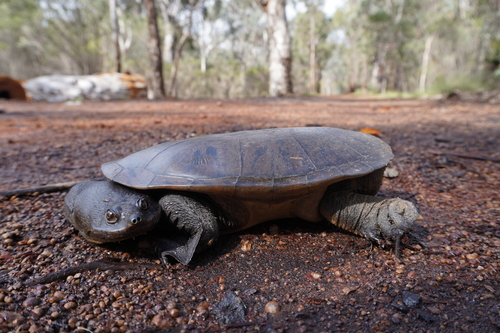
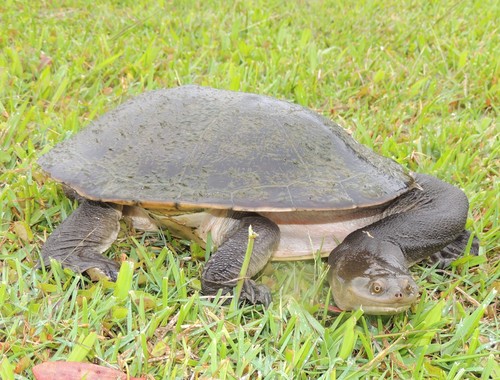
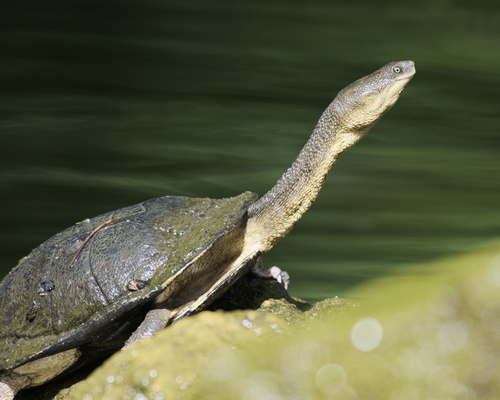
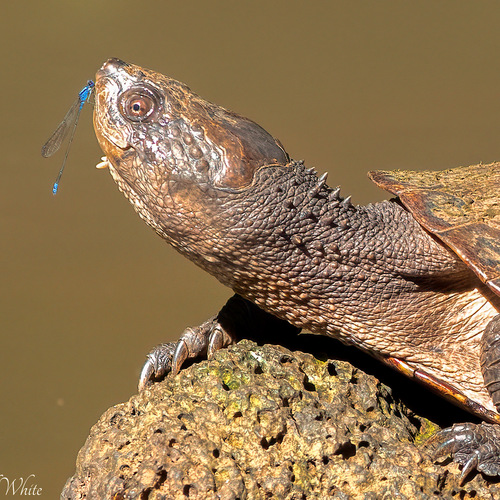
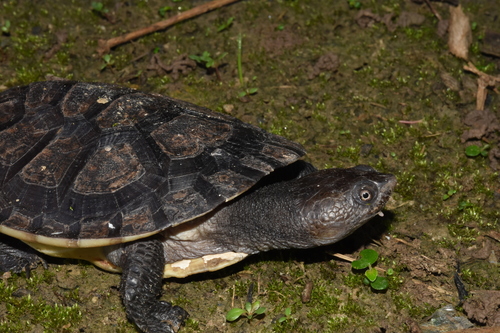
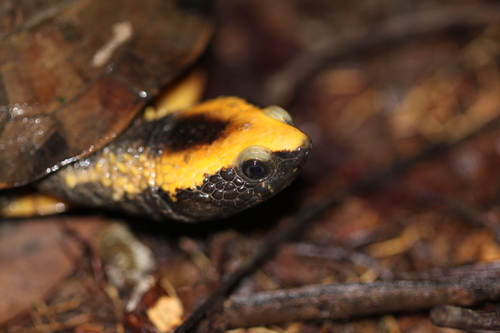
Platemys platycephala, the twist-necked turtle, is a medium-sized turtle with a shell length ranging from 14 to 18 cm. On average, females are slightly smaller than males and have shorter tails. The carapace, the upper portion of the shell, is elliptical, flattened, and has two raised keels that form a trough-shaped depression. Carapace coloration ranges from orange to yellow-brown mixed with black, with patterning varying by subspecies. The plastron, the lower portion of the shell, is dark brown or black. The bridge, the side portion of the shell, is yellow with a black bar across it, and the consistency of this bar also varies by subspecies. The face and neck have orange or yellow-brown stripes on the upper side, and black stripes on the lower and side sections. The head is small, triangular, smooth, and undivided. The neck has conical tubercles, which are rounded protective projections and scales that defend against predators. This species is a member of Pleurodira, a suborder of turtles that withdraw their heads into their shells by bending their necks sideways, unlike the straight-back neck retraction used by Cryptodira turtles. The snout projects slightly, and the irises are brown. The limbs are black and have large scales on their front surfaces; the short tail is also black. Both front and back limbs have intermediate webbing, an adaptation for movement both in water and on land. The twist-necked turtle lives across a large area of northern and central South America, ranging from the southern Orinoco drainage in Venezuela to the Amazon basin. It does not inhabit large rivers, instead occurring in shallow creeks and on forest floors. In a 1983 survey of the species' extensive geographic range, Ernst documented a dark subspecies in the western part of its range. Ernst used Quaternary forest refuge theory to explain the origin of this subspecies. This theory states that significant climatic changes occurred around the equator during the Quaternary period. During glacial periods of these changes, northern South American rainforests received less rainfall and shrank, then expanded again during interglacial periods. This change led to allopatric speciation in many species, producing the subspecies Platemys platycephala melanonota. The coloration and shape of the turtle's carapace, head, and feet help conceal it from predators living in the Amazon. In the wild, twist-necked turtles naturally prefer amphibian eggs, and also eat a variety of insects, mollusks including snails and slugs, amphibians, and some plant material, foraging both on land and in water. In captivity, specimens thrive on commercial reptile food, vegetables, insects, worms, and even fish. The species is most often found in shallow pools, and can inhabit dry areas for long periods of time. During the dormant dry season, many individuals become heavily parasitized by leeches – one turtle was found to carry 81 suckers – and suffer health effects from this parasitism.