About Platax pinnatus (Linnaeus, 1758)
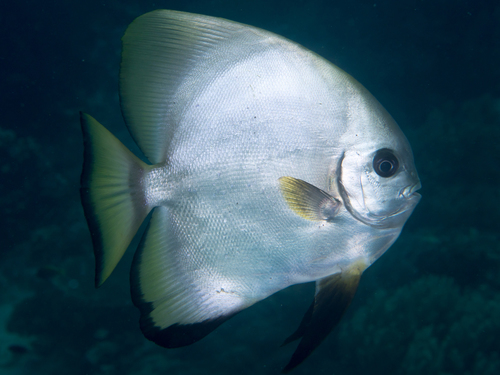
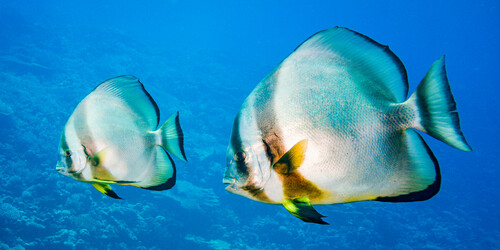
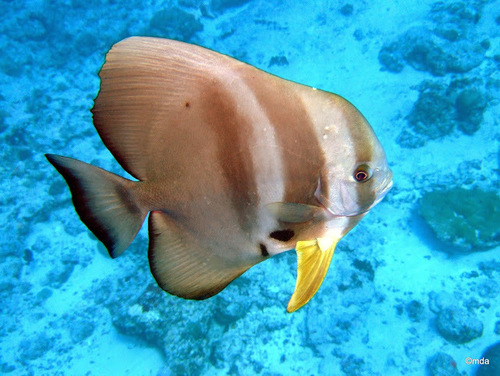
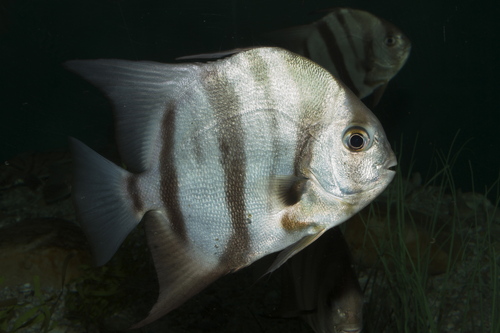
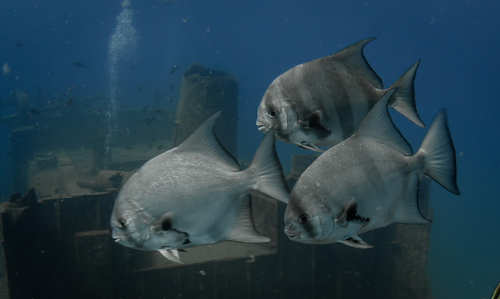
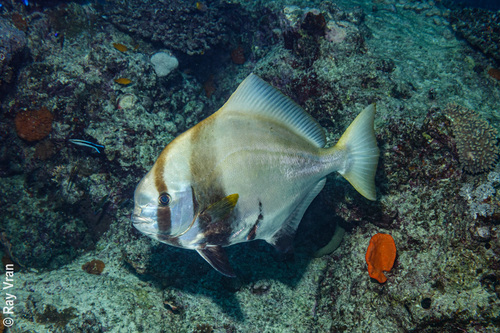
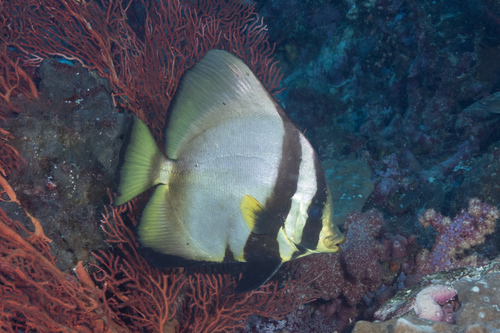
Platax pinnatus, described by Linnaeus in 1758, has a round, strongly compressed adult body with a depth equal to twice the length of the head. This species reaches a maximum published total length of 45 cm (18 in). Larger adults with a standard length over 35 cm (14 in) have a protruding snout and a concave dorsal profile of the head. Both jaws hold bands of thin, flattened, tricuspid teeth, where the central cusp is roughly twice as long as the lateral cusps. This species has vomerine teeth, but no palatine teeth. The dorsal fin is supported by 5 or 6 spines and 34 to 37 soft rays, while the anal fin has 3 spines and 24 to 28 soft rays. Adults are overall silvery, with a dusky or dark vertical bar passing through the eye, and a second similar bar passing through the base of the pectoral fin. The dorsal, anal, and caudal fins are yellow. Juveniles are mainly black, with orange outlines along the body and median fins, and have greatly elongated dorsal and anal fins. Platax pinnatus is reported to occur across the Indo-West Pacific, though FishBase notes that records from the Indian Ocean outside Australia are considered doubtful. Its confirmed range spans the western Pacific, from the Ryukyu Islands south to Australia. In Australia, it has been recorded off the central coast of Western Australia, around the tropical northern coasts, and south along the east coast as far as the central coast of New South Wales. Adult Platax pinnatus live under overhangs of steep outer reef slopes, at depths greater than 20 m (66 ft). Juveniles are found among mangroves, or shelter in caves and under ledges in inner protected reefs.