About Platax boersii Bleeker, 1853
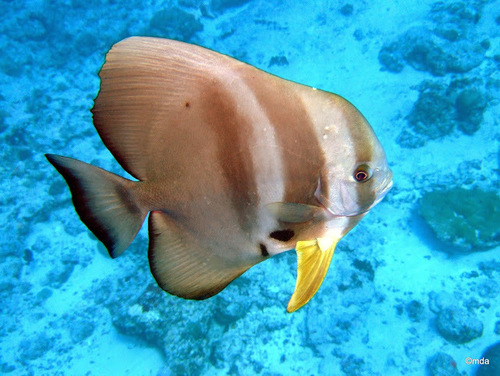
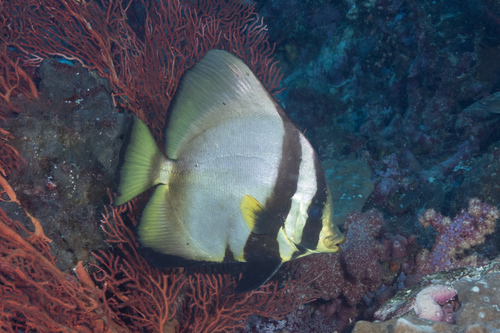
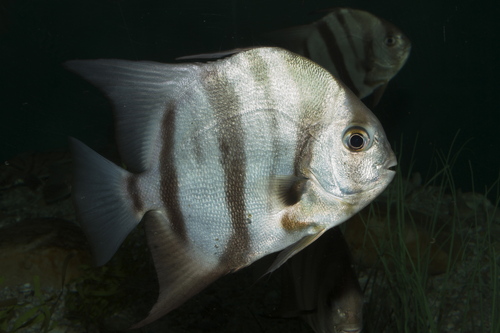
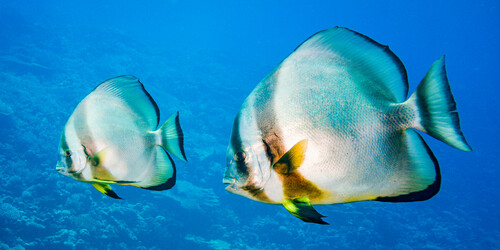
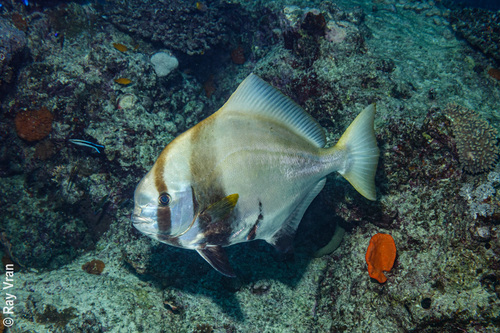
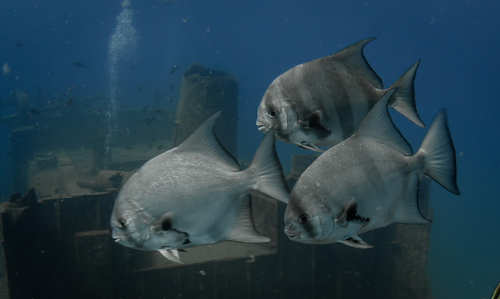
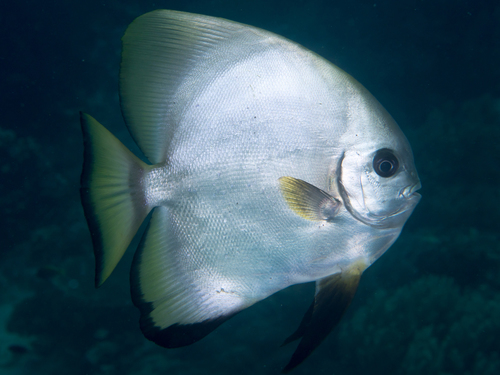
Adults of Platax boersii have a smoothly rounded head profile, similar to that of the orbicular batfish (P. orbicularus), but can be distinguished by their golden sheen and the lack of small black spots. The juveniles of this species share extremely elongated dorsal and anal fins with P. teira juveniles, but differ from them by having a silvery sheen and an overall paler colour. Adults of this species that grow longer than 18 cm (7.1 in) are yellowish-silver, with scattered small dark spots across the body. They have one dark vertical bar running through the eye, and a second dark bar positioned to the rear of the head. The caudal, pectoral, anal, and dorsal fins are yellowish green; the margin of the anal fin and the rear margin of the caudal fin are black, and the pelvic fins are entirely black. Small juveniles are yellowish brown or silvery, and have the same two black bars on the head that adults have. The posterior third of the juvenile body is blackish, and this dark colour extends onto the dorsal and anal fins. The front edge of this black body region is often directly preceded by a thin, indistinct dark bar. The caudal fin of small juveniles is transparent except for its black base. The dorsal fin is supported by 5 spines and 31 to 34 soft rays, while the anal fin contains 3 spines and 24 to 28 soft rays. The maximum published total length recorded for this species is 40 cm (16 in). Both juvenile and adult Platax boersii live on or near reefs at depths between 10 and 60 m (33 to 197 ft). Individuals may be solitary or gather in small schools. Schools occur along drop-offs in tall coral structures, while solitary fish are most commonly found in inshore areas. This species is found in Indonesia, the Philippines, and Papua New Guinea.