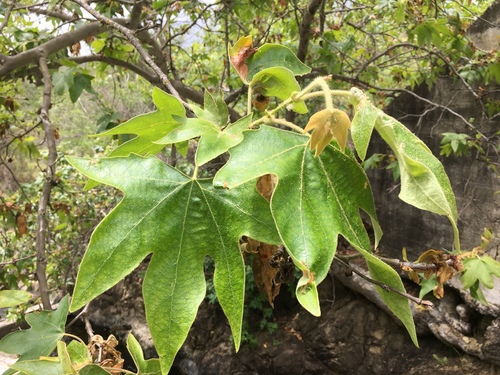
About Platanus racemosa Nutt. ex Audubon
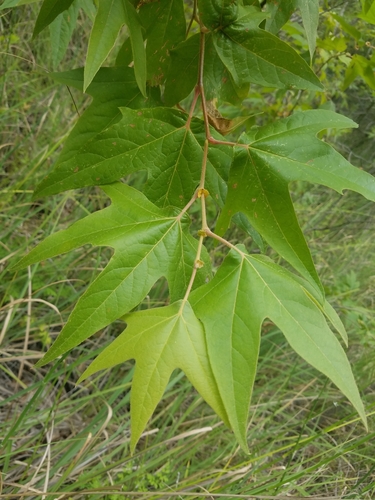
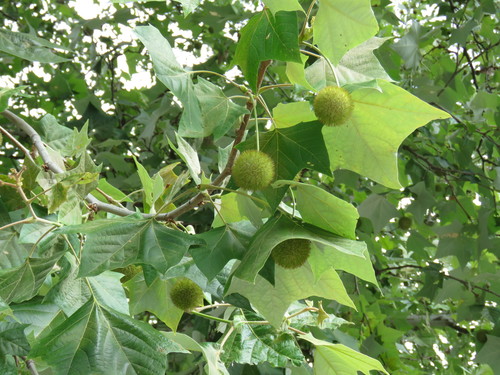
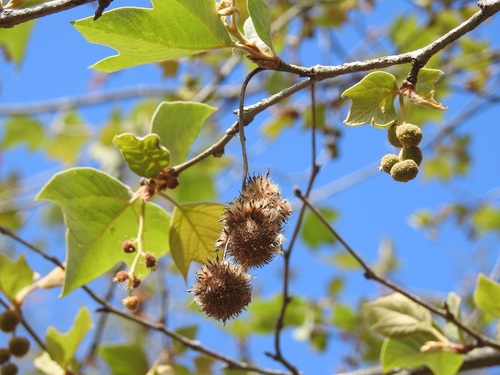
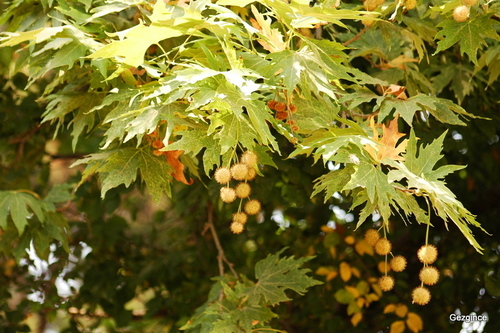
Platanus racemosa Nutt. ex Audubon, commonly known as California sycamore or western sycamore, is a large deciduous tree. It typically reaches 10 to 35 meters (33 to 115 ft) in height, with a maximum trunk diameter of up to one meter (three feet). One recorded specimen on the campus of Stanford University has a trunk circumference of 10.5 feet (3.20 m). Its trunk generally divides into two or more large trunks, which then split into many branches. The bark forms an attractive patchwork of white, tawny beige, pinkish gray, and pale brown. As the tree ages, older bark and twigs darken over time, ranging from light brownish gray to a sepia-like shade. This species is the dominant tree in the globally and state-endangered sycamore-alluvial woodland habitat. Its leaves are large and palmately lobed, with three or five pointed lobes, and can grow up to 25 centimeters (9.8 in) wide. New leaves are bright translucent green and have a somewhat woolly texture. In autumn, this deciduous tree drops large amounts of dry golden to orangish red leaves. Its inflorescence consists of several spherical flower heads, each around one centimeter wide. Male inflorescences are chartreuse, while female inflorescences are red. After fertilization, female flower heads develop into spherical fruit clusters made of many hairy, maroon-red-woolly achenes. Both the fruit achenes and the tree’s pollen break apart and scatter after development. The tree’s tough, coarse-grained wood is difficult to split and work. It has a range of uses, including use as meat preparation blocks for butchers. Many small birds feed on its fruit, and several mammals eat its twigs and bark. Pollen from the hairs on the leaves and flowers of western sycamores can act as an allergen for some people. New leaves of this species are susceptible to anthracnose canker. When the disease causes a side bud to grow into the new main leader, older specimens often develop picturesque angled trunks and branches. Increased human interference makes Platanus racemosa more likely to cross-breed with other Platanus species. Hybridization with species such as Platanus × hispanica gives Platanus racemosa the advantage of resistance to sycamore anthracnose, a fungal disease that damages the wood of pure native Platanus racemosa. However, sycamore anthracnose produces deadwood that creates habitat for animals such as wood ducks. A decline in non-hybridized Platanus racemosa harms the riparian woodlands where the species grows naturally. Another disease that this species is particularly susceptible to is Fusarium dieback, which is carried and transmitted by two types of invasive ambrosia beetles. Removing an infected tree is one method to stop the significant harm caused by Fusarium dieback from spreading. A combination of fungicides such as metconazole and an insecticide can also reduce the number of ambrosia beetles that transmit the disease. Close monitoring is required to prevent substantial beetle infestations, which damage trees so severely that removal becomes necessary. Ongoing hybridization between Platanus racemosa and Platanus × hispanica is a threat to the genetic diversity and distinct identity of native Platanus racemosa. The disease resistance advantage of hybrids can lead to a decline in the native tree. This decline and genetic erosion can harm not only the native tree itself, but also nesting birds, monarch butterflies, and many other small animals that live or find shelter in the shade of California sycamore. A 2000s RNA study by D. Whitlock of Platanus trees growing near the Sacramento River found that most sampled Platanus racemosa already contain genetic material from Platanus × hispanica, confirming increasing genetic mixing that erases the native species. This species is widely planted horticulturally as a landscape tree in both public spaces and private gardens. It requires some water when young and can be grown in lawns, but becomes drought tolerant once it is established. Growing appreciation for its ability to provide shade in summer, while letting sunlight pass through in winter, has led to its use in green architecture and sustainable design. Beyond the use of its wood for butcher blocks, California sycamore’s hard, difficult-to-work wood can still be used to make a variety of items including buttons, tobacco boxes, furniture, wooden utensils, and barrels. The species’ form and wide canopy make it an effective shade tree. The shade provided by western sycamore cools nearby bodies of water, while the humid environment where the tree naturally grows provides habitat for various animals. The Native Tongva people call this tree Shavar, and teas prepared from its bark were traditionally used as a blood tonic, a remedy for asthma, and an aid during childbirth.