About Platanthera praeclara Sheviak & M.L.Bowles
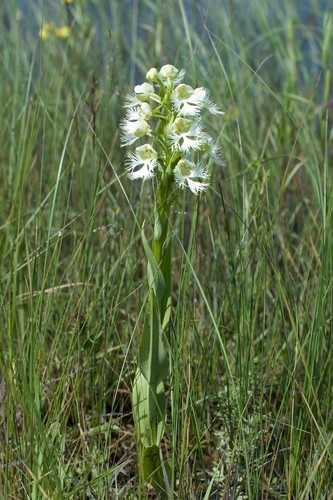
Platanthera praeclara grows from a fleshy tuber, reaching between 38 and 85 centimeters (1 foot 3 inches to 2 feet 9 inches) in height. Each individual plant can produce up to two dozen or more flowers arranged along a single stalk. This species can be told apart from the closely related Platanthera leucophaea (eastern prairie fringed orchid) by its slightly larger flowers, distinct petal shape, and longer nectar spur. Platanthera praeclara is a long-lived perennial orchid. It emerges in spring May, and blooms in June; blooms occur in July for populations growing further north. Its flowers release fragrance at night, and are pollinated by large sphinx moths. This species is native to the tallgrass prairie ecosystem, and requires full direct sunlight to grow. It is most commonly found in moist habitats or sedge meadows. It has been able to persist in areas that experience light grazing, periodic burning, or regular mowing. Researchers do not yet fully understand how these land management activities impact the plant’s survival. Removing accumulated dead grass mulch from these activities may benefit the orchid, while heavy grazing is known to be harmful to the species. Historically, Platanthera praeclara occurred in tallgrass prairie habitats west of the Mississippi River, ranging from extreme southern Canada south to northeastern Oklahoma. In Oklahoma, historical 1975 records document the species in Craig and Rogers Counties. Today, the orchid has existing, living populations in Iowa, Kansas, Manitoba, Minnesota, Missouri, Nebraska, and North Dakota.