About Platanthera clavellata (Michx.) Luer
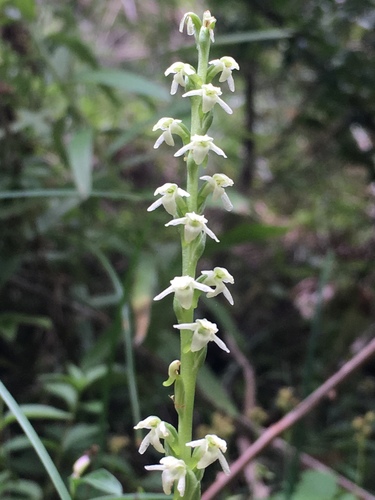
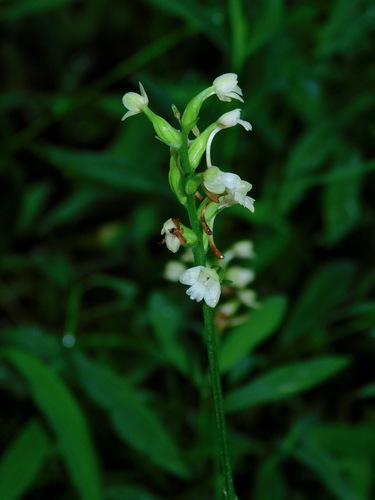
Platanthera clavellata (Michx.) Luer plants grow 4 to 16 inches tall, making it one of the smallest species among the 32 common Platanthera species native to North America. Several linear-oblong to narrowly elliptic or oblanceolate leaves attach to its unbranched stem; all leaves except the lowermost are greatly reduced in size. Mature leaves measure 7 to 16 cm long and up to 3 cm wide. The unbranched stem ends in a raceme holding 5 to 20 small, inconspicuous flowers. Each flower has 3 petals and 3 petal-like sepals, which can be greenish, white, or yellowish. The two upper petals and upper sepal form a hood, while the two lateral sepals curve forward like small wings. The lower petal is longer, forming a lip at the front and a nectar spur at the back. The curved nectar spur is 7 to 12 mm long and is enlarged at its tip. Seed capsules of this species are 6 to 10 mm long and grow at an upward angle. P. clavellata blooms from mid to late summer, with peak blooming occurring during the last two weeks of July. P. clavellata grows in moist, acidic soil and requires partial shade. It occurs in habitats including moist meadows, bogs, swamps, and forested seeps. Its range is limited because its seeds cannot germinate on their own, and instead need a specific soil fungus to germinate; a known associated fungus is Epulorhiza inquilina. This orchid is found in eastern North America, in the eastern United States and Canada. In the U.S., it has been historically recorded in 34 states ranging from North Dakota, Minnesota, and Maine south to Florida and Texas. It is currently considered extirpated in North Dakota, and listed as endangered in Illinois and Florida. In Canada, it has been recorded in six provinces from Newfoundland to Ontario. Ecologically, the flowers of P. clavellata are autogamous: they do not require pollinators, and each flower self-pollinates to produce viable seeds.