About Platanthera ciliaris (L.) Lindl.
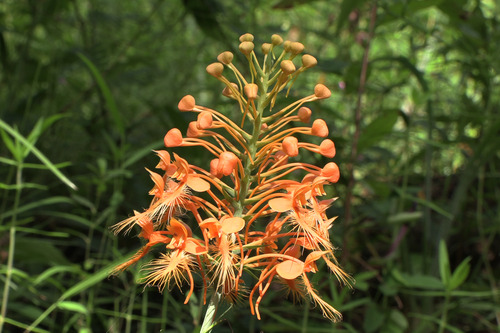
Platanthera ciliaris (L.) Lindl. is an herbaceous perennial orchid. It is known to flower in late summer, typically in August, and produces uniquely lacerate, fringed orange flower petals. These fringes help create a broad, visible landing surface for visiting pollinators and contribute to the flowers' visual appeal. The inflorescence is generally oval in shape, with individual plants bearing between 20 and 60 flowers. The flowers themselves are resupinate, meaning they twist as they develop so that the lip (labellum) faces downward, presenting a landing platform for pollinators. The bright orange color facilitates daytime detection, and nocturnal moths and other pollinators have been observed to avoid P. ciliaris at night, preferring to visit other members of the Platanthera genus. The sepals help define the flower's fringed outline and create open "windows" around the labellum, increasing visual access for pollinators. Arguably the most defining floral feature of P. ciliaris is its elongated nectar spur. This elongated nectar spur, along with local adaptations of the spur, is the trait most responsible for the species' pollinator specificity. Spur lengths generally range from 20 to 35 mm, typically depending on the geographic location of the population, showcasing local adaptation within the species. This elongated spur length means efficient nectar access is only possible for long-tongued pollinators, primarily swallowtail butterflies. Coastal plain populations tend to have longer spurs than those in the Appalachian Mountains, a difference that likely reflects selection from regional pollinator communities. Like other orchids, the reproductive structures of P. ciliaris are fused into a single structure called the column. The column is compact, about 3x3 mm, and positioned above the opening of the nectar spur. At the top of the column are the anther sacs, each containing a pollinium, a packet of clumped pollen grains. Narrow caudicles connect each pollinium to sticky viscidia that protrude out of the anther sac, forming the pollinarium. The viscidia sit on either side of the spur opening and are angled so that visiting butterflies contact them with their compound eyes as the butterflies reach down for nectar. When a pollinator withdraws from the flower, it tugs on the attached viscidium and pulls off the entire pollinaria. During the next flower visit, the rotated pollinaria are deposited onto the stigma, which is located above the spur entrance and just below the half-anther cells. This arrangement ensures highly precise pollen transfer and highlights the evolutionary relationship between the plant and its pollinators. Platanthera ciliaris is notably pollinated by large butterflies, and geographic variation between plant populations influences which butterfly species act as primary pollinators. In mountainous regions of Eastern North America, particularly the Appalachian Mountain Range, Papilio troilus is the dominant pollinator. In contrast, in coastal plain regions, Papilio palamedes has been observed as the primary pollinator of P. ciliaris. Regardless of region, many different pollinator species have been observed visiting sporadically throughout observation periods, which contributes to P. ciliaris' high tendency for hybridization. The genus name Platanthera has Greek origins, from the roots platys and anthera, which mean "broad" and "anther" respectively. The species name "ciliaris" is derived from the Latin word cilium, meaning eyelid or eyelashes. Originally named Habenaria ciliaris, French botanist Louis Claude Marie Richard established the separate genus Platanthera from Orchis and Habenaria, due to the distinct shape and size of anthers (the pollen-producing organ of the stamen) across the approximately 200 species placed in the genus. Platanthera ciliaris is native to eastern North America, occurring from Ontario and Massachusetts west to Michigan and eastern Oklahoma, and south through the Gulf Coastal Plain to Florida and eastern Texas. Although widespread across this range, local population densities are often low, with many sites supporting only scattered individuals rather than large colonies. Geographic variation within the species is particularly notable and is closely tied to regional pollinators, which have influenced morphological divergence between mountain and coastal-plain populations. Across its range, P. ciliaris occupies a broad array of wetland habitats. It is commonly found in bogs, wet meadows, and pitcher plant savannas, but also occurs in more upland settings such as open pine woods and mountain slopes. The species tends to prefer open, sunny environments but is tolerant of partial shade, particularly in moist or saturated soils. High soil acidity is characteristic of many of its habitats, especially in bogs and seepage areas. These habitat preferences and its wide but scattered distribution illustrate the ecological and biological flexibility of this orchid. Platanthera ciliaris begins growing each spring from overwintering buds formed on one of its thick, fleshy roots in the prior growing season. Throughout the growing season, the plant produces an upright stem that flowers in late summer, typically August. Each year, the developing bud produces new roots and tuberoids that will support the next year's growth. This makes the species particularly sensitive to damage early in the season, when it cannot regenerate lost tissues until the following year. Typically robust, these plants can grow to around 1 meter tall, with leaves concentrated basally that gradually reduce in size upward along the stem. Its reproductive structures, described in detail in the floral morphology and pollination section, follow the typical orchid condition where stamens and stigmas are fused into a tightly packed column, with an arrangement that allows precise pollen deposition onto visiting pollinators. The highly abundant seeds of Platanthera ciliaris are exceedingly small, allowing for easy dispersal by wind or water. However, successful germination of these seeds requires a specific condition. Because the seeds lack any stored nutrients, successful germination can only occur when they land in substrates containing the appropriate mycorrhizal fungi, which supply sufficient nutrients for early development. These fungal partners provide enough nutrients for seeds to survive underground for several years before emerging above the surface. A notable characteristic of Platanthera biology is the unique capacity for hybridization. Many species within the genus readily interbreed, and in some regions, hybrids outnumber the parental species. P. ciliaris has been specifically noted to commonly hybridize in nature with P. blephariglottis. Across populations in North America, hybridization between P. ciliaris and other Platanthera species is site-dependent, and often occurs due to shared pollinators. Where P. ciliaris populations coexist with other Platanthera species of similar genomic composition, weak reproductive barriers allow extensive hybridization. Floral morphology also plays an important role in the hybridization capacity of Platanthera species. For example, P. ciliaris hybridizes more extensively with P. blephariglottis than P. cristata does with either of the two species, because of similarities in flower morphology and spur length. Although P. ciliaris is self-compatible, natural self-fertilization is uncommon in nature. These plants predominantly rely on outcrossing, mediated by pollinators, to maintain sustainable populations and increase genetic diversity within regions. Modern uses of Platanthera ciliaris remain relatively unknown. Historically, Native American tribes, notably the Cherokee and Seminole tribes, used the species in a variety of ways. Medicinally, the roots of the plant were used as an anti-diarrhetic, to relieve headaches, and to treat snake bites. Additionally, fishermen would use bits of the roots as bait, as it was believed to "make the fish bite better."