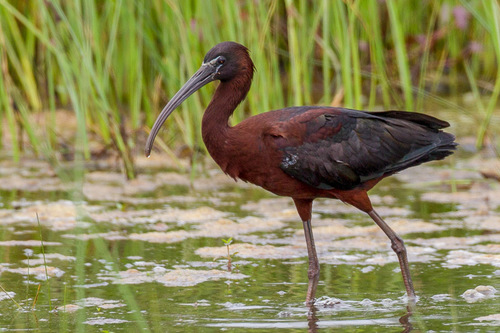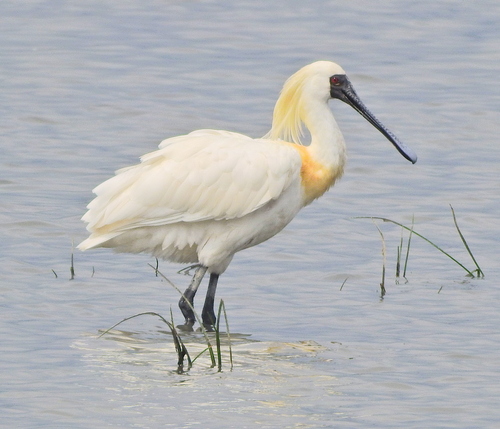
About Platalea minor Temminck & Schlegel, 1849
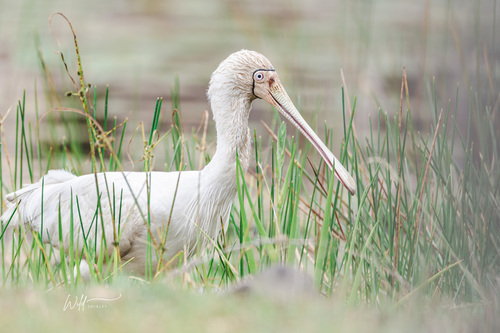
The black-faced spoonbill, with the scientific name Platalea minor Temminck & Schlegel, 1849, is a species of wading bird in the ibis and spoonbill family Threskiornithidae, found in eastern Asia. It has the most restricted distribution of the six existing spoonbill species, and is the only spoonbill species classified as endangered. Like all spoonbills, black-faced spoonbills are large water birds with dorso-ventrally flattened, spatulate (spoon-shaped) bills. They feed using a tactile method: they wade through water and sweep their beaks from side to side to detect prey. Black-faced spoonbills are crepuscular eaters that use intertidal mudflats as feeding grounds.
This species is restricted to the coastal areas of eastern Asia; historically, it appears to have been common across its entire native distribution range. Currently, it only breeds on a small number of small rocky islands off the west coast of North Korea. Confirmed wintering sites include Macau, Hong Kong, Taiwan, Jeju (South Korea), Kyushu and Okinawa (Japan), the Red River delta in Vietnam, and additional locations in Vietnam, with other sites used during migration. More recently, black-faced spoonbills have also been sighted in Thailand, the Philippines, and additional sites across China.
The black-faced spoonbill was internationally classified as an endangered species by the IUCN in 2000. The global population was nearly driven to complete extirpation in the 1980s, but coordinated conservation efforts across multiple Asian countries in recent decades have led to a steady increasing population trend. A global population census in 1988–1990 counted only 288 individuals. By 2006, the estimated global population had grown to 1,679; the 2008 census recorded 2,065 individuals; the 2010 census reported 2,346 individuals; the 2012 census recorded 2,693 total birds, with an estimated 1,600 mature individuals; and the 2022 global census counted 6,162 total individuals. The known breeding population in North Korea does not exceed 30 birds, so researchers believe there is an as-yet undiscovered breeding colony, likely located in northeast China on islands in Liaoning, near the known Korean nesting zone, that contributes to regional population stability.
Black-faced spoonbills breed between March and August, forming breeding colonies on small islands. As migratory birds, their effective conservation requires protection of breeding sites, migration stop-over sites, and wintering sites, which makes conservation efforts complex. Despite this, black-faced spoonbills are able to adapt to large-scale disturbances. The exact full distribution of the species remains unclear, though researchers have attempted to model future population developments under the impact of climate change. Conservation efforts to protect breeding and wintering sites have been carried out, and researchers have conducted surveys to gauge the opinions and awareness of local people living near the species' natural habitats. One such survey, published by Jin et al. in 2008, examined local residents' Willingness-To-Pay for conservation, and compared the effects of mandatory surcharges versus voluntary contributions.