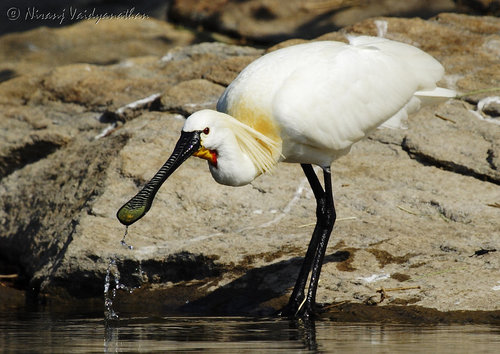
About Platalea leucorodia Linnaeus, 1758
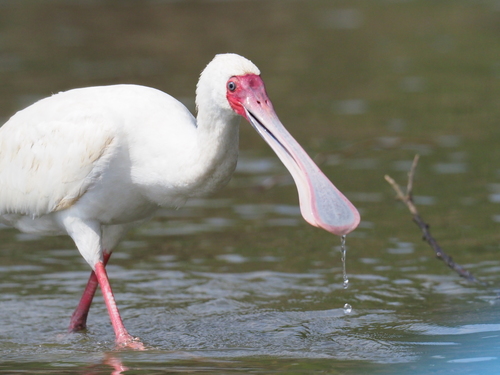
Platalea leucorodia Linnaeus, 1758, commonly known as the Eurasian spoonbill, is a bird species that is almost unmistakable across most of its range. Breeding adults are entirely white apart from dark legs, a black bill with a yellow tip, and a yellow breast patch similar to that of a pelican, and they develop a crest during the breeding season. Non-breeding adults have neither the crest nor the yellow breast patch. Immature birds have a pale bill and black tips on their primary flight feathers. Unlike herons, spoonbills fly with their necks fully outstretched. The Eurasian spoonbill can be distinguished from the African spoonbill, which overlaps with it in winter range: African spoonbills have red faces and legs, and lack a crest. Eurasian spoonbills are mostly silent. Even at breeding colonies, the primary sounds they produce are bill snapping, with occasional deep grunting and occasional trumpeting calls. This species has a wide distribution across Europe, Asia, and Africa. In Europe, it breeds from the United Kingdom and Portugal in the west, occurring locally across the continent, ranging north to Denmark and east to the Balkans and the Black Sea. In Asia, it breeds across a broad band through the center of the continent, from the Black Sea to the Korean Peninsula, and also in Kuwait, southern Iraq, Iran, southern Pakistan, India, and Sri Lanka. In Africa, it breeds locally in coastal Mauritania, and more widely along the coasts of the Red Sea and Gulf of Aden. Populations breeding in warmer parts of Asia, Africa, and the Iberian Peninsula are resident or only make local movements, while more northern breeding populations generally migrate south to winter in southwestern Europe, the northern half of Africa, or warm parts of Asia. Some northern birds do stay in their general breeding region over winter, including in the United Kingdom, the Low Countries, and France. Outside of its typical range, it has been recorded as a rare vagrant in Ireland, Belarus, Brazil, Trinidad and Tobago, the Canary Islands, Greenland, Nigeria, Uganda, Guadeloupe, Martinique, Barbados, and Saint Lucia. Eurasian spoonbills prefer large, shallow wetlands with muddy clay or fine sandy beds. They can live in any type of marsh, river, lake, floodplain, or mangrove swamp, regardless of whether the water is fresh, brackish, or saline. They are particularly attracted to sites with undisturbed islands for nesting, and habitats with dense riparian-emergent vegetation such as reedbeds, plus scattered trees or shrubs, especially willow (Salix spp.), oak (Quercus spp.), or poplar (Populus spp.). In winter, Eurasian spoonbills also often use sheltered marine habitats including deltas, estuaries, tidal creeks, and coastal lagoons. The Eurasian spoonbill's diet includes aquatic insects, mollusks, newts, crustaceans, worms, leeches, frogs, tadpoles, and small fish up to 10–15 cm (3.9–5.9 in) long. They may also consume algae or small fragments of aquatic plants, though these are possibly eaten accidentally alongside animal prey. They catch tiny fish and shrimp by sweeping their beak sideways through water to filter out prey.