About Platalea ajaja Linnaeus, 1758
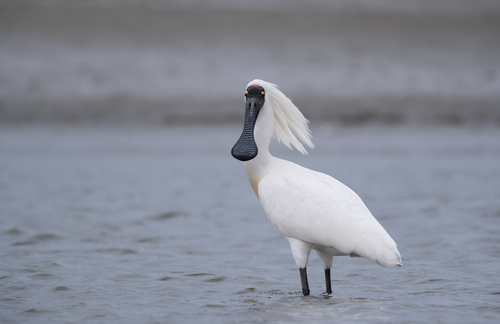
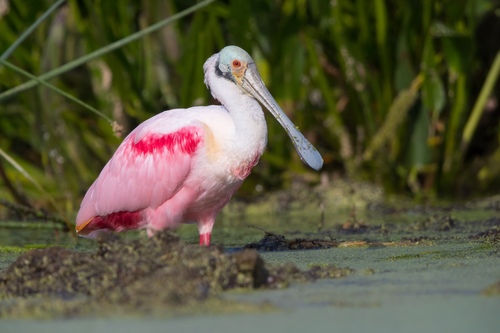
Platalea ajaja, commonly called the roseate spoonbill, measures 71–86 cm (28–34 in) in total length, has a 120–133 cm (47–52 in) wingspan, and weighs 1.2–1.8 kg (2.6–4.0 lb). Detailed body measurements are: tarsus 9.7–12.4 cm (3.8–4.9 in), culmen 14.5–18 cm (5.7–7.1 in), and wing 32.3–37.5 cm (12.7–14.8 in). These measurements give the species elongated legs, neck, and characteristic spatulate spoon-shaped bill. Adult roseate spoonbills have a bare greenish head that turns golden buff during breeding. They have a white neck, back, and breast, with a tuft of pink feathers in the center of the breast when breeding. The rest of their body is deep pink, and their bill is grey. There is no significant sexual dimorphism between males and females. Like the American flamingo, the pink color of roseate spoonbills comes from their diet: it comes from the carotenoid pigment canthaxanthin. A second carotenoid, astaxanthin, is also deposited in the species’ body and flight feathers. Overall feather color can range from pale pink to bright magenta, varying by age, breeding status, and location. Unlike herons, roseate spoonbills fly with their necks fully outstretched. They alternate between periods of stiff, shallow wingbeats and gliding flight.
In the United States, this species is locally common in Texas, Florida, and southwest Louisiana. Its general distribution includes most of South America east of the Andes, plus coastal regions of the Caribbean, Central America, Mexico, and the U.S. Gulf Coast. Its range along the U.S. Atlantic coast extends from central Florida’s Merritt Island National Wildlife Refuge (adjacent to NASA Kennedy Space Center) north at least to Myrtle Beach, South Carolina.
Plume hunting in the eighteenth and nineteenth centuries almost drove the roseate spoonbill to extinction. After decades of conservation efforts and alongside the effects of climate change, the species’ range has expanded considerably in the 21st century. The first recorded breeding of roseate spoonbills in the U.S. state of Georgia occurred in 2011. The species’ presence in South Carolina has expanded significantly since the 1970s. Single individuals have also been sighted in both Michigan and Wisconsin. The last prior recorded record of the species in Wisconsin was a deceased specimen collected in Rock County in 1845; the species made an historic reappearance 178 years later, when an individual was sighted on July 27, 2023 by a bird survey crew on the restricted-access Cat Island Causeway. In the summer of 2021, sightings were reported far outside the species’ typical range, including in Washington, D.C., upstate New York, and New Hampshire. A large flock was spotted at Huntley Meadows Park in Fairfax County, Virginia, which drew a large crowd of spectators. Roseate spoonbills have also been spotted in New Jersey with increasing frequency.
In Florida Bay, roseate spoonbills serve as an ecological and scientific indicator species. Their number of nests varies with both the volume of fresh water and seawater depth in the area, as local wetlands transition into open ocean. Between 2006 and 2020, researchers recorded sharp changes in the species’ nesting locations in Florida: roseate spoonbills have shifted to nest further north and further inland in the state.