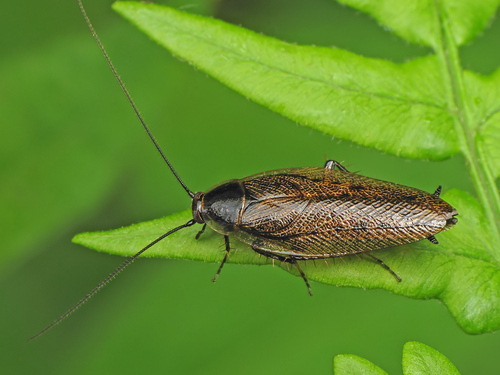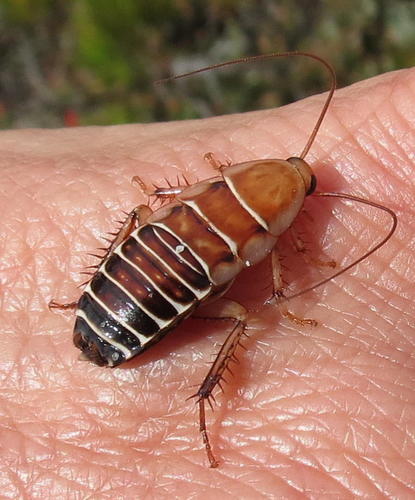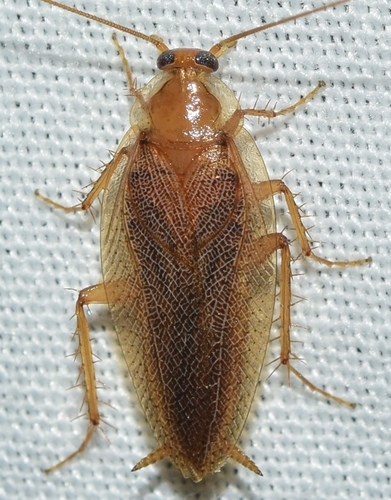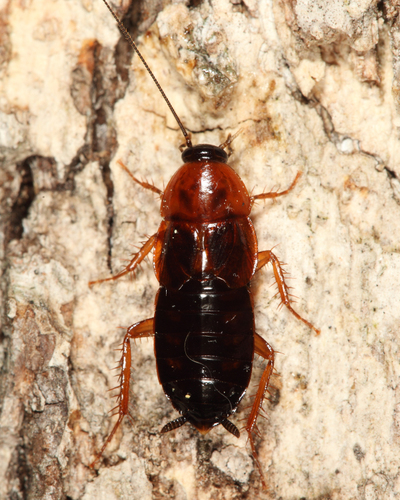
About Planuncus tingitanus (Bolívar, 1914)
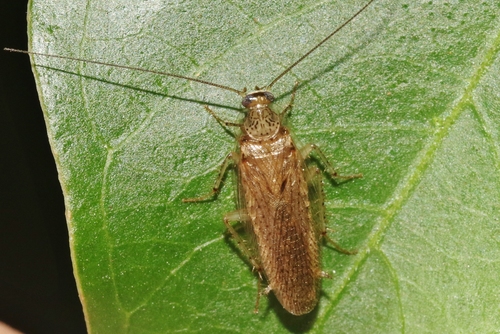
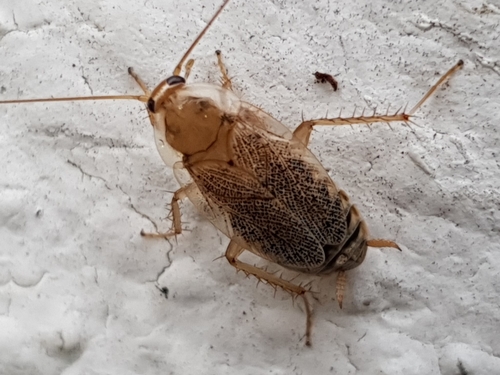
Planuncus tingitanus sensu lato (s.l.) is a designation used to refer to any species within the Planuncus tingitanus species group, which belongs to the cockroach genus Planuncus in the subfamily Ectobiinae, order Blattodea. Because the exact taxonomic status of some species in this group cannot be confirmed without additional research, the entire species complex is referred to using the name of the oldest species in the group in the sensu lato sense, which gives rise to the 's.l.' abbreviation. In this context, Planuncus tingitanus s.l. refers to an adventive cockroach, or possibly a complex of cryptic species, that dramatically expanded its range into southern parts of Northwestern Europe over a very short period of time during the first decades of the 21st century. In Britain, it is commonly called the variable cockroach, named for the variability of its abdominal markings.
Records show that members of this species or species group were already present in Spain and southern France by at least the 1980s and 1990s. Starting no later than 2005, they began rapidly expanding northward: the first records from Germany date to 2007, while the first records from Great Britain and Belgium date to 2011 and 2012, respectively. Cockroach researcher Horst Bohn and colleagues had already monitored this expansion, but no findings had been published at first due to uncertainty about the exact identification. This uncertainty stemmed partly from a lack of recent genetic material from the type locations of the previously described species Ectobius tingitanus and Ectobius finoti. By this time, the cockroaches had become common enough to be hard to miss in France, and many specimens were misidentified as Ectobius eckerleini or other species, before being formally published as the new species Ectobius vinzi Maurel, 2012. When describing Ectobius vinzi, Maurel only considered known European species, and did not account for the very close match, or even potential identity, with North African species in the group. This prompted Bohn et al. to publish the preliminary results of their existing work as-is, without conclusive molecular evidence to confirm the taxonomic status of the species concerned. This publication nonetheless established the new genus Planuncus Bohn, 2013. Specimens collected from different locations across the newly expanded range sometimes show slight morphological differences, but these differences are not necessarily greater than what counts as normal individual variability. Given the sudden, notable range expansion, a current ongoing speciation process has been suggested as a possibility.
Similar to Ectobius vittiventris, another Ectobiinae species that is rapidly expanding its range northward in Europe, Planuncus tingitanus s.l. appears to be more or less dependent on human activity for both range expansion and survival. As a southern-origin group, it thrives best in the relatively warm, sheltered environments provided by buildings, urban parks, and urban gardens. For this reason, it lives much closer to humans than is typical for native Ectobiinae species, and can easily be found on the exterior walls of buildings, and may occasionally stray indoors. Unlike similar-looking cockroaches such as the German cockroach, it is unlikely to reproduce indoors, and thus does not need to be considered a household pest.