About Plantago asiatica L.
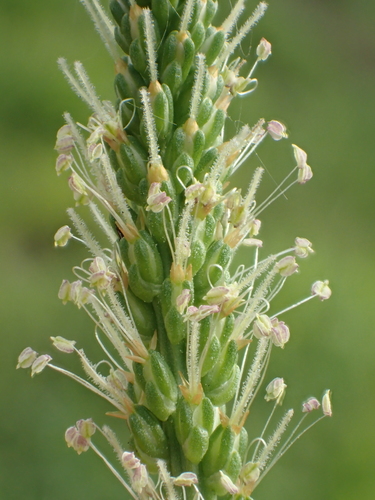
Plantago asiatica L. is a perennial herb that grows 20–60 cm (8–24 in) tall. It has a short, thick rootstock with numerous fibrous, fasciculate roots. Its short stems produce a rosette of leaves that range from broadly ovate to broadly elliptic. The leaf blades are thin or very thin and papery, measuring 4–12 cm (2–5 in) long and 2.5–6.5 cm (1–3 in) wide. They are sparsely pubescent, have three to seven veins, an obtuse to acute apex, a broadly cuneate to surrounded base that is decurrent to the petiole, and margins that are entire, repand, serrate or dentate. Petioles are 3–10 cm (1–4 in) long and sparsely pubescent. The plant produces erect spikes that grow 20–45 cm (8–18 in) high, holding many small, white, hairless flowers. Flowers have oval sepals 1.8–2 mm (0.07–0.08 in) long, a tubular corolla with five oval lobes, and four stamens. The fruits are oval-shaped pyxides 3.5 mm (0.1 in) high and 2 mm (0.08 in) wide, containing four black seeds up to 1.8 mm (0.07 in) long. It can act as a weed in uplands, fields and gardens, and it can host aphids and red spiders. Its blooming period runs from April to August, and its fruiting period runs from June to September. This species grows in a wide range of habitats including mountain slopes, ravines, riverbanks, fields, roadsides, wastelands, and lawns across many regions. It is a hardy plant that can grow in all USDA zones. It tolerates full sun or part shade, and adapts to well-drained sandy, loamy, and clay soils. It grows well in acid, neutral, and basic (alkaline) soils. Traditionally, Plantago asiatica has been used to treat liver disease, stomach problems, and urinary system inflammation. In traditional Chinese medicine, all parts of the plant are considered medicinal, used to clear heat, promote urination and diuresis, clear damp-heat, brighten the eyes, and dislodge phlegm. Its leaves and seeds have documented anti-inflammatory, antiseptic, antitussive, cardiac, diuretic, expectorant, and haemostatic effects. A decoction made from its roots is used to treat coughs. Scientific studies have found that petroleum extract of Plantago asiatica has a significant antidepressant effect, while hot water extracts of P. major and P. asiatica have anti-leukaemia, anti-cancer, and anti-viral activities, as well as activity that regulates cell-mediated immunity. Seed gel extract acts as a lubricant to promote human laxation, and Plantago asiatica L. seed extract (PSE) may act as a potential dietary supplement to help treat or prevent obesity and its related symptoms. Plantaginis Semen significantly inhibits the activity of Xanthine oxidase (XOD), so it can be used to reduce hyperuricemia and treat gout. Plantamajoside, a compound isolated from Plantago asiatica, has antioxidant and anti-glycation effects, so it is used in research on natural herbal supplements to prevent diabetic complications. Pregnant people should avoid using this medicinal plant, as it may cause uterine activity and laxation. Patients should not take lithium or carbamazepine at the same time as plantain. Known side effects of Plantago asiatica include anaphylaxis, chest congestion, sneezing, watery eyes, occupational asthma, and gastric concretion. For culinary use, Plantago asiatica is suitable for cooking with grains and stews, and can be added to herbal wines. Its leaves are used in many Japanese dishes, especially soups. In Vietnam, the young leaves are boiled, fried, or made into soup with meat or prawns. It can also be fried with salt, or boiled with Yin Chen (Artemisia capillaris herba) to make Yin Chen Tea.