About Planorbarius corneus (Linnaeus, 1758)
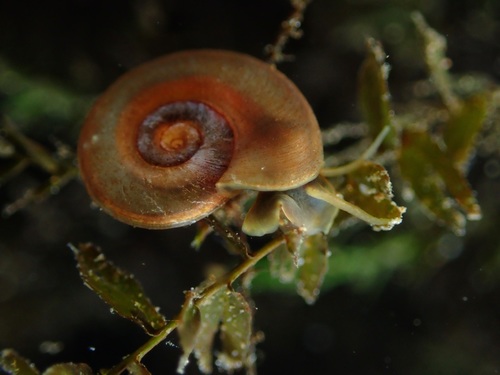
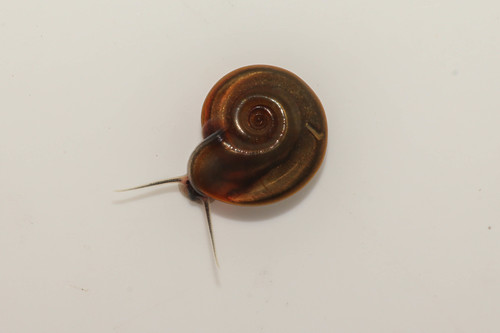
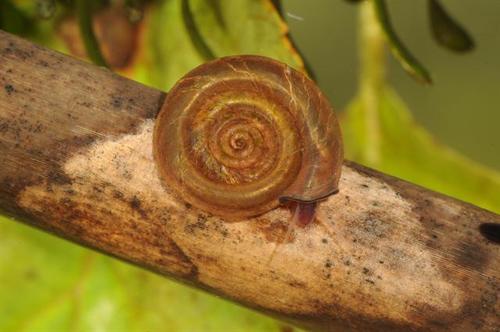
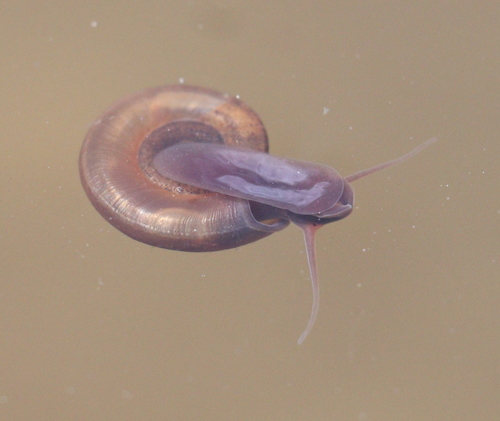
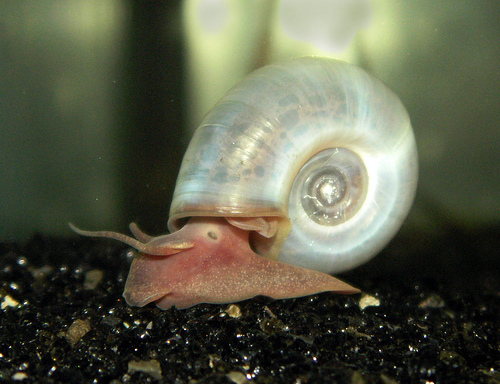
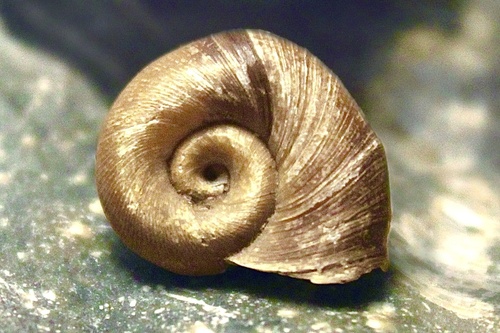
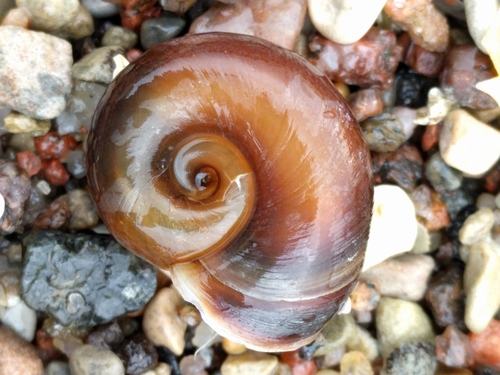
Planorbarius corneus (Linnaeus, 1758) is the largest European species of ramshorn snail, a member of the family Planorbidae. When fully grown, its shell typically measures 35 mm (1.4 in) in diameter and 12 mm (0.47 in) in width. The shell is usually reddish-brown or olive, though albino variants can be lighter; it is somewhat reflective with visible growth lines, and juvenile snails have hairs along the shell surface. The shell has between 5 and 5.5 whorls (shell revolutions). Each whorl is round, with no observable keel. Each successive whorl increases in size, leaving the shell's center (the umbilicus) sunken, and the sutures between whorls are deep. The shell opening, called the aperture, is kidney-shaped. An alternative description notes the coiled shell measures 10–17 by 22–40 millimetres (0.39–0.67 by 0.87–1.57 in), has between 3 and 4.5 rounded whorls with deep sutures, with the last whorl being the largest. The upper side of the shell is weakly depressed, and the lower side is deeply depressed (the underside is flattened, while the spire is recessed on the upper side), with no keel. The shell is light yellowish with a brown, reddish or greenish outer periostracum layer, with weak radial and spiral striations. The aperture is wide and almost circular. All species in the family Planorbidae have sinistral shells. The snail's skin can be brown or black, but albino variants may appear red or white. A protrusible siphon is located near the front edge of the shell, connected to the chamber that holds the snail's lungs. Planorbarius corneus is distributed from western Europe, through central Europe, into the Caucasus, north to Siberia, and south to the Middle East. Because it is commonly sold in the aquarium trade, it can also be found outside its native range in ponds where it has been introduced. It is very common in central Europe and the Balkans, where recorded densities reach up to 40 individuals per square meter, and it is less common in southwestern Europe. In western Europe, it has been recorded in Belgium, France and the British Isles (including Britain, Ireland, the Isle of Man, Guernsey and Jersey); it is not found in mainland Spain, but has been recorded on some Spanish and Portuguese islands, including Madeira, the Azores, and the Canary Islands. In the Nordic countries, it has been recorded in Denmark, Finland, Sweden and Norway. In central Europe, it is found in Austria, Germany, the Netherlands, Luxembourg, Liechtenstein, Switzerland and the Czech Republic. In southern Europe, it has been recorded in Greece and Italy. In eastern Europe and the Caucasus, its range includes Albania, Armenia, Azerbaijan, Bosnia and Herzegovina, Bulgaria, Croatia, Estonia, Hungary, Latvia, Lithuania, North Macedonia, Montenegro, Poland, Romania, Serbia, Slovakia, Slovenia and Ukraine. It is also found in western Asia, with records from Kazakhstan, Iran, western regions of Russia, Turkey, Turkmenistan and Uzbekistan. This snail lives in freshwater ponds, rivers, and canals, where it clings to vegetation. It prefers slow-moving, highly vegetated water with high dissolved mineral content, and can sometimes live in poorly oxygenated water. It is thought to stay close to shallow water, similarly to Peregriana peregra, because emergent plants growing there provide access to the water surface for oxygen. It has two methods of respiration: in well-oxygenated water, it can breathe through simple diffusion of oxygen across its skin, while in poorly oxygenated water it extends its siphon above the water surface to fill its lungs. Its blood contains hemoglobin, a protein that acts as an oxygen transporter in low-oxygen environments. Studies have been conducted on the responses of P. corneus to high temperatures by Kartavykh & Podkovkin (2002). This species is a generalist feeder; its diet depends on what food is available and how hungry the individual is. It has been observed eating the egg capsules of Anisus vortex, though this feeding may have been incidental. Like most freshwater pulmonates, Planorbarius corneus is thought to follow a yearly reproduction cycle. A 1963 study in southern England found eggs hatching in May, with the reproductive period ending before June. The snail can live longer than one year, with reports of captive individuals living up to 6 years. In one experiment, this species laid pinkish egg masses on aquatic plants such as Elodea and Ceratophyllum, as well as on the glass walls of aquariums. The egg masses were cylindrical or oval, with an average size of 12 by 8 mm (0.47 by 0.31 in). Each egg mass contained between 12 and 49 light yellow eggs, though one account notes this number can reach up to 60. The first eggs began hatching 31 to 65 days after being laid, and not all embryos hatched at once; the final embryos emerged 9 to 21 days after the first hatching. The experimenter concluded these observations are likely consistent for both captive and wild specimens. Other observations note reproduction occurs in spring and autumn when water temperatures are above 15 °C. Individual eggs are 1.2-1.7 mm in diameter, and are laid in mostly elongate capsules 8–15 mm wide, with each capsule holding 12 to 40 eggs. Egg masses are attached to aquatic plants; embryos are reddish with transparent shells, and juveniles hatch after 14–16 days. The maximum recorded lifespan under this observation is up to 3 years. Self-fertilization is possible: a single released individual can establish a stable population, but only 5% of juveniles from self-fertilized eggs hatch.