About Planes minutus (Linnaeus, 1758)
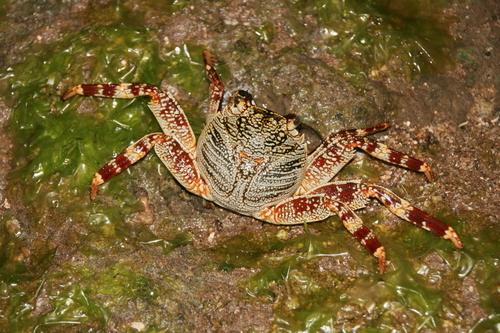
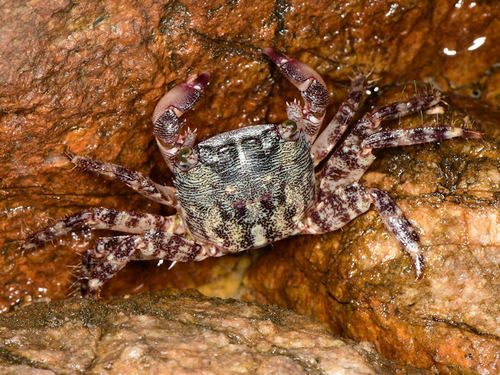
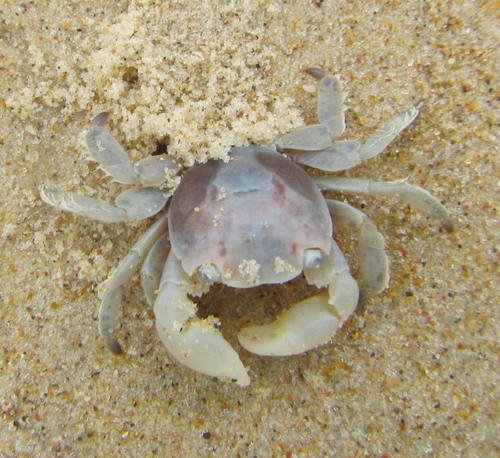
Planes minutus (Linnaeus, 1758) is a small crab, reaching a maximum carapace length of 17.5 millimetres (0.7 in), and most individuals are typically less than 10 mm (0.4 in). It has conspicuous eyes set in wide orbits at the corners of the wide front edge of its carapace. The first pair of its pereiopods, or walking legs, bears a symmetrical pair of chelae that have cutting teeth; the other four pairs of legs have spines on the last two segments of each leg. It can be distinguished from the larger species P. major by the shape of the male abdomen: in P. minutus, the male abdomen is broadly triangular, rather than narrowing abruptly after the third segment as it is in P. major. It differs from P. marinus by having flattened legs with a fringe of setae that help it swim. The colouration of Planes minutus is highly variable, and acts as camouflage against the Sargassum weed that the crab often lives on. Its base colour is typically brown, and sometimes shifts toward yellow or red. This base colour is often marked with large white patches, which appear to mimic the calcareous tubes that annelid worms attach to Sargassum. Although the crab's colour pattern usually matches the substrate it is found on, it can only change colour slowly after moving to a new substrate. Planes minutus is distributed across the North Atlantic Ocean, between 11° N and 32° N latitude. It is also found off the west coast of Africa, in the Mediterranean, and in the Indian Ocean. Occasionally, individuals have been recorded on the Cornish coast; the first published record was from Falmouth in 1845 by William Pennington Cocks. Additional specimens have been recorded at Falmouth in 1848, on the Manacles in 1899, and most recently in 2015. Related species, including Planes major (formerly P. cyaneus) and Planes marinus, live in other regions of the world's oceans. Planes minutus is exclusively pelagic, and inhabits a wide range of substrates, including Sargassum weed, floating timber, and ship hulls. It is often found associated with turtles, especially the loggerhead sea turtle, Caretta caretta. It was once thought that the crabs fed on the turtle's faeces, but they are now believed to perform a cleaning role for the turtles. They have also been found in rock crevices in the lower intertidal zone of Dhamlej coast, Gujarat, India. Although Planes minutus is a proficient swimmer, it has low endurance: at 28 °C (82 °F), it can only swim for less than 45 minutes before sinking. It uses all of its legs while swimming: the first two pairs hold the crab up in the water, and the remaining legs propel it forward. The legs may begin beating before the crab releases itself from its resting spot, allowing it to accelerate more quickly. The crab usually only attacks passing animals that come within 5 cm (2 in) of its substrate. The diet of P. minutus is very varied, and includes small fish, krill, isopods, sea skaters, and squid. The crab may store food items to eat later.