About Planchonella eerwah (F.M.Bailey) P.Royen
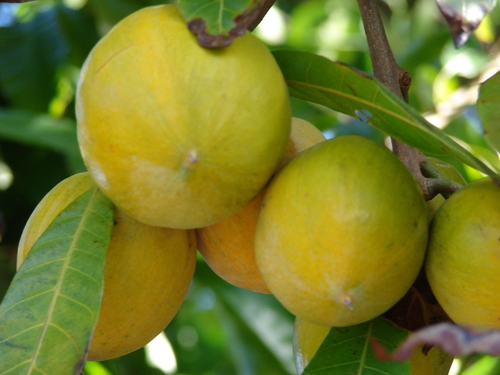
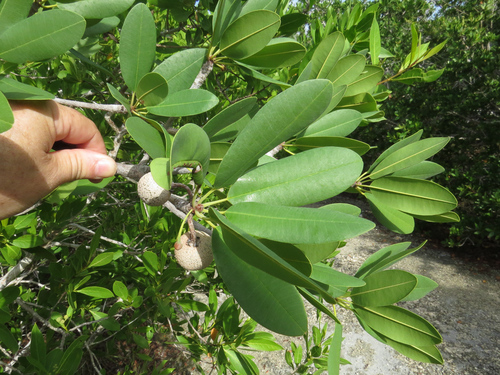
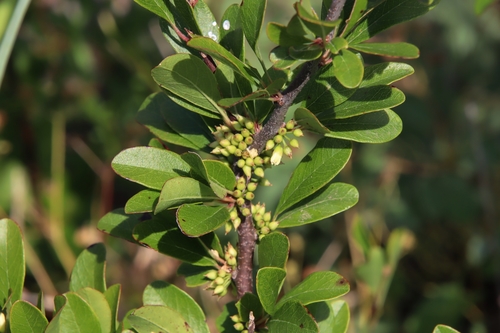
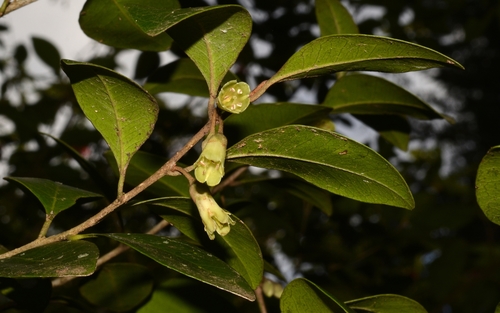
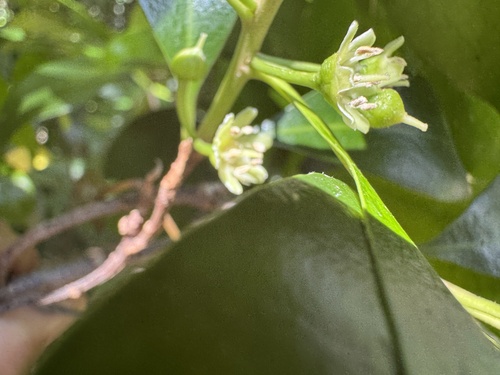
Planchonella eerwah, a member of the Sapotaceae plant family, is a rare Australian rainforest tree. Its common names are shiny-leaved condoo, black plum, and wild apple. This species is endemic to southeastern Queensland, has a restricted distribution, and is classified as endangered. It was first formally described as Sideroxylon eerwah in 1894 by Frederick Manson Bailey, and later reclassified into its current accepted binomial name Planchonella eerwah (F.M.Bailey) P.Royen. The specific epithet eerwah comes from Mount Eerwah, located near Eumundi in Queensland. Genetic analysis of plant material has shown that Planchonella eerwah is most closely related to Planchonella cotinifolia, with Planchonella australis as the sister species to these two; all three together form a distinct evolutionary group. Planchonella eerwah grows as a tall shrub or small tree, reaching heights of 4 to 10 metres (13 to 33 ft), and has scaly bark on its trunk. Its leathery leaves have prominent raised veins, and measure 4–14 cm (1.5–5.5 in) in length. Flowers and fruit can appear on this species in any season. The flowers are cream-green, hairy, and around 4 mm long. The fruit is dark red-purple to black, ranges in shape from oval to globular, and measures 3–6 cm (1–2.5 in) in length, containing three to five seeds per fruit. The species is only found in three separate locations in southeastern Queensland, where it grows on rocky slopes in vine thickets and rainforest. In southern populations, dominant associated tree and shrub species include Araucaria cunninghamii (hoop pine), Harpullia pendula, and species in the genus Flindersia. In northern populations, dominant associated species include Argyrodendron species, Atalaya multiflora, Choricarpia subargentea, Excoecaria dallachyana, and Flindersia australis. Key threats to the species include habitat encroachment by invasive weeds: widespread lantana (Lantana camara), and on the Sunshine Coast additional invasive weeds include glycine (Neonotonia wightii), corky passionflower (Passiflora suberosa), and umbrella tree (Heptapleurum actinophyllum). Feral pigs also consume the species' fruit and seeds, reducing recruitment.