About Plagusia squamosa (Herbst, 1790)
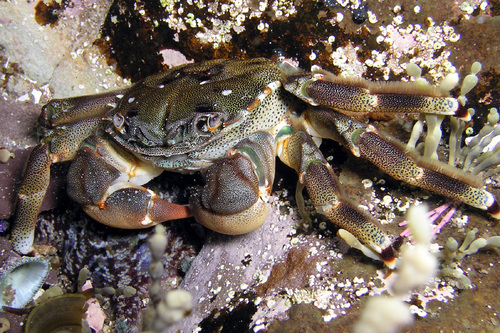
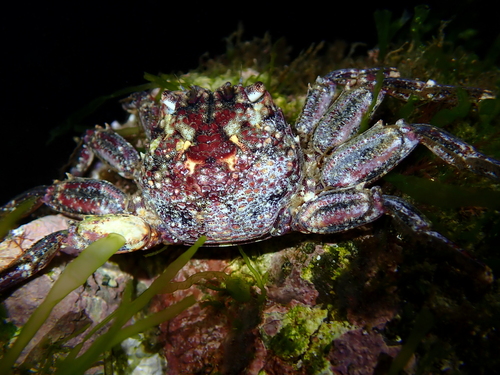
Both morphological traits and mitochondrial DNA distinguish Plagusia squamosa, the scaly rock crab, from its closely related crab species. This species is sometimes confused with the Sally-Light-Foot crab (Gapsus albolineatus). One morphological difference appears as early as the first zoeal developmental stage. A distinct shape of the labrum is present on the coaxial joints of its walking legs. Adult scaly rock crabs have a body width of 5 to 6 centimeters across. Their oval body is convex and covered in small bumps that form the distinctive "scales" that give the species its name. Its pincers are typically short and slender, while its walking legs are long, fringed with short hairs, and end in pointed claws. Mitochondrial DNA analysis confirms clear genetic separation between P. squamosa and its close relatives. The species displays a varied mix of colors, including shades of brown, blue, purple, and orange. P. squamosa’s diet consists mostly of plant material, with some small amphipods also consumed. It inhabits intertidal and oceanic zones across the Pacific region, and is restricted to Indo-Pacific waters. Though it is referred to as a rafting crab, the scaly rock crab is normally found on rocky shores when it is not rafting on open water organisms or objects.