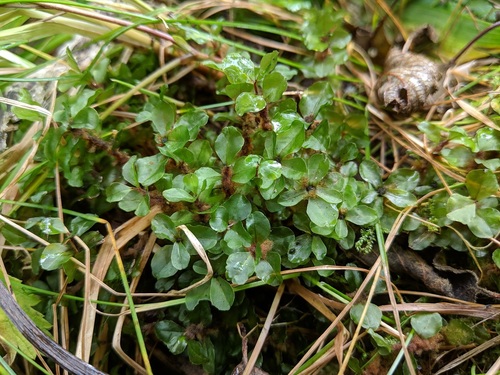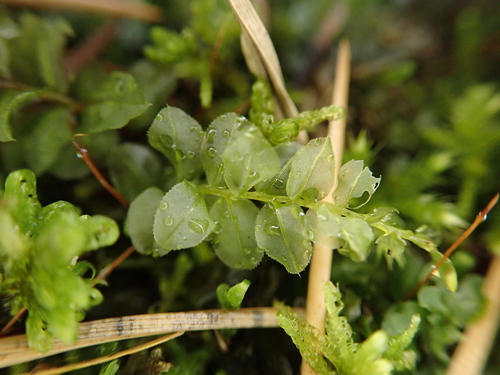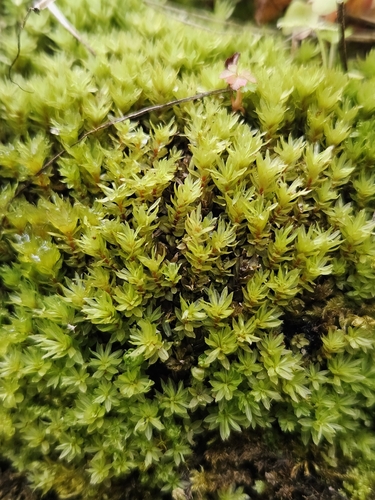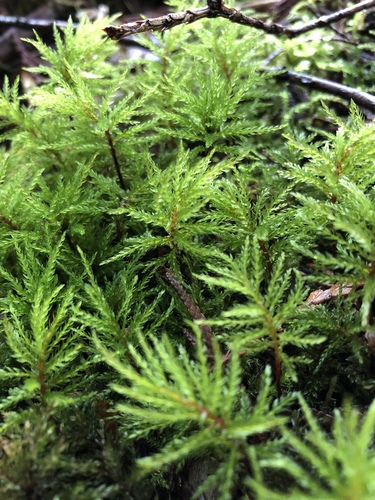
About Plagiomnium cuspidatum (Hedw.) T.J.Kop.
Plagiomnium cuspidatum (Hedw.) T.J.Kop., also called toothed plagiomnium moss, "baby-tooth" plagiomnium moss, and woodsy thyme-moss, is a species of thyme-moss. It originated in North America, and can now also be found across Middle America, Africa, Europe, and Northern and Southern Asia (excluding China). It is widely distributed across North America and Europe, but less common in Africa and Eastern Asia. Within North America, it grows predominantly in the continent's warmer, humid areas, though it can also survive in cooler climates. This species is capable of growing using artificial light in locations that lack natural light, such as Crystal Cave in Wisconsin. It commonly grows at the base of trees, on stumps, coarse woody debris, and rocks, in base-rich habitats: these include wet meadows, forested rich peatlands, wet forests, fire-dependent woodlands, mesic hardwood forests, and cliff/talus, at low to moderate elevations. In the wild, songbirds use this moss as nesting material, specifically to line the inner part of their nests. Four-toed salamanders (Hemidactylium scutatum) also use it during nesting to keep their eggs from moving; salamanders attach their eggs to the moss's rhizomes located at the base of the plant, which helps stabilize the eggs. Humans use it as planting material for bioactive terrariums, aquariums, and paludariums, because it has antimicrobial and antifungal properties. It is well-suited for this hobby because it also retains high humidity and grows in mats or carpets that provide good cover for a tank's clean-up crew. It is known to produce substances that inhibit bacteria and fungi, and these properties are currently being researched for additional medicinal uses. Because these inhibitory substances are unstable, they have not yet been used in the medical field, though they have drawn attention for their potential applications. The instability of these substances comes from the fact that they are produced when the moss is under stress, and different populations produce different varieties of substances. P. cuspidatum has shown resistance to methicillin-resistant Staphylococcus aureus (MRSA). Studied extracts of P. cuspidatum have demonstrated promising antiproliferative activity against certain cancer cell lines, achieving 50% or more inhibition when tested on cervical, ovarian, and breast cancer cell lines. The flavonoid extracts of P. cuspidatum are a topic of research interest. Flavonoids are polyphenolic secondary metabolites commonly consumed as part of human diets. Three major flavonoids found in P. cuspidatum are saponarine, luteolin, and apigenin-7-O-neohesperidoside.