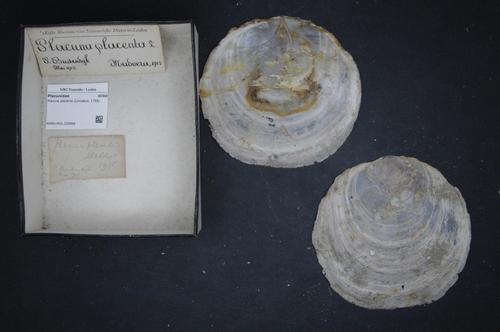
About Placuna placenta (Linnaeus, 1758)
Placuna placenta, commonly called the windowpane oyster, window shell, or jingle shell, is a species of bivalve marine mollusk in the family Placunidae. This species is edible, but it is most valued for its shell and the small pearls it produces. For thousands of years, the durable, translucent shells of this oyster have been used as a substitute for glass. More recently, they have been used to make decorative items like chandeliers and lampshades. In this manufacturing use, the shell is called capiz shell or kapis. Capiz shells are also used as raw materials for producing glue, chalk, and varnish. This species is distributed across a range stretching from the shallow waters of the Gulf of Aden, through the Philippines (including the province of Capiz, which shares the shell's common name), north to Taiwan, and south to Queensland, Australia. These mollusks live on muddy or sandy shores, within bays, coves, and lagoons, at depths up to around 100 meters (330 feet). Populations of Placuna placenta have declined in recent years due to destructive fishing and gathering practices, including trawling, dredging, blast fishing, and surface-supplied diving. In the Philippines, fisheries for this species are now regulated through permits, harvest quotas, minimum size limits, and protected habitats. Despite these regulations, the species' populations continue to be depleted. The nearly flat shells of capiz can grow up to 180 millimeters (7.1 inches) in diameter, and individuals reach maturity when their shells measure between 70 and 100 millimeters (2.8 and 3.9 inches) in diameter. The shell is held in place by a V-shaped ligament. Males and females can be told apart by the different color of their gonads. Fertilization is external. Larvae are free-swimming planktonic organisms for 14 days, then attach to surfaces via a byssal thread during metamorphosis, before eventually settling on the seabed. Placuna placenta feeds on plankton, which it filters from water that passes through its slightly open shell. When the bivalve is exposed above water during low tide, it closes its shell.

