About Placopecten magellanicus (Gmelin, 1791)
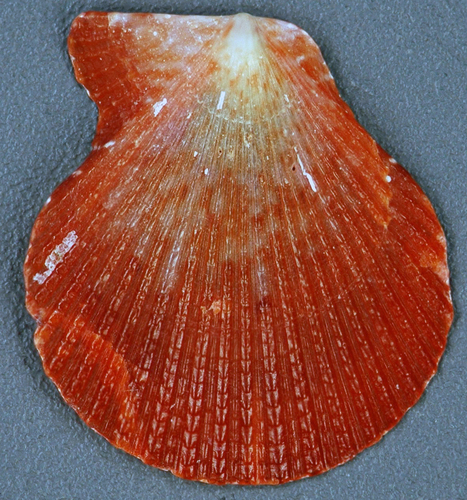
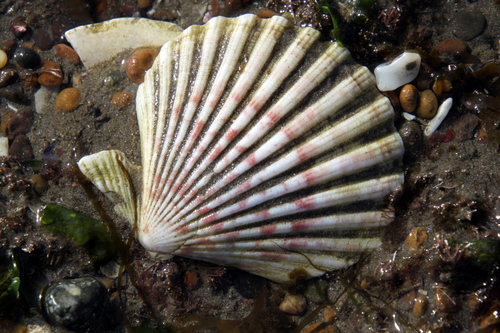
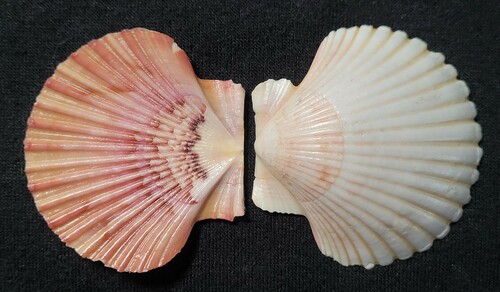
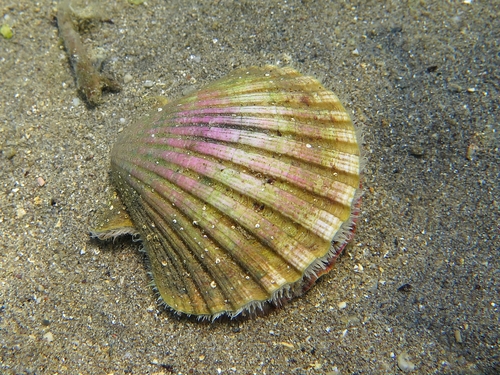
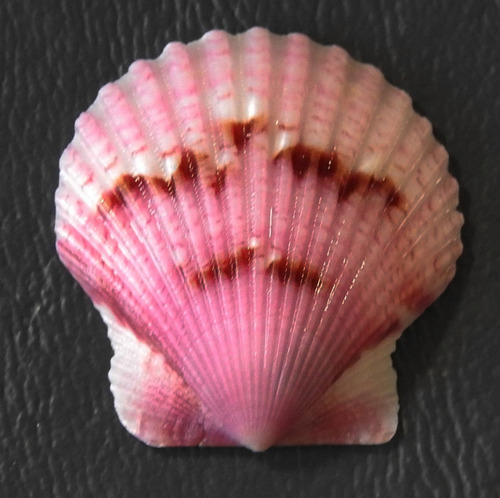
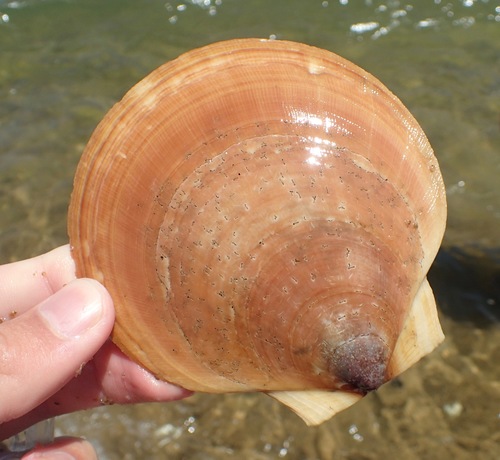
This species, scientifically named Placopecten magellanicus (Gmelin, 1791), commonly known as the sea scallop, has a classic scallop-shaped shell with a smooth surface and smooth edges. This sets it apart from Pecten maximus — the great or king scallop — which has ridged flutes along its shell and scalloped edges. Most individuals have a shell diameter of around 80 millimeters (3+1⁄4 inches), though the species can grow as large as 170 millimeters (6+3⁄4 inches) across. The shell is generally pinkish-red, and many individuals have striped, variegated patterning that darkens to deeper shades. The large adductor muscle of this species typically measures 30–40 millimeters (1+1⁄4–1+1⁄2 inches) in diameter. Like all scallop species, P. magellanicus has light-sensitive photoreceptive eyes along the edge of its pinkish mantle. P. magellanicus occurs on the continental shelf of the northwest Atlantic Ocean, ranging from the north shore of the Gulf of St. Lawrence south to Cape Hatteras, North Carolina. Sea scallops most commonly live at depths between 18 and 110 meters. Shallow-water populations as deep as only 2 meters can be found in estuaries and embayments along the Maine coast and in Canada. In the southern portion of its range, this scallop is primarily found at depths of 45 to 75 meters, and is less common in shallower 25–45 meter waters due to high water temperatures. While sea scallops are not commonly found deeper than 110 meters, some populations have been recorded at depths as great as 384 meters. Deep-water populations at 170–180 meters have been specifically reported in the Gulf of Maine. Sea scallops typically gather in groups called beds. These beds can be short-lived and sporadic, persisting for only a few years, or effectively permanent; the commercial beds that support the Georges Bank fishery are an example of permanent beds. The highest concentrations of permanent beds generally align with areas that have suitable temperatures, sufficient food availability, appropriate substrate, and physical oceanographic features such as fronts and gyres that retain larval scallops near the spawning population. Adult sea scallops are most often found on firm substrates including sand, gravel, shell fragments, and rock. A wide range of other invertebrate species are commonly associated with sea scallop beds, including sponges, hydroids, anemones, bryozoans, polychaetes, mussels, moon snails, whelks, amphipods, crabs, lobsters, sea stars, sea cucumbers, and tunicates.