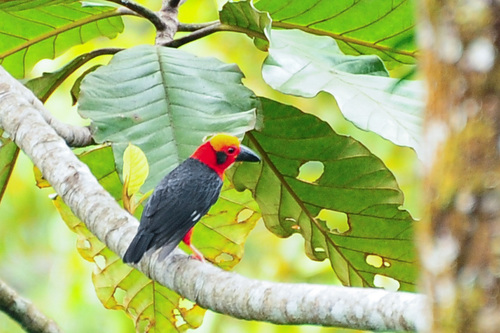
About Pityriasis gymnocephala (Temminck, 1836)
The Bornean bristlehead, scientific name Pityriasis gymnocephala (Temminck, 1836), is a medium-sized bird approximately 25 cm (9.8 in) long. Its body is mostly black, with bright red coloring on the thighs, head, throat, and neck, plus grey ear-coverts. Its featherless crown is deep yellow, and covered in short, 3–4 mm long bristle-like skin projections that give the bird a bald appearance when viewed from a distance. This unique feature gives the species its common name "bristlehead"; its genus name Pityriasis comes from Greek meaning "having dandruff", and its specific name gymnocephala comes from Greek meaning "bald-headed". All females and some males have red patches on their flanks, though these patches can be covered by the wings when the bird is perched. A white wing-patch is located at the base of the primaries, and is visible when the bird is in flight. It has a large, heavy, black hooked bill and a short tail, which gives it an overall chunky body shape. Juvenile birds have entirely or mostly black thighs, a more orange-red head and neck, orange-red ear-coverts, some red mottling on the underparts, a small number of red feathers on the crown, and undeveloped bristle-like projections. This is a noisy bird that produces a range of unmusical calls. Its calls include distinctive high-pitched nasal whining notes, interspersed with harsher notes, plus chattering, whistles, honks, and chortles. The Bornean bristlehead is endemic to the island of Borneo. It is widespread across the island, but generally sparse and patchy in its distribution, though it can be locally common in some areas. It mainly occurs in lowland areas, but can also be found in hilly regions up to 1,200 m (3,900 ft) above mean sea level. It lives in the canopy of both primary and secondary forests, including peat swamp forests, mixed dipterocarp forests, and mangrove forests.

