About Pityopsis graminifolia (Michx.) Nutt.
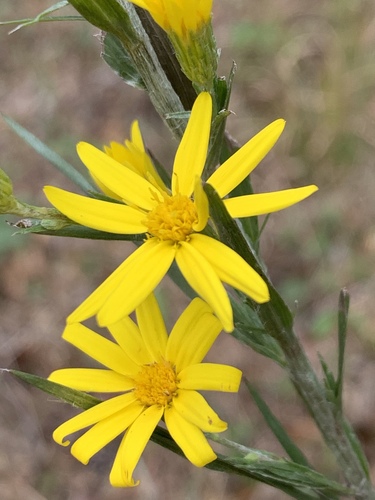
Pityopsis graminifolia (Michx.) Nutt. has several common names: narrowleaf silkgrass, silver-leaved aster, grass-leaved goldenaster, and silky golden-aster. Many of these common names mention grass, because this species is easily mistaken for grass. Its leaves are most often basal, measuring 10 to 35 cm (3.9 to 13.8 in) long and 3 to 10 millimeters wide. Each individual plant grows 1 to 5 stems that reach 20–80 cm in length, and these stems are covered in short, alternately arranged stem leaves. The silvery hairs that cover the plant’s stems give it the "silky" element of its common names, and this is a defining trait of the species. It produces yellow composite flower heads around 2.5 cm wide that contain both ray and disk florets. After flowering, it develops pappi, a common trait of the Asteraceae family. These pappi are attached to small dry fruits that hold a mature seed, and their hair-like structures act as a parachute to carry seeds away via wind. Pappi of this species have two distinct series of bristles: the inner series has barbed bristles 5-9mm long, while the outer series has much shorter bristles between 0.4-0.9mm long. Pityopsis graminifolia grows best in sunny sandy ecosystems with low canopy competition. It is most often found growing to reach full sunlight in sandhill communities, roadsides, and woodland edges. It grows well in the nutrient-poor soils that are unsuitable for many other plant species, and it is also drought tolerant. It is commonly a dominant species in longleaf pine communities, because frequent fires in these systems limit the growth of woody plants that would otherwise create dense canopies and block most sunlight. It can grow in the piedmont and mountains, but these are not ideal habitats, as the species prefers soil with little to no humus. This species is occasionally used as an ornamental plant in landscaping. Pityopsis graminifolia is most common in the southeastern United States, particularly in Florida, but its range extends beyond this region: it grows as far north as Ohio and as far west as Texas. Less common, isolated populations also occur in Central America, the Bahamas, and the Caribbean, reaching as far south as northern Honduras. Researchers have studied the chromosome count of Pityopsis graminifolia because it exhibits a wide range of ploidy levels. This species can be diploid, tetraploid, or hexaploid. Most populations consist of diploid plants. All known tetraploid individuals belong to the subspecies latifolia. While subspecies latifolia occurs across the entire distribution range of Pityopsis graminifolia, tetraploid latifolia has only been found east of the Mississippi River. In the northern portions of the species’ range, specifically in Alabama, Tennessee, North Carolina, and Virginia, tetraploid populations are the most common, and a small number of hexaploids have been recorded in Alabama. Florida is the only location where diploid, tetraploid, and hexaploid Pityopsis graminifolia have all been collected. Though populations grow in Central America, no chromosome count data exists for these populations. As a member of the Asteraceae family, which also includes sunflowers, asters, daisies, and marigolds, Pityopsis graminifolia produces flower heads that hold both ray and disk florets. Its disk florets are perfect (contain both male and female reproductive organs), while its ray florets are pistillate (female-only). Disk florets are protandrous, meaning they release pollen before their own female reproductive structures become receptive. This dichogamy, paired with the species’ self-incompatibility mechanisms, makes self-pollination very rare outside of geitonogamy. Each capitulate flower head holds an average of 20-70 total florets: 10-16 are ray florets, and 30-40 are disk florets. Flowering time varies widely by subspecies and location, but most plants flower from late summer to early winter. This species is pollinated by bumblebees and lepidopterans. It produces fusiform wind-dispersed achenes, marked with thin, translucent ridges running along their sides.