About Pittosporum tobira (Murray) Aiton fil.
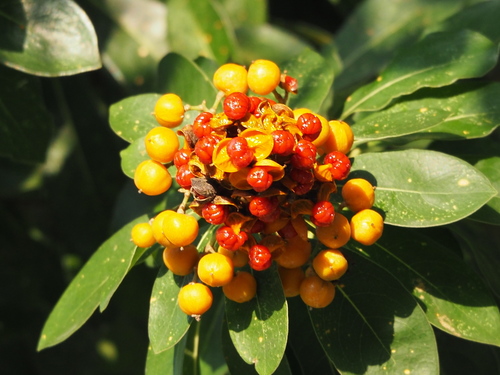
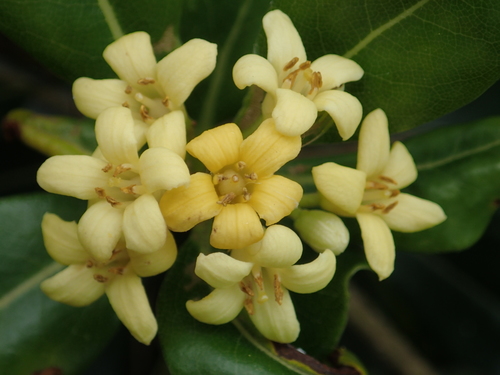
Pittosporum tobira (Murray) Aiton fil. is an evergreen shrub that can grow to 10 m (33 ft) tall and 3 m (10 ft) wide, and can develop a tree-like form. It can be trimmed to form a hedge. Its leaves are oval, with edges that curl under, and reach up to 10 cm (4 in) in length. The leaves are leathery and hairless, with darker, shinier coloration on their upper surfaces. The inflorescence is a cluster of fragrant flowers that grows at the ends of branches. Each flower has five white petals, each approximately one centimeter long. The fruit is a hairy, woody capsule around 1 cm wide that splits into three valves. Inside the capsule, black seeds are embedded in a bed of resinous pulp. This species is native to parts of Eastern Asia, and has been introduced as an ornamental plant across many other regions of the world. Within its native range, it occurs naturally in Fujian province, China, with introduced populations established in several other Chinese provinces. In Japan, it is found in Honshu, Kyushu, Shikoku, and the Ryukyu Islands. It is also native to South Korea and northern Taiwan. Introduced populations occur in parts of the United States, specifically California, North Carolina, Georgia, and Florida. It grows in forests, limestone areas, slopes, sandy seashores, and roadsides, typically at elevations up to 1,800 m (5,900 ft) above sea level. Common pests affecting this plant include various aphids, mites, leafhoppers, cotton cushiony scale (Icerya purchasi), root-knot nematodes (Melogyne spp.), and pit-making pittosporum scale (Planchonia arabidis). It is vulnerable to infection by the fungal pathogen Erythricium salmonicolor, which causes galls and a dieback disease called pink limb blight. The pathogenic fungus Rhizoctonia solani produces white, web-like basidial fructifications on the lower surfaces of infected leaves of this species. The plant's fruits are not poisonous, but are not edible for humans. However, bulbuls and other birds in Japan eat the fruits. The sticky coating surrounding the seeds lets them adhere to birds' beaks, allowing seed dispersal over long distances. When broken, the plant releases a strong unpleasant odor thought to have evolved to repel predation by foraging animals, despite sika deer favoring the species as food. This shrub is a common drought-tolerant, fairly hardy landscape plant. Many cultivars have been developed, including dwarf forms such as Wheeler's dwarf and the popular 'Variegata', which has variegated leaves. It is grown for use as hedges, living privacy screens, and for both indoor and outdoor planter boxes. Its stems, leaves, and dried fruits are used in cut flower arrangements. P. tobira is well suited to Mediterranean climates, but may be more sensitive to drought-induced stress than other common ornamental plants. A 2014 study comparing the effects of drought stress across five common ornamental plants found that P. tobira was the only species whose total dry biomass was significantly affected by drought, with a recorded 19% decrease in biomass. The plant may be useful for fire-resistant landscaping because it has a high gross heat of combustion. When growing outside its native range, this plant is associated with greater damage to native plant communities. A 2016 analysis of 49 plant species found in green spaces in Madrid found P. tobira to be among the shrubs most likely to be associated with damage to native plant species. Both the main species and the 'Variegatum' cultivar have received the Royal Horticultural Society's Award of Garden Merit.