About Pittosporum tenuifolium Gaertn.
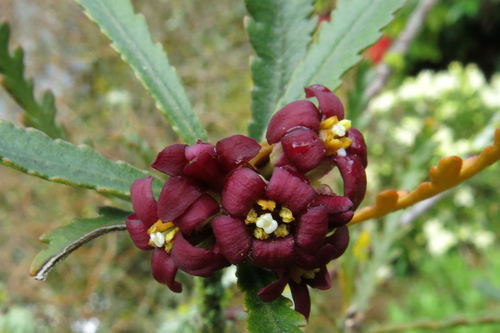
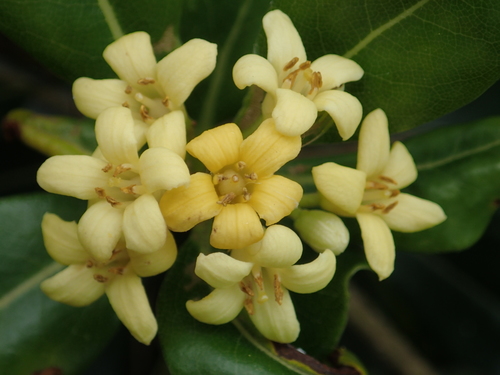
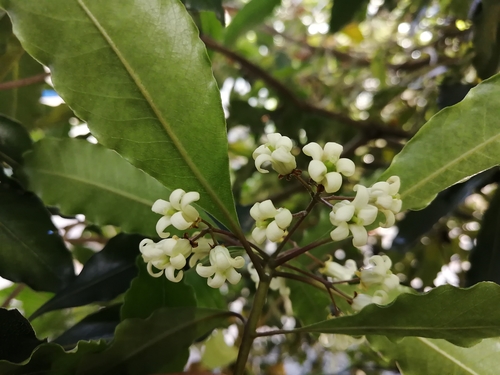
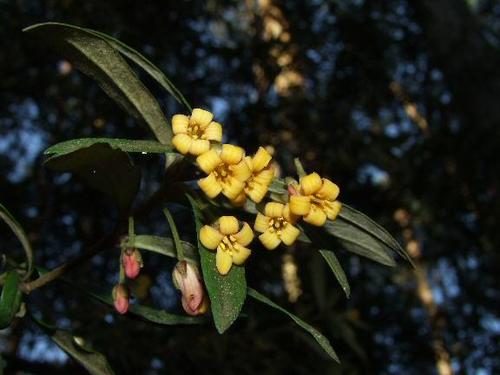
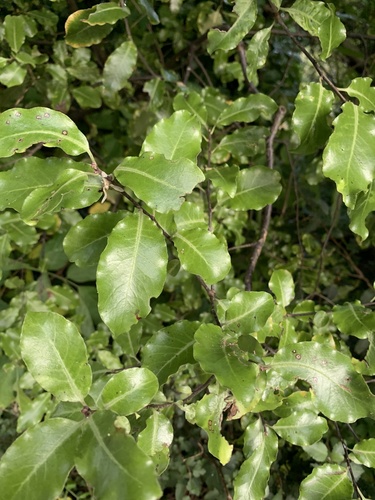
The scientific name Pittosporum tenuifolium Gaertn. breaks down as follows: Pittosporum comes from pittos meaning tarry and sporum meaning seed, referring to the sticky fluid that surrounds the seeds; tenuifolium comes from tenui meaning thin and folium meaning leaf. This species is commonly called kōhūhū, and also known as tāwhiri and rautāwhiri. Kōhūhū grows as a bush or small tree reaching around 8–10 metres in height. It has a slender trunk 30–40 cm in diameter, with mottled dark grey bark that gradually turns black toward the tips of branches. Kōhūhū has dense leaf coverage; leaves are arranged alternately along stems with short petioles. Leaves are typically small, measuring 2–4 cm long by 1–2 cm wide, though they may grow up to 7 cm long. Leaf edges are undulated, and leaf shape ranges from oval to nearly circular. Young leaves are covered in fine hairs that are shed as leaves mature. Adult leaves have a smooth, glossy texture, and are silvery green, darker on the upper surface and lighter underneath. The leaf midrib and smaller lateral veins are whitish and clearly visible on the upper leaf surface. Kōhūhū produces small dark flowers around 1 cm in diameter. Flower colour ranges from dark red to dark purple, turning almost black as flowers age; rare colour variants include red or yellow. Flowers develop from lateral buds, growing either singly or in clusters, and may be male or bisexual. Flowers are full of nectar, and release a honey-scented fragrance in the evenings, with the scent being more noticeable in slightly damp conditions. This scent attracts moths and other night-flying insects, which are thought to assist with pollination. Fertilized flowers develop into small globe-shaped fruits around 1.2 cm in diameter. Young fruits are covered in a fine layer of hairs that is gradually lost as the fruit capsule ripens. As the capsule ripens, it shrinks, hardens, turns almost black, and splits into two or three segments when fully ripe. Inside the capsule are black seeds, encased in a very sticky substance; this stickiness likely aids seed dispersal. Kōhūhū is endemic to New Zealand. It is widespread across most of New Zealand, only absent west of the Southern Alps and on Stewart Island. Kōhūhū grows naturally in coastal and lower mountain forest areas up to an altitude of 900 m. It grows particularly quickly at forest edges located at the base of high terraces, and can also be found growing in riverbeds. It grows readily in disturbed forested areas and in reverting farmland, and plays an important role in ecological succession. Most plants in the genus Pittosporum can be easily propagated from seed, though germination may be slow. In horticultural production, the sticky substance coating kōhūhū seeds is removed before sowing, because it acts as a germination inhibitor. Seeds are treated to simulate natural conditions for six weeks to improve germination rates. Kōhūhū is a relatively fast-growing plant, growing from 0.5 metres to 3 metres within five years. It has a shallow, spreading root system. These characteristics make it ideal, when used alongside other plants, for stream stabilization and erosion control. Kōhūhū flowers in late spring, from October to November, and fruits mature between mid-summer and autumn, from January to March. Kōhūhū seedlings are unusual in that some produce three or four seed leaves instead of the typical two. Māori have several recorded uses for kōhūhū. Resin and oils extracted from the leaves have been used for their scent, and are often mixed with ingredients from other native trees to produce an oil of variable composition. Resin is collected by making cuts in the tree bark, and leaves are crushed and mixed with other oils. The resulting oil is used to scent small pouches or dead bird skin that are often worn around the neck. It is also used to scent the houses and mats of high-ranked people. Māori have also used kōhūhū for medicinal purposes. Resin is mixed with other gums and chewed to treat bad breath and mouth sores. Plant parts are used as a topical treatment to relieve symptoms of skin diseases. Crushed leaves are used as a poultice for ulcers. Crushed bark is soaked in water, and the resulting mixture is used to treat breast or chest ailments, with the remaining liquid taken orally. Kōhūhū is used together with flax root to make a brew that treats fever, bleeding and bruising. A 2010 study confirmed that kōhūhū has antimicrobial properties, which supports its traditional use as a medicine. Kōhūhū branches are used in Māori life ceremonies such as baptisms, and for welcoming visitors to a marae. Two of the species' common names, tāwhiri meaning "to wave to" and rautāwhiri meaning "to wave a leaf", reflect this ceremonial use.