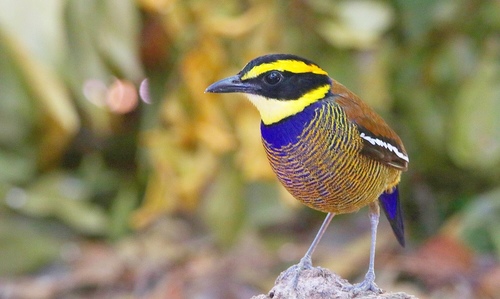
About Pitta nympha Temminck & Schlegel, 1850
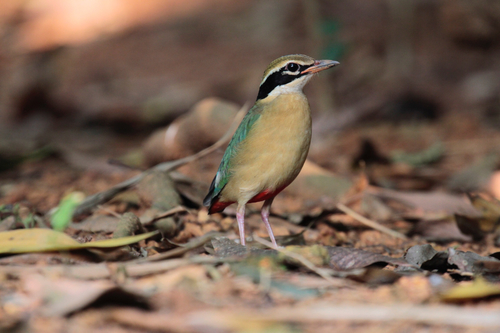
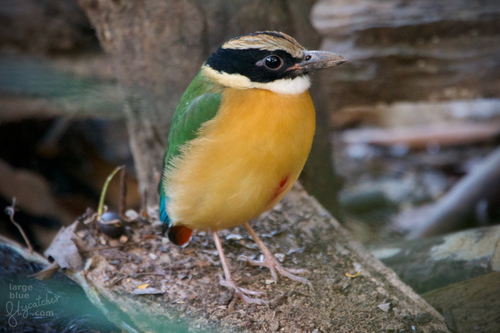
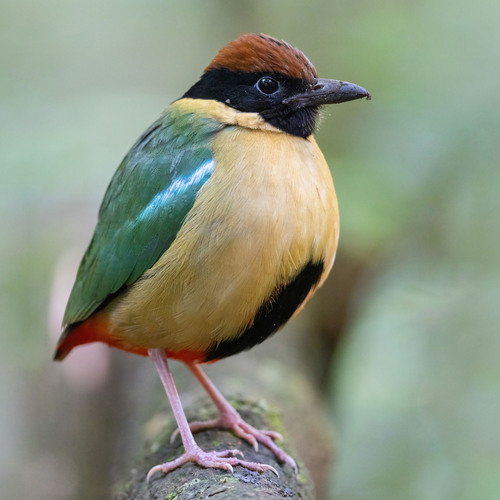
The fairy pitta (Pitta nympha Temminck & Schlegel, 1850) has a body length of 16–19.5 cm (6.3–7.7 in), and is easily recognizable by its seven differently colored plumage that resembles a rainbow. Its back and wing bows are green; scapulars and upper tail coverts are green and cobalt. A blue rump sits on the upper tail coverts. The tail is dark green with a cobalt tip, and the tarsi are yellowish brown. The fairy pitta also has differently colored wing coverts: primary coverts are dark blue, secondary coverts are greenish blue, greater and middle coverts are dark green, and lesser coverts are cobalt or bright blue. A noticeable white patch on each of its brownish-black primaries becomes visible when the bird flies. Its lower body, including the nape, chest, and sides, is cream-colored, while the lower belly and undertail coverts are red. The fairy pitta has a chestnut crown. Brown plumage covers the area from its forehead to the back of its head, and a black median stripe runs from the lores to the nape. Off-white supercilia extend across the nape. It has a white throat and a black beak. The similar-looking blue-winged pitta is larger than the fairy pitta; it has buff crown sides and supercilia (instead of the fairy pitta's chestnut), brighter upper tail coverts, a darker yellowish brown belly, and vivid blue on upper wing coverts. The fairy pitta's song is a clear, whistled kwah-he kwa-wu, which is similar to the blue-winged pitta's song, but longer and slower. The fairy pitta is a migratory species. It breeds in Northeast Asia during the summer from April to September, then travels to South and Southeast Asia to spend the winter from October to March. Sightings have been recorded in India, Indochina, both the Bruneian and Kalimantan sides of Borneo, New Guinea, China, North Korea, South Korea, and Taiwan. Recorded migratory stopovers are in North Korea, Vietnam, Hong Kong, the Philippines, and Thailand. The species follows the same migratory routes in spring and autumn every year, and most passages occur in April and September to October. Although it is fairly widespread across eastern Asia, the fact that it is highly localized in subtropical forests indicates the fairy pitta is faithful to wintering sites and requires specific habitat conditions. Fairy pittas departing from Borneo in spring arrive on the Korean Peninsula in early or mid-May and depart southward in October, though migrations occur across the whole peninsula in both spring and winter. On the Korean Peninsula, the fairy pitta breeds on coasts, islands, or in dense moist deciduous forests such as camellia forest, in Hwanghae Province, Gyeonggi Province, South Gyeongsang Province, and South Jeolla Province. It mostly prefers islands off the southern coast of Korea. Regular returns to the same sites have been recorded on Geoje in South Gyeongsang Province and Jeju Island. On Jeju Island alone, more than 60 pairs are thought to breed regularly between 100 m and 600 m altitude on Halla Mountain, making Jeju the most important breeding ground in South Korea. The subspecies found on the Korean Peninsula is also distributed in East China as far as the Shandong Peninsula, and in limited regions of Taiwan. In Japan, the fairy pitta arrives at both the Sea of Japan and Pacific sides of southern Japan in mid-May, including the islands of Kyushu, Honshu, Shikoku, and Tsushima, with notable populations in Miyazaki Prefecture, Kōchi Prefecture, and Hiroshima Prefecture, and occurrence as far north as Hokkaido. Like Korean breeding groups, Japanese fairy pittas favor areas with dense undergrowth of bushes, ferns, scrub, and grass, but with good visibility to detect predators or disturbances. Japanese populations exclusively nest in coastal deciduous evergreen forests. In 1991, 93.5% of breeding sites were found in broadleaf evergreen or deciduous forest, while only 6.5% were in mixed coniferous-broadleaf forest. In recent years, a trend of the fairy pitta nesting in plantations has been observed. For example, in Kōchi Prefecture, the fairy pitta prefers Japanese red pine (Pinus densiflora) forest during the early part of the breeding season. In Japan, the species mostly lives on hill slopes below 500 m altitude, though occasional recordings note pairs living as high as 1,200 m. In Taiwan, the species similarly favors areas with a thick crown layer, a variety of tree species, no shrubs or vines near the nest, and steep slopes that prevent intrusion by other animals. It arrives in mid to late April, and is usually spotted in central and western hilly or mountainous regions at altitudes no higher than 1,300 m. In China, the fairy pitta appears to be widely distributed in the mountains of the southeast, in mixed forests between 500 m and 1,500 m altitude. This preference also holds in Hong Kong, where the bird stops during migration. For reproduction, the fairy pitta builds a relatively large nest in a dark location, such as a crevice between rocks in thick broadleaf forest or on sloped foliage, 1–5 m above the ground. The nest entrance is lined with cattle dung, and the nest itself is lined with lichen. When necessary, the male will aggressively defend the nest by chasing and attacking intruders. This defensive behavior is only displayed before eggs are laid. The female lays 4 to 6 eggs per breeding attempt between May and mid-July. The eggs have a light gray background marked with small light brownish purple and grey dots, and measure 25–27.5 mm along the major axis and 19–22.5 mm along the minor axis. Both the male and female incubate the eggs; the female usually feeds hatchlings, while the male stands guard. For the first 4 days after hatching, fairy pittas rarely leave the nest. This is likely because temperatures are low during the rainy season, and newly hatched nestlings have no down feathers. Nestlings develop their first plumage within 14 days of hatching. Throughout the breeding season, adult birds rarely travel farther than 100–400 m from the nest. Chicks fledge in June or July, but rearing continues until the nestlings are ready to migrate south. The average reproductive success of the fairy pitta is 41.9%.