About Pitta iris Gould, 1842
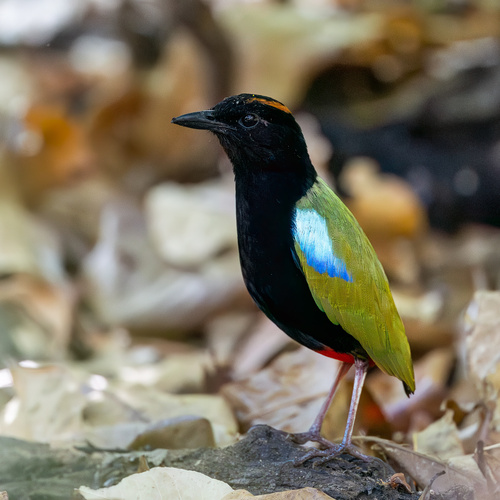
The rainbow pitta, with the scientific name Pitta iris Gould, 1842, measures 16 to 18 cm (6.3–7.1 in) in length and weighs 52–88 g (1.8–3.1 oz) overall. On average, females weigh 67 g (2.4 oz), which is slightly more than males that average 62 g (2.2 oz). When searching for food or resting, it typically stands upright: its legs are slightly bent, and its body is held at a 60–70° angle. It travels by hopping. This species has velvet black plumage on its head, neck, breast, flanks and upper belly; olive-green plumage on its upper parts; and scarlet red plumage on its lower belly and undertail coverts. Its wings are green with a golden sheen, and feature a shining blue patch on the lesser wing coverts, while the flight feathers and underwing are black. The tail is olive-green with a black base, and the uppertail coverts sometimes have a silvery-blue band across them. It has a black bill, pink legs, brown eyes, and a chestnut stripe along each side of its crown. Many individuals have the characteristic dark streaks (which may be arrow-shaped or linear) of the pitta family running through the center of upper body feathers. Examination of study specimens found that around 60% of rainbow pittas have these streaks, with some regional variation: no individuals from Darwin were found to have the streaks. Unlike other species in the pitta family, these streaks are bronze-coloured rather than dusky or blackish. The plumage of males and females is essentially identical. Females may have slightly more buff-yellow colouring on their flanks and a slightly different shade of red on the lower belly, but these differences are not enough to tell the two sexes apart by plumage alone. The subspecies P. i. johnstoneiana is very similar to the nominate subspecies, but has a larger chestnut eyebrow, a larger blue wing spot, and is slightly smaller overall in body size. The rainbow pitta is endemic to the Northern Territory and Western Australia in Australia, and is the only pitta species endemic to the country. It occurs from sea level up to 380 m (1,250 ft) in elevation. In the Northern Territory, it is found in the Top End, ranging from Darwin east to the edge of the Arnhem Escarpment; further east, it occurs on Groote Eylandt and the Wessel Islands. In Western Australia, it is restricted to coastal Kimberley, ranging from Walcott Inlet to Middle Osborn Island, and is also found on some islands of the Bonaparte Archipelago. It is most common in monsoon forest, as well as adjacent vine-scrub and gallery forest. It also occurs in eucalypt forest, bamboo forests, paperbark forest and scrub, Lophostemon forests, and the edges of mangrove forests, but it never enters mangrove forests themselves. It is mostly found in closed forests, but also occurs in more open forests. It has sometimes been found in plantations of introduced pines, and has even bred in this habitat. This species is one of only two pitta species that have been recorded feeding on open lawns in towns. The rainbow pitta is sedentary, with most pairs occupying their territories year-round. Some local movements into more marginal habitats have been recorded during the dry season. Its movements can be hard to trace during the post-breeding season, as it is silent during its annual moult and is generally shy throughout the year. Young birds disperse from their parents' territories to find their own territories. One banded juvenile was recorded 6.5 km (4.0 mi) away from its native territory.