About Pitta cyanea Blyth, 1843
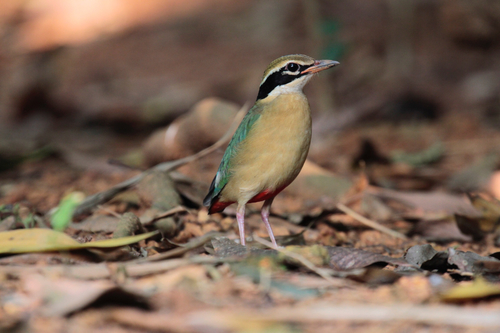
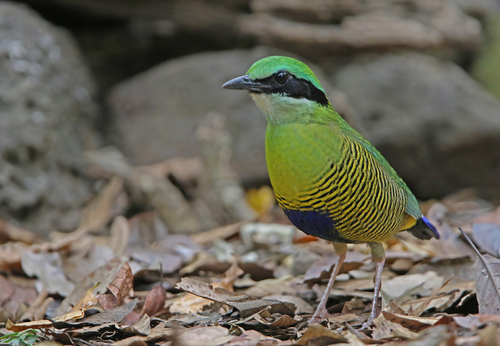
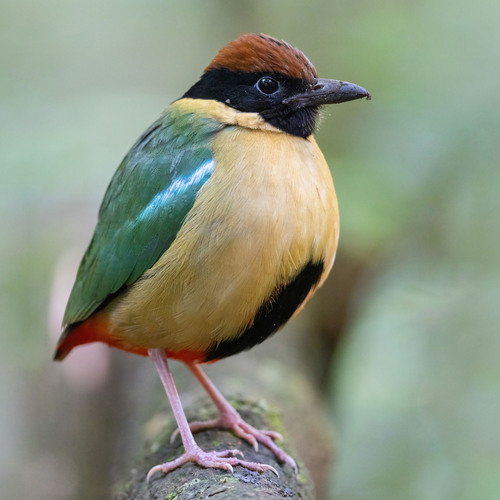
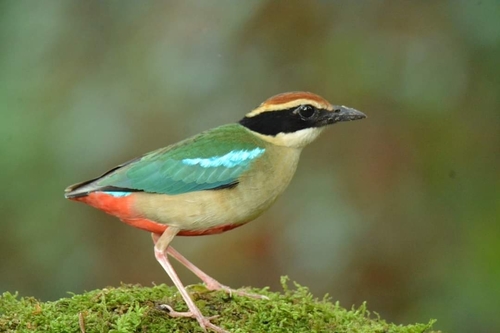
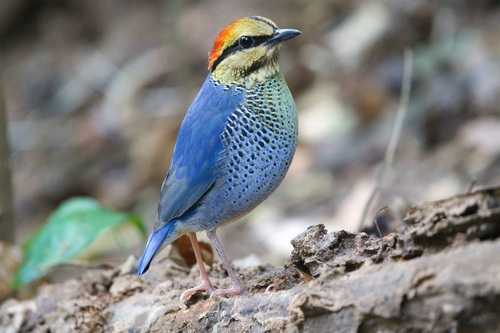
Pittas are medium-sized, stocky passerine birds with long legs and short tails. The blue pitta (Pitta cyanea Blyth, 1843) reaches a length of about 23 cm (9 in). It has a yellow forehead and crown, and a bright orange nape. A thick black stripe runs through its eye, and a shorter, less distinct stripe is present on its chin. Males have a blue back and tail, and a pale bluish breast speckled with black. Females have a grey back and a pale grey breast, also speckled with black. The bill is dark grey, and the legs are pale pink. The blue pitta’s call is a long, drawn-out “pleoow-whit” or “choocoo-whip” that ends abruptly. Three subspecies of blue pitta are recognized. P. c. cyanea is found in northeastern India, eastern Bangladesh, Myanmar, northern Laos, Vietnam, southern Thailand, and southern China. P. c. aurantiacus occurs in eastern Thailand and southwestern Cambodia. P. c. willoughbyi is native to central Laos and southern Vietnam. This bird has an altitudinal range from sea level up to around 2,000 m (6,600 ft). It is a forest-dwelling species; its typical habitat is lowland and montane moist evergreen forest with bamboo, often found near streams and in ravines, but it also lives in drier tropical forests. Like other species in the pitta genus, blue pittas are shy, secretive birds that usually occur alone. Even juvenile blue pittas forage on their own, only receiving visits from their parents. Despite their shy nature, they will respond to recordings of their call. They are diurnal, an adaptation that lets them see their often well-camouflaged prey, but they typically forage in darker areas of the forest. They search through plant litter on the forest floor for insects (especially beetles) and their larvae, spiders, snails, worms, and grubs. They forage by flicking away leaves and probing the ground with their bills. Breeding occurs in May and June in India and Myanmar, and between June and October in Thailand. The blue pitta builds a large, bulky dome-shaped nest with a side entrance, hidden among tangled plant growth.