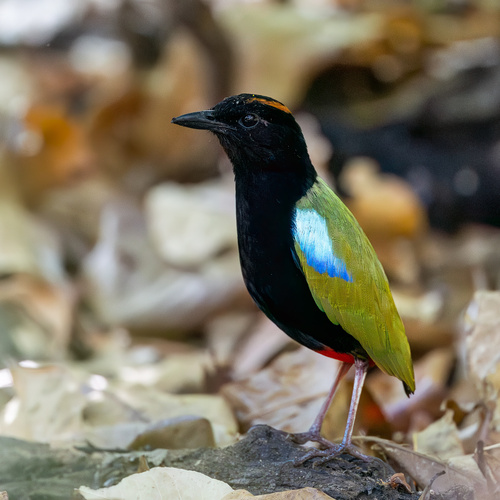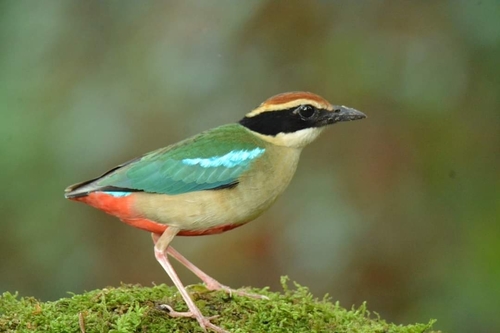
About Pitta brachyura (Linnaeus, 1766)
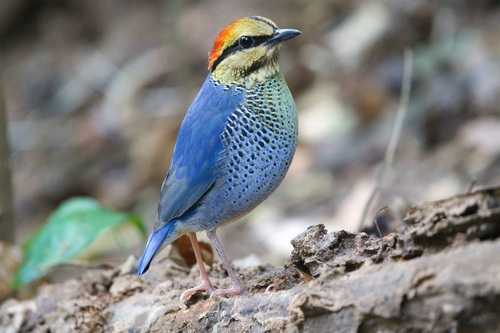
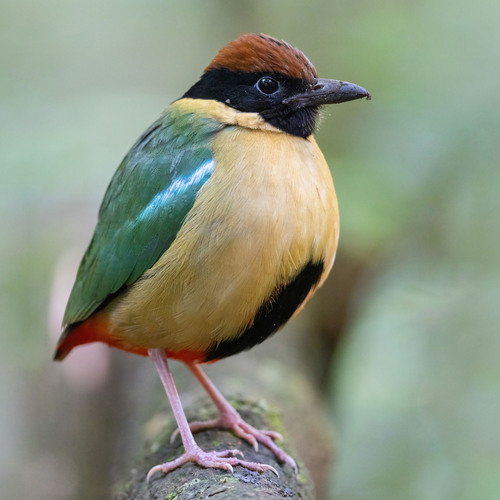
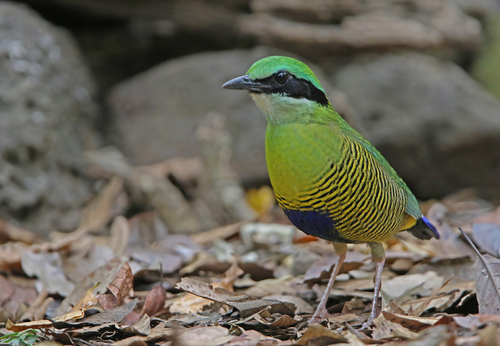
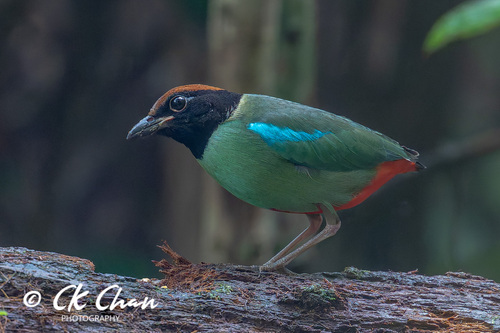
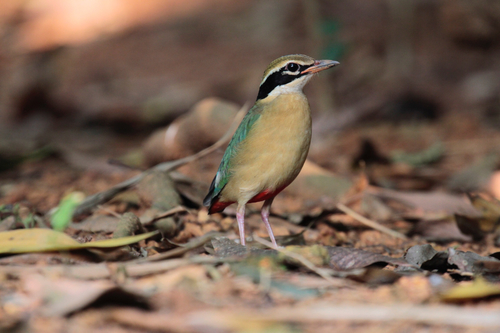
Description: The Indian pitta, with the scientific name Pitta brachyura (Linnaeus, 1766), is a small stubby-tailed bird. It is most often found on forest floors or under dense undergrowth, foraging for insects in leaf litter. It has long, strong legs, a very short tail, and a stout bill. Its markings include a buff-coloured crown stripe, black coronal stripes, a thick black eye stripe, and a white throat and neck. The upper parts of the bird are green, with a blue tail; the underparts are buff, with bright red colouring on the lower belly and vent. The bird hops on the ground while foraging, and has been known to become trapped in ground traps set for small mammals. It has been suggested that the width of the coronal stripe may differ between males and females. It is more often heard than seen, and has a distinctive loud two-note whistle: wheeet-tieu, wieet-pyou, or occasionally a triple note hh-wit-wiyu. They also produce a single note mewing call. They typically call once or twice, and neighbouring individuals often join in, calling at dawn or dusk. This behaviour gives them the common Tamil name "Six-O-Clock" bird. When calling, they throw their head back and point their bill upwards. Pittas are among the few Old World suboscine birds. The Indian pitta is the basal member of a distinct clade that includes many Oriental species. It forms a superspecies with the fairy pitta (P. nympha), mangrove pitta (P. megarhyncha) and blue-winged pitta (P. moluccensis).
Distribution and habitat: The Indian pitta breeds mainly in the Himalayan foothills, ranging from the Margalla hills in northern Pakistan to Nepal, and possibly as far east as Sikkim. It also breeds in the hills of central India and in the Western Ghats, extending south to Karnataka. It migrates to all parts of peninsular India and Sri Lanka during winter. Exhausted individuals sometimes appear in human settlements. The species is rare in the Thar Desert.
Ecology and behaviour: Indian pittas roost in trees. They feed on insects and other small invertebrates that they typically pick up from the ground or leaf litter. They have also been observed eating kitchen food scraps from the ground. They breed during the south-west monsoon, from June to August. Breeding peaks in June in central India, and in July in northern India. Their nest is a globular structure with a circular opening on one side, built on the ground or on low branches. It is constructed from dry leaves and grasses. The clutch size is four to five eggs; the eggs are very glossy white, spherical, and marked with spots and speckles of deep maroon or purple. Avian malaria parasites have been recorded in this species. In an ectoparasite survey, five out of thirteen Indian pitta individuals were found to carry the tick Haemaphysalis spinigera. The seasonal movements of this species linked to rains have not been well studied.