About Pitavia punctata (Ruiz & Pav.) Molina
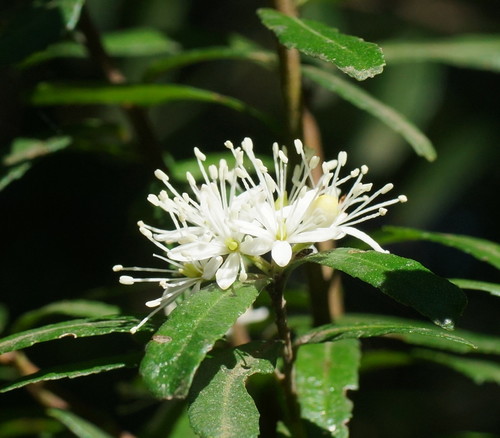
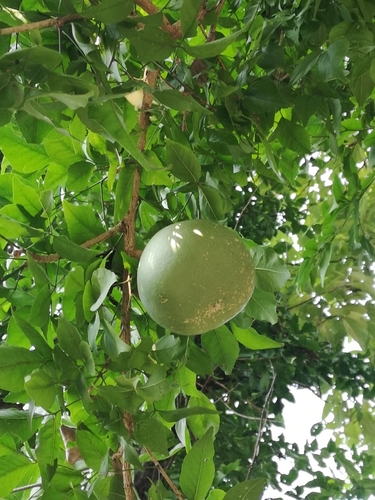
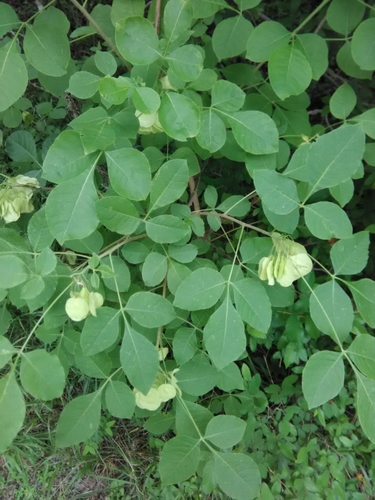
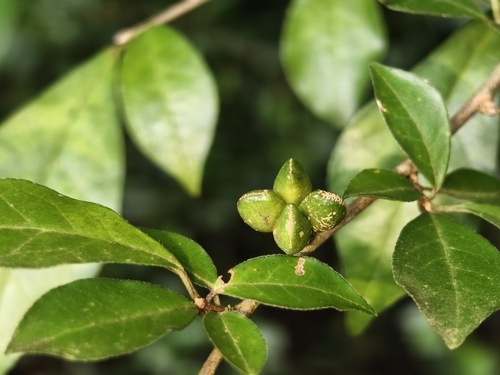
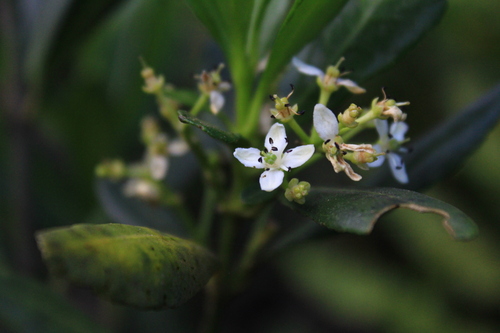
Pitavia punctata (Ruiz & Pav.) Molina is an evergreen small tree or shrub that reaches up to 15 m (49 ft) in height and 50 cm (20 in) in diameter. It has a round, leafy crown, a straight trunk, and ascending branches. Mature trees have brownish-grey bark that is soft-textured and rough. Its simple leaves are dotted with visible marks that can be seen when held against light, have a strong citrus-like aromatic scent, and grow in either whorls of three or, in some cases, opposite arrangements. The leaves have a leathery texture, with an oblong or lanceolate-oblong shape, a slightly apiculate apex, an attenuate base, and a 3–4 mm long petiole. Leaf edges are slightly toothed, and the midrib is clearly visible on the leaf underside. Leaves measure 6.5–13 cm long and 2.5–4 cm wide. Flowers are either hermaphrodite or unisexual, around 1 cm in diameter, and tetramerous. They grow in axillary three-flowered racemes, with 3–5.9 mm long pedicels. The calyx consists of four opposite sepals. The androecium holds 8 stamens arranged in two whorls: outer stamens are longer, measuring 4–5.44 mm, and sit opposite the sepals, while inner whorl stamens are shorter, measuring 3–3.5 mm, and sit opposite the petals. The tetracarpelar gynoecium has a superior, globose ovary with marginal placentation. Styles measure 0.8–0.9 mm, and stigmas are slightly papillose. The fruit produces 1 to 4 globose drupes, most often just one, that measure 1.8–2.5 cm wide and 1.2–2 cm long, and are greenish-yellow marked with dark dots. The glossy dark brown seeds are ovate, around 0.8–1.5 cm long, with a toothed edge and an oblong shape. Young leaves are petiolate, yellowish-green, and 3–6 cm long. This species is endemic to the western, seaward slopes of the Chilean Coast Range in the Maule and Bío Bío regions of central Chile, occurring between 35º 21' S and 37º45' S. It grows in native deciduous Maulino forest, at elevations between 30 and 850 meters. The dominant canopy tree in this forest is Nothofagus glauca, with associated species including Nothofagus alessandrii and Gomortega keule. Pitavia punctata typically grows in remnant forests that have consistent year-round moisture, such as ravines and areas near streams, alongside Drimys winteri, Aextoxicon punctatum, and Persea lingue. This species occurs in small subpopulations scattered across remaining forest habitat, surrounded by commercial forest plantations. Small populations of the species are protected within Península de Hualpén Nature Sanctuary, Los Ruiles National Reserve, Los Queules National Reserve, and Nonguén National Park.