About Pitangus sulphuratus (Linnaeus, 1766)
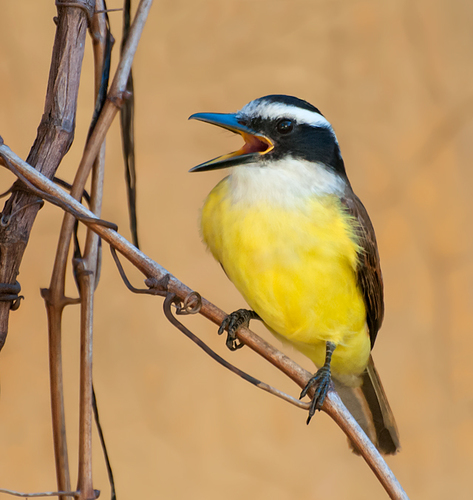
Pitangus sulphuratus (Linnaeus, 1766), commonly called the great kiskadee, is among the largest of the tyrant flycatchers. Adult great kiskadees measure 25 to 28 cm (9.8 to 11.0 in) in length and weigh 53 to 71.5 g (1.87 to 2.52 oz). Their heads are black with a prominent white supercilium and a hidden yellow crown stripe. Upperparts are brown, while the wings and tail are brown with typically strong rufous fringes. Their bill is short, thick, and black. The similar boat-billed flycatcher (Megarynchus pitangua) has a more massive black bill, an olive-brown back, and very little rufous coloration on its tail and wings. Some other tyrant flycatchers, such as the social flycatcher (Myiozetetes similis), share a similar color pattern but are noticeably smaller. The great kiskadee's call is an exuberant BEE-tee-WEE, which gives the species onomatopoeic common names across different regions and languages: in Brazil it is known locally as bem-te-vi, meaning "I saw you well"; in Spanish-speaking countries it is often called bien-te-veo, meaning "I see you well", and this name is sometimes shortened to benteveo; in Venezuela it is called cristofué, or "Christ did it".
The great kiskadee occupies a wide range of habitats, ranging from open grassland with scattered trees to urban areas. Its native range extends from the Lower Rio Grande Valley in southern Texas south through Central America to southern Argentina, and it does not regularly occur in Chile. The species was intentionally introduced to Bermuda in 1957, when 200 birds were imported from Trinidad in an attempt to control local lizard populations, particularly the already introduced tree lizard Anolis grahami. The birds bred successfully, and by 1976 the Bermudian population had expanded to around 60,000 individuals. As the great kiskadee is omnivorous, the introduction failed to reduce lizard numbers.
The great kiskadee is a common, noisy, and conspicuous bird. It is almost omnivorous, and hunts in a style similar to shrikes or other flycatchers: it waits on an open high perch in a tree, then sallies out to catch insects in flight, or pounces on rodents and similar small vertebrates, including other birds' chicks and bats. It also gleans other prey such as small snakes, lizards, frogs, perched insects, spiders, millipedes and land snails, as well as seeds and fruit, from vegetation by jumping for items or ripping them free while hovering mid-air. It occasionally dives in shallow water to catch freshwater snails, fish or tadpoles, making it one of the few passerine birds that fishes. It will also visit human feeding stations to eat bread, dog food, bananas, and peanut butter/seed mixtures.
Great kiskadees prefer to hunt alone or in pairs. Though they could potentially make use of prey flushed by smaller understory birds that are too large for those birds to take, they do not often join mixed-species feeding flocks, and when they do, they hunt in their usual familiar manner. This opportunistic feeding behavior makes the great kiskadee one of the most common birds in urban areas across Latin America, and its bright underparts and loud shrill call make it one of the most conspicuous species in these areas. This alert, aggressive bird has strong, maneuverable flight that it uses effectively when annoyed by raptors. Great kiskadees will attack even much larger birds, usually by diving or flying directly at the raptor while it is airborne, and give harsh calls during these attacks that alert all nearby potential prey to the predator's presence. If not very hungry, any raptor mobbed by a great kiskadee will typically leave, as it is nearly impossible to successfully hunt while enduring the bird's persistent harassment. In general, avian predators tend to avoid alert great kiskadees to avoid having their hunting ruined, and only hunt great kiskadees opportunistically, even though the bird is as meaty as a fat thrush. The species is more vulnerable to mammalian and squamate predators that can sneak up on nesting or sleeping great kiskadees. Even small omnivorous mammals such as the common marmoset (Callithrix jacchus) will attempt to raid great kiskadee nests at least during the dry season when fruits are scarce, despite the birds' attempts to defend their offspring. One of two great kiskadees studied in Colombia's Parque Nacional de La Macarena was found to be parasitized by microfilariae.