About Pistacia lentiscus L.
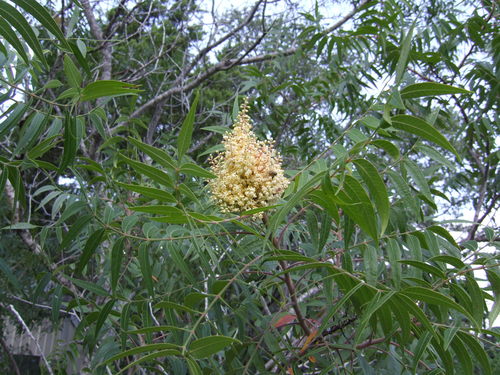
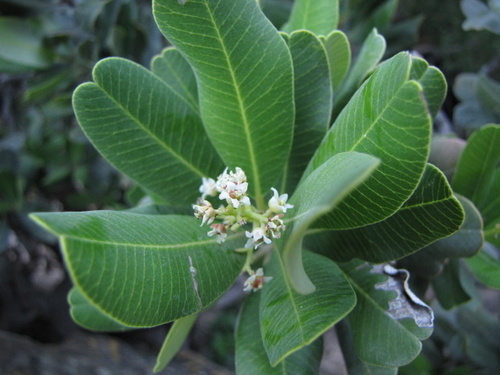
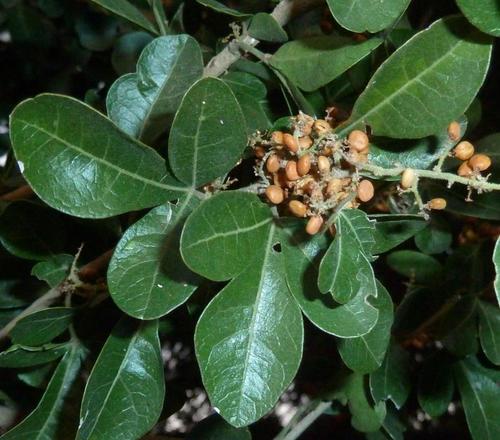
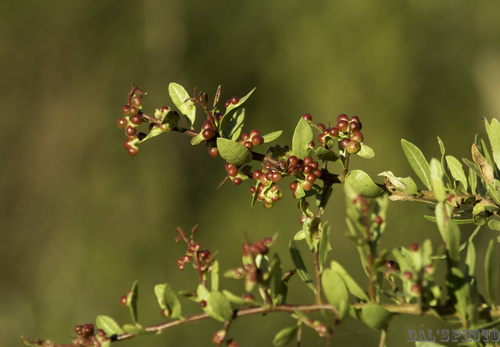
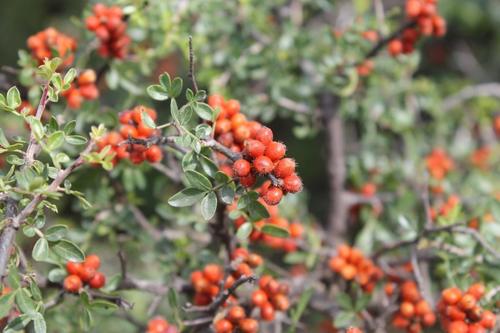
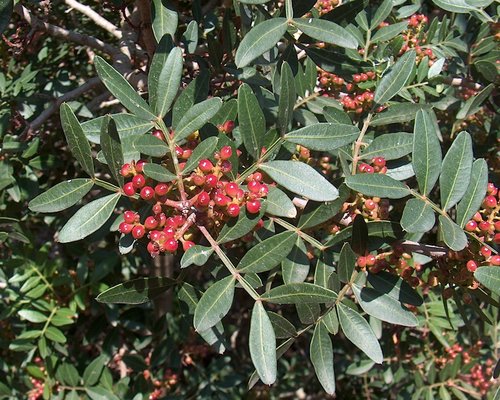
Pistacia lentiscus L. (commonly called mastic tree) is an evergreen shrub or small tree that grows 1 to 5 meters (3 ft 3 in to 16 ft 5 in) tall, and has a strong resinous scent. It naturally occurs in dry, rocky habitats across North Africa, Mediterranean Europe, and the wider Mediterranean region. It tolerates mild to heavy frosts but prefers milder winters, and can grow in all soil types. It grows particularly well in limestone areas and even salty or saline environments, so it is more abundant near the coast. It can also be found in woodlands, dehesas (partially deforested pasture areas), Kermes oak woods, oak-dominated woodlands, garrigues, maquis shrublands, hills, gorges, canyons, and rocky hillsides across the entire Mediterranean area. It is a typical component of Mediterranean mixed plant communities that also include myrtle, Kermes oak, Mediterranean dwarf palm, buckthorn, and sarsaparilla. It provides food and shelter for birds and other native wildlife in these ecosystems. It is a very hardy pioneer species, and its seeds are dispersed by birds. As it ages, it develops large trunks and many thicker, longer branches. In suitable habitats where it is allowed to grow undisturbed to full maturity, it often grows into a tree reaching up to 7 meters (23 ft) tall. However, human activities including logging, grazing, and wildfires usually prevent it from reaching this full mature size. Its leaves are alternate, leathery, and paripinnately compound, meaning pinnately compound with no terminal leaflet, and bear five or six pairs of deep-green leaflets. It produces very small flowers: male flowers have five stamens, while female flowers have a 3-part style. Its fruit is a drupe that is red when unripe and turns black when ripe, with a diameter of around 4 mm (0.16 in). Though not commonly eaten, the fruit is edible and has a tart, raisin-like flavour. Pistacia lentiscus is closely related to Pistacia terebinthus, and the two species hybridize frequently in areas where their ranges overlap. P. terebinthus is more common in inland and mountain habitats, while mastic is more often found in areas where the sea’s Mediterranean influence moderates the climate. Mastic trees never reach the size of P. terebinthus, and hybrids between the two are very difficult to distinguish from either parent species. Mastic has winged leaflet stalks: the stalks are flattened with raised side edges, while P. terebinthus has simple unwinged leaflet stalks. On the Mediterranean west coast, the Canary Islands, and the Middle East, Pistacia lentiscus can be confused with Pistacia atlantica. Pistacia lentiscus is native across the entire Mediterranean region, ranging from Morocco, Algeria, Tunisia, and the Iberian Peninsula in the west, through southern France and Turkey, to Iraq and Iran in the east. It is also native to the Canary Islands. Due to its hardiness and attractive evergreen appearance, it is often used as an ornamental plant in gardens and resorts in coastal Mediterranean urban areas where Mediterranean dwarf palms and other exotic plants grow. Unlike other Pistacia species, it keeps its leaves year-round. It has been introduced as an ornamental shrub to Mexico, where it has become naturalized, and is most commonly found in suburban and semiarid areas, where the region’s summer rainfall climate does not negatively impact it. Mastic resin is harvested by making small cuts in the bark of the tree’s main branches to drain the resin, which drips onto specially prepared ground below. Harvesting takes place in summer, between July and September. After collection, the mastic is washed by hand and dried in a shaded area, as it melts when exposed to direct sun. Mastic resin is a relatively expensive spice, and has been primarily used as chewing gum for centuries. Its flavour has a strong, slightly smoky, resiny aroma that can be an acquired taste. As a culinary ingredient, mastic gum is mainly used either for its flavour or its textural gum properties, most famously in mastic chewing gum. As a spice, it is still used in Greece to flavour spirits and liqueurs including mastiha, the traditional drink of Chios, as well as chewing gum, many cakes, pastries, spoon sweets, and desserts. It is sometimes even added to cheese. Mastic resin is a key ingredient in dondurma and Turkish puddings, giving these confections their signature unusual texture and bright whiteness. In Lebanon and Egypt, the spice is used to flavour a wide range of dishes from soups to meats to desserts, while in Morocco, smoke from the resin is used to flavour water. In Turkey, mastic is used as a flavour for Turkish delight. In Kurdish regions of Iraq, fresh resin is used as a spice, particularly for pickled Torshi. Mastic resin is a key ingredient in Greek festival breads, including the sweet bread tsoureki and the traditional New Year’s bread vasilopita. Mastic is also an essential ingredient in myron, the holy oil used for chrismation in Orthodox Churches. In the Mediterranean region, mastic has been used in folk medicine for its purported healing properties, a use recorded as early as the first century by Greek physician and botanist Dioscorides in his treatise De Materia Medica.