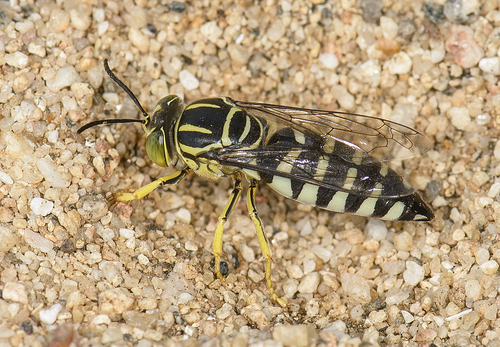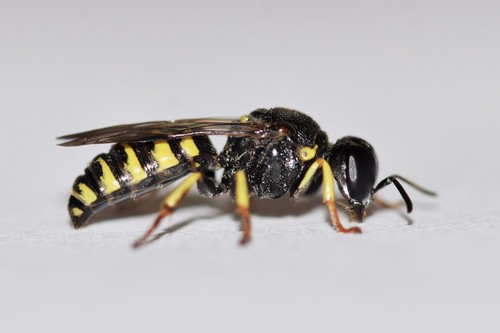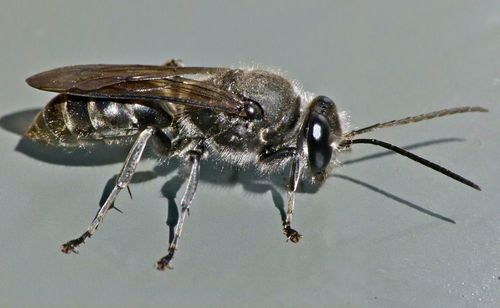
About Pison spinolae Shuckard, 1838
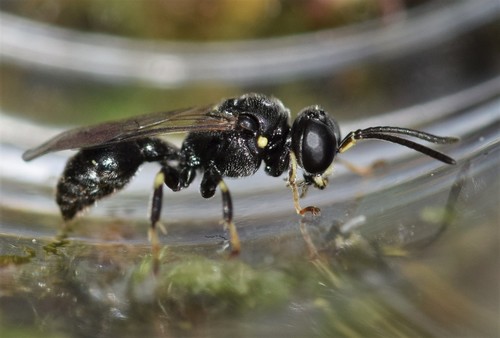
Like all insects, Pison spinolae has a hard exoskeleton, one pair of antennae, and three pairs of strong legs that it uses to carry spiders back to nests for its developing young. Its body is segmented into three distinct sections: head, thorax, and abdomen, and it has two pairs of wings. A key identifying feature of this mason wasp, shared with many other wasp species, is the narrow waist between the thorax and abdomen, which helps distinguish it from bees. Unlike bees, P. spinolae can use its stinger repeatedly; it injects venom into spiders to paralyze them before carrying them back to the nest. Unlike many common wasps, P. spinolae is not patterned black and yellow: adult individuals are entirely black, and measure approximately 16 millimetres (0.63 in) in length.
Mason wasp nests are built mostly from sand and mud. The small nests are very common, and are typically built in protected sites such as building cracks and keyholes. Their most defining characteristic is multiple separate, sealed compartments, each of which holds one paralyzed spider and one of the female's offspring. Recognizing these nest features makes it easier to identify the species' juvenile life stages. The species' eggs are white, elongated, and oval-shaped. They hatch into white larvae that have a distinct head and a translucent outer cuticle. Larvae then spin a cylindrical grey cocoon that is rounded at both ends.
The genus Pison is widespread across tropical and temperate regions, and is concentrated mostly in the southern hemisphere, with a high diversity of species found in Australia. P. spinolae is native to Australia, and is thought to have been accidentally introduced to New Zealand around 1880. In New Zealand, the mason wasp occurs widely across the country. It is relatively common, but not abundant enough to cause drastic impacts on its prey populations. Despite being a non-native species, it is the most frequently encountered mason wasp in New Zealand, so it is sometimes called the New Zealand mason wasp.
Like other sand wasps, P. spinolae occupies a diverse range of habitats, from sand dunes to building cracks for nesting. Like other species in the genus Pison, it builds nests in pre-existing holes in wood, keyholes, and even crevices on ships and aircraft, which allows the species to be widely distributed by humans accidentally.
Adult females lay white, elongated oval eggs, which develop into white larvae with a distinct head and a translucent cuticle. The final larval stage is reached in less than three weeks, and cocoon formation begins within one month after the egg is laid. Pison cocoons are cylindrical, grey, and rounded at both ends. Unlike most sphecid wasps in New Zealand, P. spinolae is bivoltine: it produces two generations per year, a summer generation that develops without diapause, and a winter generation that enters diapause. All New Zealand Sphecidae spend at least the winter in a prepupal diapause. After diapause ends in spring, the prepupa molts into an exarate pupa, a pupal stage with movable appendages. Pupal development takes 14 days, after which an adult wasp emerges.
When adults emerge, solitary male wasps patrol nesting areas to mate, as this is when females are sexually receptive. Most solitary wasp species mate only once in their lifetime, usually shortly after emergence. Mating attempts have not been observed at feeding sites or other locations. It is unknown whether this mating behavior differs in bivoltine species like P. spinolae, where first-generation males might potentially mate with females of both generations if they live long enough.