About Pisaurina mira (Walckenaer, 1837)
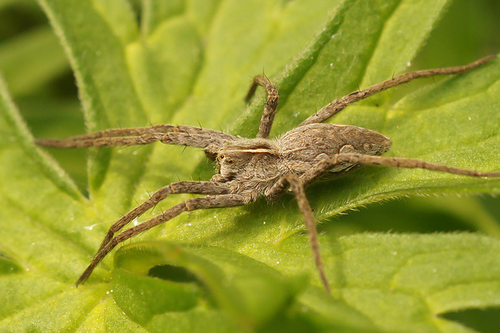
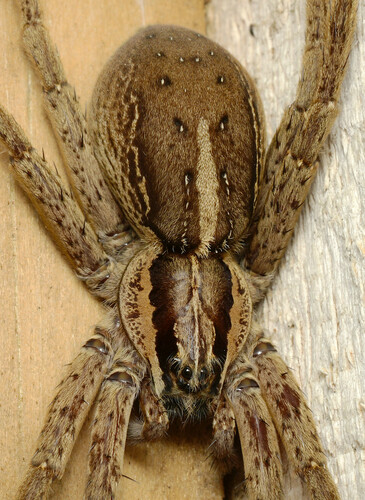
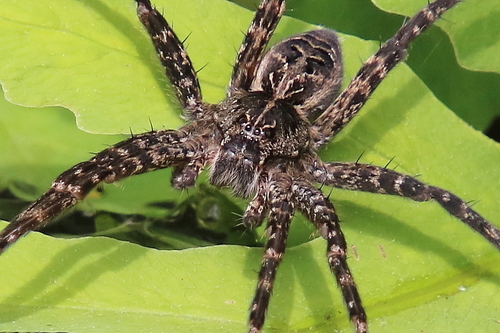
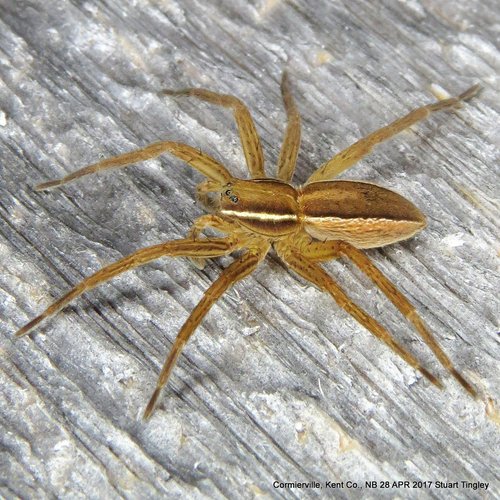
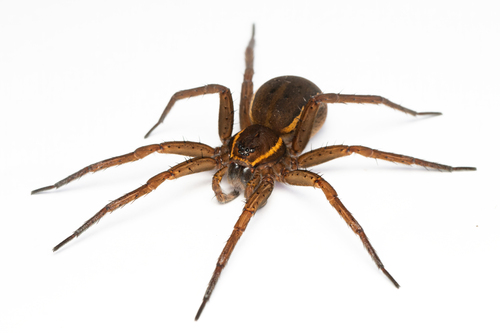
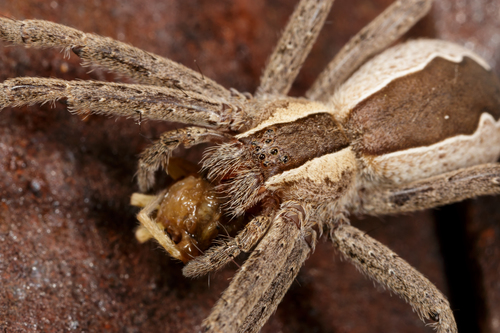
Pisaurina mira (Walckenaer, 1837), commonly called the nursery web spider, has a moderately high carapace — the hard outer protective layer covering the cephalothorax, the combined head and thorax region. Its abdomen is moderately long, and is typically less than twice the length of the carapace. P. mira can be distinguished from other species with similar general morphology by its unique straight anterior row of eyes. It has eight eyes arranged in two rows: four eyes in the front form a straight line, and four eyes in the back form a U-shape. This species is sexually dimorphic: male spiders generally have longer legs, and a larger ratio of leg length to body size, than females. Abdominal patterns of P. mira vary, ranging from a distinct dark median band on the abdomen to an indistinct median band paired with two rows of lateral spots.
Nursery web spiders like P. mira are wandering hunters. They are usually found on vegetation or at water margins across North America. Pisaurina mira is most often seen in woods and meadows, and reaches its highest population density in transitional areas between woods and open fields. It inhabits tall grass, shrubs, and bushes, which suits its hunting strategy: it is a sit-and-wait ambush predator that waits for prey to come within reach before catching it with its pincers.
The geographic range of P. mira covers Eastern North America. It extends north into Ontario and Quebec, south to central Florida and the Rio Grande Valley of Texas, and west to Minnesota, Kansas, and Oklahoma.
Mating for P. mira typically occurs between mid-June and mid-July. After mating, the female first moves her eggs into a cocoon held under her abdomen. She carries the cocoon until the eggs are ready to hatch. While waiting for hatching, the female builds a "nursery web" by gathering leaves together, which acts as a safe space where spiderlings will grow after hatching. Nursery web spiders are univoltine, meaning they produce only one brood of offspring per year. Offspring care is almost entirely the responsibility of the female: she carries the eggs, maintains the egg sac until hatching, and does most other care work, while the male has a very limited role. Spiderlings molt multiple times as they grow, developing a larger new exoskeleton at each stage to accommodate their increasing size. The weaning phase begins after the spiderlings' first molt, when the spiderlings leave the nursery web.