About Pisaura mirabilis (Clerck, 1757)
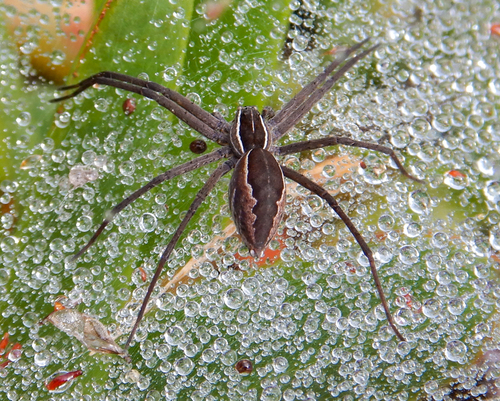
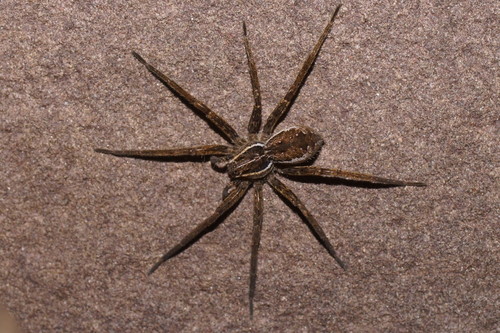
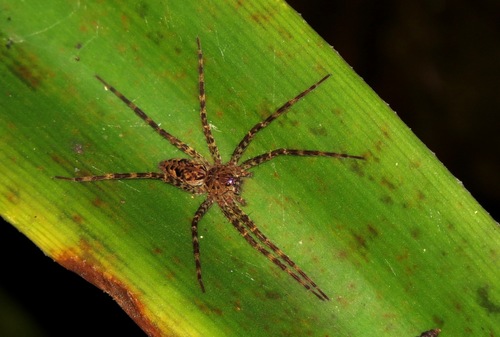
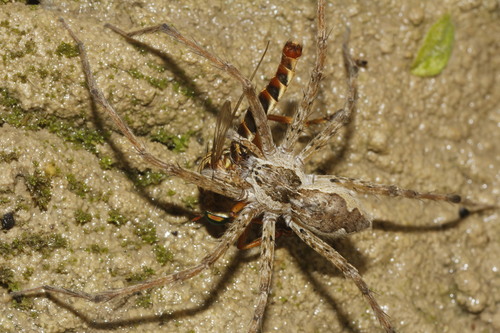
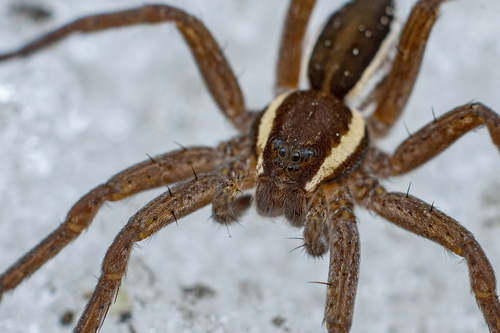
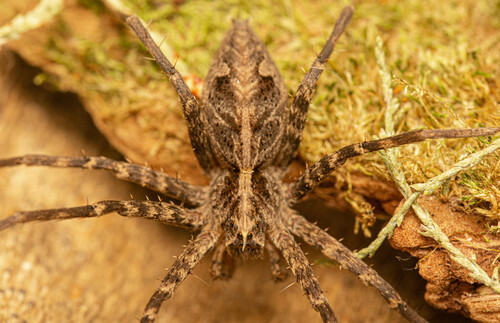
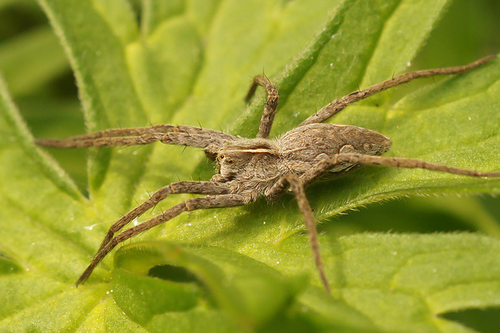
Pisaura mirabilis has two key striking characteristics: long legs, with the fourth pair being the longest, and a slender abdomen (also called the opisthosoma). Males of this species range from 10 to 13 mm in body length, while females range from 12 to 15 mm. After their final molt, males have an average weight of 54 mg, and females average 68 mg. The prosoma, or cephalothorax, varies in color, ranging from light to reddish brown, and from gray to black, with a lighter stripe running down its middle. The opisthosoma, or abdomen, is long, narrow, and tapered toward the rear end. Females have a dark patch called the epigyne, which contains their copulatory organs, on the underside of the abdomen. Male genital openings are located at the same spot, but are not easily noticeable. Body patterning and coloration are variable due to polymorphism. These patterns, created by hair and pigments, change as the spider grows, a process called ontogenesis. Males show stronger color contrast than females, and often appear black, especially when contrasted against their white nuptial gifts. Females typically become paler toward the end of summer. The stripe running along the back of the body is present on all individuals of this species, and acts as crypsis, a protective adaptation against predators. In nymphs and females, the pedipalps have a similar appearance to legs. In mature males, the pedipalp thickens toward its tip, and the structure called the bulbus stores sperm until reproduction. The outer segment of the chelicerae has three teeth. This species hunts and catches prey both during the day and at night, and it remains active on warm winter days. Pisaura mirabilis has a Palearctic distribution, and occurs throughout Europe. It can also be found in the Canary Islands, Madeira, the Asian portion of Russia, China, and North Africa. It can live in nearly all habitat types, but prefers wet environments including wet meadows, lowland moors, salt marshes, dunes, forest edges, and wet hedges. It occupies all vertical strata from the ground up to the tops of trees, but is not found under rocks or inside caves. This species occurs at altitudes up to 1100 meters above sea level.