About Pisaster ochraceus (Brandt, 1835)
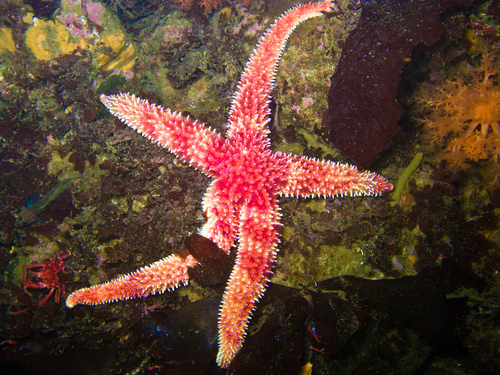
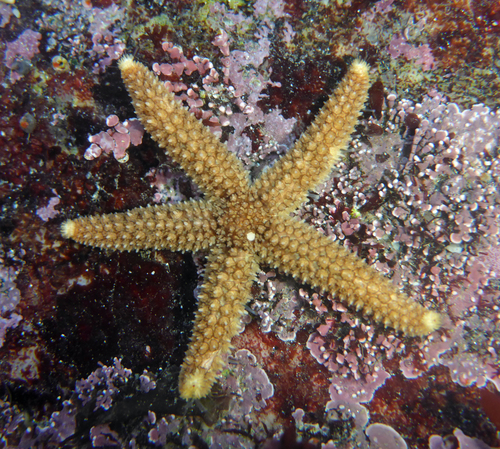
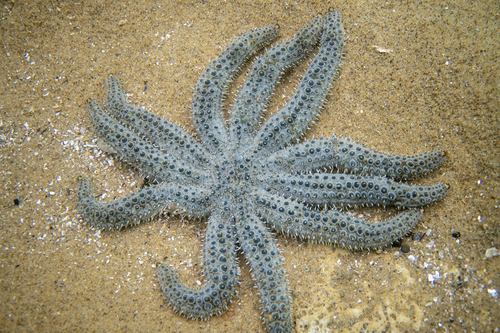
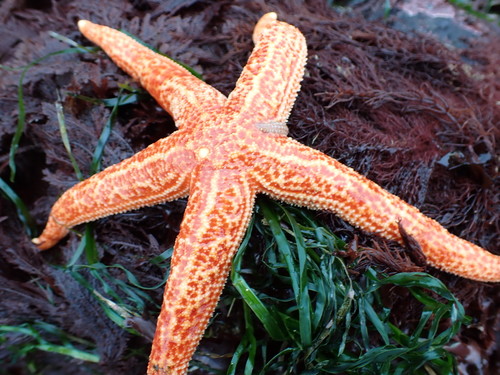
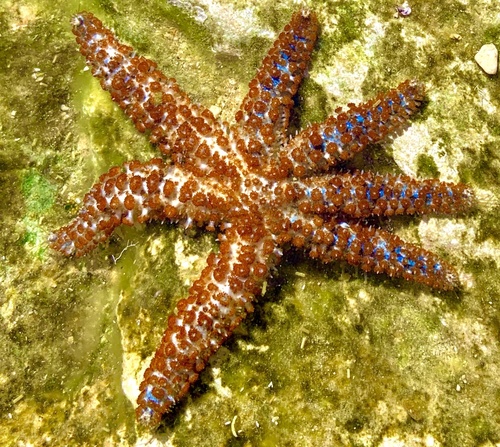
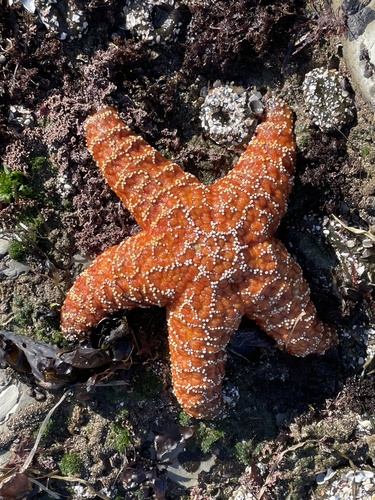
This sea star, Pisaster ochraceus, typically has five stout rays, each ranging from 10 to 25 centimeters (4 to 10 inches) in length. The rays are arranged around an ill-defined central disk; a portion of this central disk must remain attached to a severed arm for a full new sea star to grow from the arm. While most individual Pisaster ochraceus are purple, they may also be orange, orange-ochre, yellow, reddish, or brown. The aboral surface has many small spines called ossicles, which form a netlike or pentagonal pattern on the central disk. These ossicles do not grow taller than 2 mm. The tube feet of this species have suckers on their distal ends, which let the sea star attach to rocky substrate and live in heavily wave-swept areas. Pisaster ochraceus has a simple nervous system with no brain; a nerve ring connects the sea star's radial nerves and relays nerve impulses between them. A number of other sea star species are commonly mistaken for P. ochraceus. Pisaster giganteus can be told apart by its blue rings surrounding white or purple spines, while Pisaster brevispinus is pink with small white spines; both differ from P. ochraceus in their aboral spine structure and coloration. Evasterias troschelii may also be confused with this species, but it can be distinguished by its smaller central disk and longer, tapering rays that are usually thickest a short distance out from their base, rather than at the base like the rays of P. ochraceus. The geographic range of Pisaster ochraceus extends from Prince William Sound in Alaska down to Point Sal in Santa Barbara County, California. A subspecies, P. o. segnis, lives in the warmer waters stretching from Santa Barbara County to Baja California. This sea star occurs in large numbers on mussel beds and wave-washed rocky shores. Juveniles are most often found in crevices and under rocks. Its depth range extends from above the low-tide zone down to 90 metres (300 ft). Pisaster ochraceus is very hardy and can tolerate losing up to thirty percent of its body weight in body fluids. All members of the genus Pisaster are dioecious, with no visible sexual dimorphism; sexes can only be distinguished by checking whether the gonads hold eggs or sperm. This species reproduces via broadcast spawning; for populations in Puget Sound, spawning takes place between May and July. There is no parental investment after spawning occurs. Fertilization takes place in open water, and P. ochraceus develops through multiple larval stages. The reproductive system is made of a pair of gonads that branch into each ray from a circular genital strand that runs along the oral inner surface of the central disk. The gonads have the appearance of a feathery cluster of tubules: female gonads are orange, while male gonads are whitish. As gametes mature, the gonads grow in size and can make up as much as 40 percent of the sea star's total body weight. The gonopores are too small to be visible, and can only be identified when the sea stars are actively spawning.